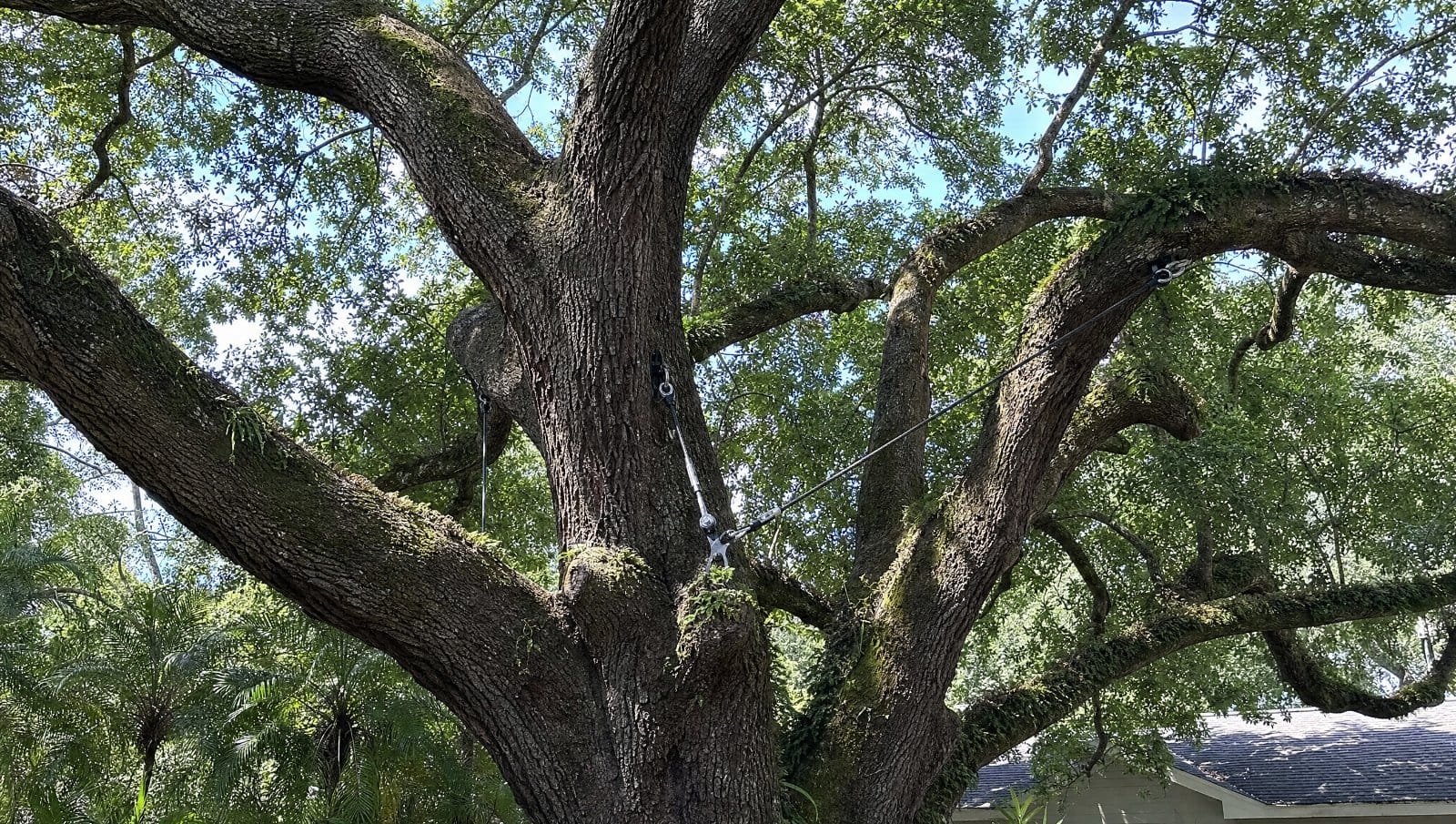
Cabling and bracing can save a splitting tree.
Tree Cabling and Bracing: Save a Splitting Florida Tree
When a mature oak or laurel in your Central Florida yard develops a split crotch or a heavy limb that’s pulling away from the trunk, you don’t always have to lose the tree. Tree cabling and bracing is a structural support method that lets arborists reinforce a weak union and buy a healthy tree many more years of safe life. Around Orange City, DeLand, and the greater Orlando metro, we use it most on the big, fast-growing shade trees our sandy zone 9b soil produces, and it’s one of the most rewarding things we do because it saves a tree instead of removing it.
This guide walks through how tree cabling and bracing works, when it’s the right call, and what to expect if you have a splitting tree on your property.
What Tree Cabling and Bracing Actually Does
The two terms describe two different tools that often work together. Cabling uses high-strength cable installed high in the canopy to limit how far two or more leaders can move apart in wind. It doesn’t pull the limbs together like a tourniquet; it gently restricts excessive movement so a weak union isn’t stressed past its breaking point during a storm.
Bracing uses threaded steel rods installed directly through a weak or already-cracked union to add rigid, fixed support right where the wood is failing. On a trunk that has begun to split, rods hold the two halves together while cables above manage the load.
Used together, tree cabling and bracing turns a hazardous defect into a managed, monitored condition. The goal is never to make a tree “bulletproof” — it’s to reduce the chance of a sudden, catastrophic failure on a structure that is otherwise worth keeping.
Static steel versus dynamic synthetic systems
Not every cable is the same. There are two broad families of canopy support, and a good arborist chooses between them based on the defect, not habit:
- Static systems use rigid steel cable and through-hardware. They hold a defined position and are well suited to unions that need firm, limited movement — and they pair naturally with bracing rods on an active split.
- Dynamic (synthetic) systems use a slightly elastic, hollow-braid rope (Cobra-type and similar products) installed without drilling. They let the tree keep flexing and building reaction wood while still capping the worst of the movement, which can be the better choice on healthier unions where you want the tree to keep strengthening itself.
Neither is universally “better.” The right answer depends on the species, the severity of the defect, and how much natural sway the union can safely tolerate.
The defects we see most in Central Florida
- Codominant stems with included bark. Laurel oaks and water oaks love to grow two trunks of equal size from a tight V. Bark gets trapped in the union, the wood never knits together, and the join becomes a built-in weak point.
- Over-extended lateral limbs. Live oaks throw long horizontal limbs that get heavier every year. A cable can support the limb’s weight against gravity and wind.
- Existing cracks. A union that’s already started to separate after a summer storm is a classic candidate for through-rod bracing.
Why Our Trees Are Such Strong Candidates
Central Florida hands trees a tough hand. Our sandy soil drains fast and offers less anchorage than heavier clay soils, so root plates work harder. Trees here grow quickly in the long warm season, which means they pile on weight and length faster than the wood structure sometimes matures to handle.
Then there’s the weather. From June through September we get heavy, near-daily rain that saturates the ground and adds water weight to a full canopy. Layer Atlantic hurricane season on top, and a weak union that sat quietly for a decade can become the failure point in a single afternoon. Saturated soil plus a heavy wet crown plus a tropical-storm gust is exactly the load a cable system is designed to help manage.
That’s also why we’re honest about candidacy. A tree that’s already mostly dead, deeply decayed, or rooted in failing soil is usually not worth supporting — hardware can’t fix rotten wood. The best candidates are structurally sound trees with one clear, addressable defect. A thorough tree risk assessment is the honest first step that tells us which camp your tree is in.
How a Professional Installation Works
Good support hardware is engineering, not guesswork. A proper system follows the industry standard (ANSI A300 Part 3, the tree-support specification) so the placement, cable size, and anchor points actually match the load. Here’s the typical sequence:
- Assessment. We climb or inspect the tree, identify the weak union, judge the overall health, and decide whether support is appropriate at all.
- Cable placement. Cables are installed high in the crown — the A300 convention places them roughly two-thirds of the distance from the weak union up toward the top of the canopy — so they have the leverage to limit movement.
- Hardware selection. We size the cable and anchors to the limbs they’re supporting, and choose static or dynamic hardware to match the defect. Anchors are set into sound wood, not bark.
- Bracing rods if needed. For an active split, rods are run through the union to lock it, usually below the cables that handle the dynamic load above.
- Pruning to reduce load. Often the smartest move is to lighten an over-extended limb so the hardware has less to fight in the first place.
What it is not
It is not a do-it-yourself ratchet strap or a chain wrapped around two trunks. Homemade rigs girdle the bark, kill the cambium, and frequently make the hazard worse. Properly engineered tree cabling and bracing is installed to flex and breathe with the tree, not strangle it.
Living With a Supported Tree
Hardware isn’t “install it and forget it.” A supported tree should be re-inspected periodically — we recommend at least once a year, and always after a major storm. Cables can loosen as a tree grows, anchors can need adjustment, and the tree’s overall health can change. Think of it like any structural reinforcement: it works because someone keeps an eye on it.
With that follow-through, a well-cabled live oak or laurel oak can safely shade your yard for many more years instead of being removed in pieces.
Frequently asked questions
How long does a cable system last? Quality hardware can serve for many years, but it should be inspected annually and after big storms, with adjustments as the tree grows.
Will cabling hurt my tree? Properly installed hardware causes minimal harm and is far gentler than losing major limbs or the whole tree. The small anchor points heal as the tree grows around them, and a non-invasive dynamic system avoids drilling entirely.
Is it cheaper than removal? Often, yes — and it keeps a valuable shade tree and its cooling, property value, and curb appeal in place. We’ll give you an honest comparison either way.
Can every splitting tree be saved? No. Severely decayed, declining, or poorly rooted trees usually shouldn’t be supported. An honest assessment comes first.
Not Sure If Your Tree Can Be Saved?
If you’ve noticed a split trunk, a leaning leader, or a heavy limb that worries you, let one of our certified arborists take a look before you assume the worst. We serve Orange City, DeLand, Lake Mary, Sanford, Oviedo, Apopka, and the surrounding Seminole, Volusia, and Orange county communities. Reach out to LandTree for a free, no-pressure tree assessment — we’ll tell you honestly whether tree cabling and bracing is the right move or whether another option makes more sense for your property.