
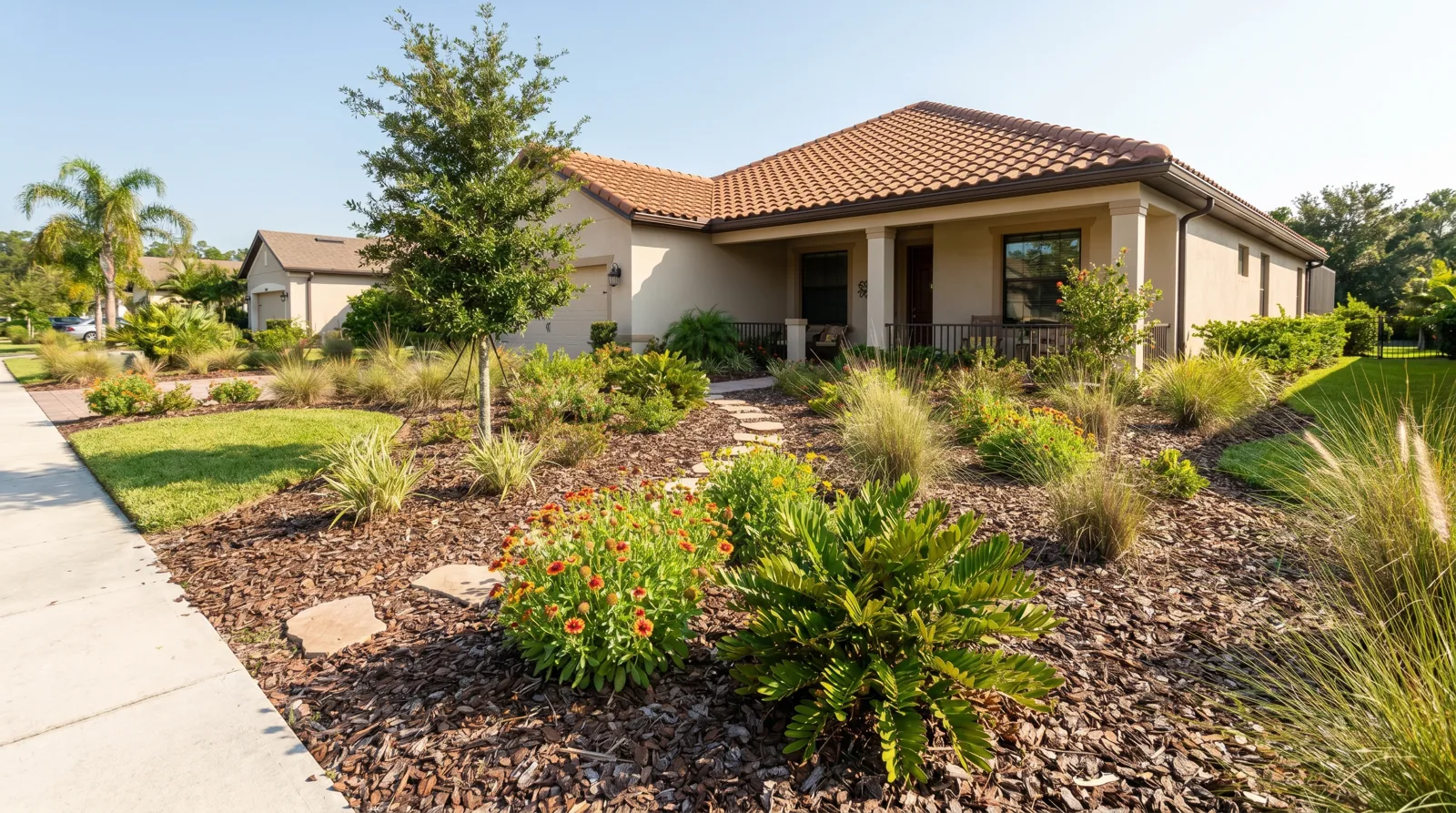
Florida-Friendly Landscaping: Lower Water Bills & Less Work
Florida-Friendly Landscaping: Lower Water Bills and Less Work
Florida-friendly landscaping is simply landscaping designed for the way Central Florida actually behaves — sandy soil, a high water table, blistering summer heat, and daily afternoon storms — so your yard needs less water, less fertilizer, and a lot less of your weekend. The payoff shows up fast: a lower water bill, fewer dead plants, and a landscape that shrugs off both drought weeks and downpours.
It’s not a particular “look.” You can do a Florida-friendly yard that’s lush and tropical or clean and modern. The idea is matching the right plants to the right spots and working with our climate instead of fighting it. We build these yards all over Seminole, Volusia, and Orange counties, and they’re some of the lowest-maintenance landscapes we install.
The core idea: put the right plant in the right place, water and feed only when needed, and let Florida natives do the heavy lifting.

The 9 Principles of Florida-Friendly Landscaping
The University of Florida built the whole approach around nine principles. You don’t have to do all nine perfectly to benefit — even adopting a few will cut your water use and your workload. Here’s how each one plays out in a real Central Florida yard.
1. Right Plant, Right Place. This is the foundation. Put sun-lovers in the sun, shade plants under your oaks, and moisture-lovers in your low, wet spots. A plant that’s matched to its location barely needs babysitting; a mismatched one is a constant fight.
2. Water Efficiently. Water deeply and infrequently so roots grow down, not sideways. Most established Florida lawns and beds need water far less often than people think — and over-watering invites fungus and brown patch. Pair this with your local watering restrictions and a rain sensor on your controller.
3. Fertilize Appropriately. Our sandy soil lets fertilizer leach straight through to the groundwater. Use slow-release products, follow the label rate, and respect any summer fertilizer blackout your county has. More is not better here — it’s just runoff.
4. Mulch. A 2-to-3-inch layer of mulch holds soil moisture, blocks weeds, and keeps roots cooler. We like pine straw and melaleuca or eucalyptus mulch; they’re sustainable and they hold up to our rain.
5. Attract Wildlife. Native flowering plants bring in pollinators and birds, which keeps your yard’s whole system healthier. A few firebush or coontie plantings turn a plain bed into a butterfly magnet.
6. Manage Yard Pests Responsibly. Spot-treat problems instead of blanket-spraying everything. A healthy, properly-placed plant resists pests on its own, so good design is your first line of defense.
7. Recycle Yard Waste. Grass clippings and shredded leaves break down into free nutrients. Leaving light clippings on the lawn returns nitrogen instead of bagging it up and hauling it off.
8. Reduce Stormwater Runoff. This one matters a lot in our flat, rainy region. Mulched beds, rain gardens in low spots, and permeable surfaces let water soak in instead of rushing off your lot. It’s the same goal we chase with permeable pavers on a driveway.
9. Protect the Waterfront. If you back up to a pond, lake, or canal, a buffer of low-maintenance native plants along the edge filters runoff before it reaches the water. Central Florida is full of retention ponds and lakes, so this principle comes up constantly.
You can read the full framework straight from the source at UF/IFAS Florida-Friendly Landscaping.
Florida Native and Drought-Tolerant Plants We Recommend
The fastest way to a low-water yard is to lean on plants that already thrive here. These are the workhorses we plant most often around Lake Mary and the surrounding area:
- Trees & big shade: live oak, southern magnolia, bald cypress, and sabal palm (our state tree) — all tough and storm-hardy. If shade is your goal, see our guide to the best shade trees for Central Florida.
- Shrubs & accents: firebush, walter’s viburnum, simpson’s stopper, and coontie — drought-tolerant once established and friendly to pollinators.
- Groundcovers & grasses: sunshine mimosa, perennial peanut, muhly grass, and Fakahatchee grass — great for cutting down on thirsty turf.
- Color: blanket flower (gaillardia), beach sunflower, and tickseed (coreopsis, our state wildflower) for low-effort blooms.
A common move we make is shrinking the lawn. Florida turf like St. Augustine drinks the most water and demands the most mowing and treatment. Replacing the strips of grass that struggle anyway — deep shade under oaks, narrow side yards, steep edges — with mulched native beds is where homeowners see the biggest drop in their water bill and their weekend chores.
Will This Pass My HOA?
This is the question we hear most, and the answer is reassuring: yes, in almost every case. Florida law (Statute 373.185) actually protects a homeowner’s right to install Florida-friendly landscaping, and an HOA can’t outright ban it.
That said, “protected” doesn’t mean “anything goes.” A weedy, unkempt yard can still violate appearance standards. The trick is doing Florida-friendly the designed way — clean bed lines, tidy mulch, intentional plant groupings, and a neat patch of healthy turf where it makes sense. Done right, a Florida-friendly yard usually looks more polished than a plain sod-and-shrubs lot, not less. We’ve designed plenty that sailed through HOA review across Heathrow, Oviedo, and Winter Springs communities.
Frequently Asked Questions
Does Florida-friendly landscaping mean no grass at all?
No. It means right-sizing your grass. Keep turf where you actually use it — a play area, a front-yard frame — and replace the strips that always struggle (deep shade, narrow side yards) with mulched native beds. You get a green yard with a fraction of the water and mowing.
How much can Florida-friendly landscaping lower my water bill?
It varies by yard, but the savings come from two places: watering less often and watering less area. Turf is the thirstiest part of most yards, so shrinking it and grouping plants by water need can meaningfully cut outdoor water use — which is usually the biggest piece of a Florida summer water bill.
Are native plants really lower maintenance?
Yes, once they’re established. A Florida native that’s matched to the right spot is adapted to our soil, heat, and rainfall, so it needs far less water, fertilizer, and fussing than a non-native that’s fighting the climate. The key phrase is “right plant, right place” — a native in the wrong spot still struggles.
Can you convert just part of my yard?
Absolutely, and that’s often the smart way to start. Many homeowners begin by converting one problem area — a soggy low spot, a bare patch under an oak, a hard-to-mow slope — into a Florida-friendly bed, then expand from there once they see how little upkeep it needs.
Get a Free Landscape Estimate Today
A Florida-friendly yard is one of the best investments you can make in our climate — lower bills, less work, and a landscape built to handle both droughts and downpours. At DeAngelo’s Land Services, we design and install these yards across Central Florida, matching the right plants to your soil, sun, and HOA. We’re BBB A+ rated, Google Guaranteed, and proud of our 5.0-star rating across 211+ reviews.
Ready to get started? Contact us online or call (386) 675-2303 today for a free estimate from our landscaping services team. Active military and veterans receive a 10% discount. We serve Lake Mary, Heathrow, Sanford, Oviedo, Winter Springs, Altamonte Springs, and surrounding communities.
About the Author
Mark DeAngelo is the founder of DeAngelo’s Land Services and an ISA Certified Arborist with years of hands-on experience designing low-maintenance, Florida-friendly landscapes throughout Seminole, Volusia, and Orange counties. Mark personally walks every property and matches the plan to the way your specific yard drains, shades, and grows.