Permeable Pavers in Florida: Drainage-Friendly Hardscaping
Permeable Pavers in Florida: Drainage-Friendly Hardscaping
If your driveway turns into a shallow pond every time an afternoon storm rolls through, permeable pavers in Florida are one of the smartest fixes we install. Instead of shedding water off the surface like concrete does, they let rain soak straight down through the joints into a stone base below — so the water disappears into the ground instead of running toward your garage, your foundation, or your neighbor’s yard.
We build a lot of these across Heathrow, Lake Mary, and the rest of Seminole and Volusia counties, and they make even more sense here than they do up north. Our flat, sandy lots and short, intense summer downpours are exactly the conditions permeable systems were designed for.
The short version: permeable pavers handle Florida’s rainy-season runoff at the surface, drain it into the soil naturally, and look every bit as clean as a standard paver driveway or patio.

How They Handle Florida’s Summer Downpours
A regular concrete slab or a standard mortared paver surface is basically a roof on the ground. Every drop that lands on it has to go somewhere — usually sheeting off the edge and collecting in the lowest spot on your property. In our area, that lowest spot is often right against the house.
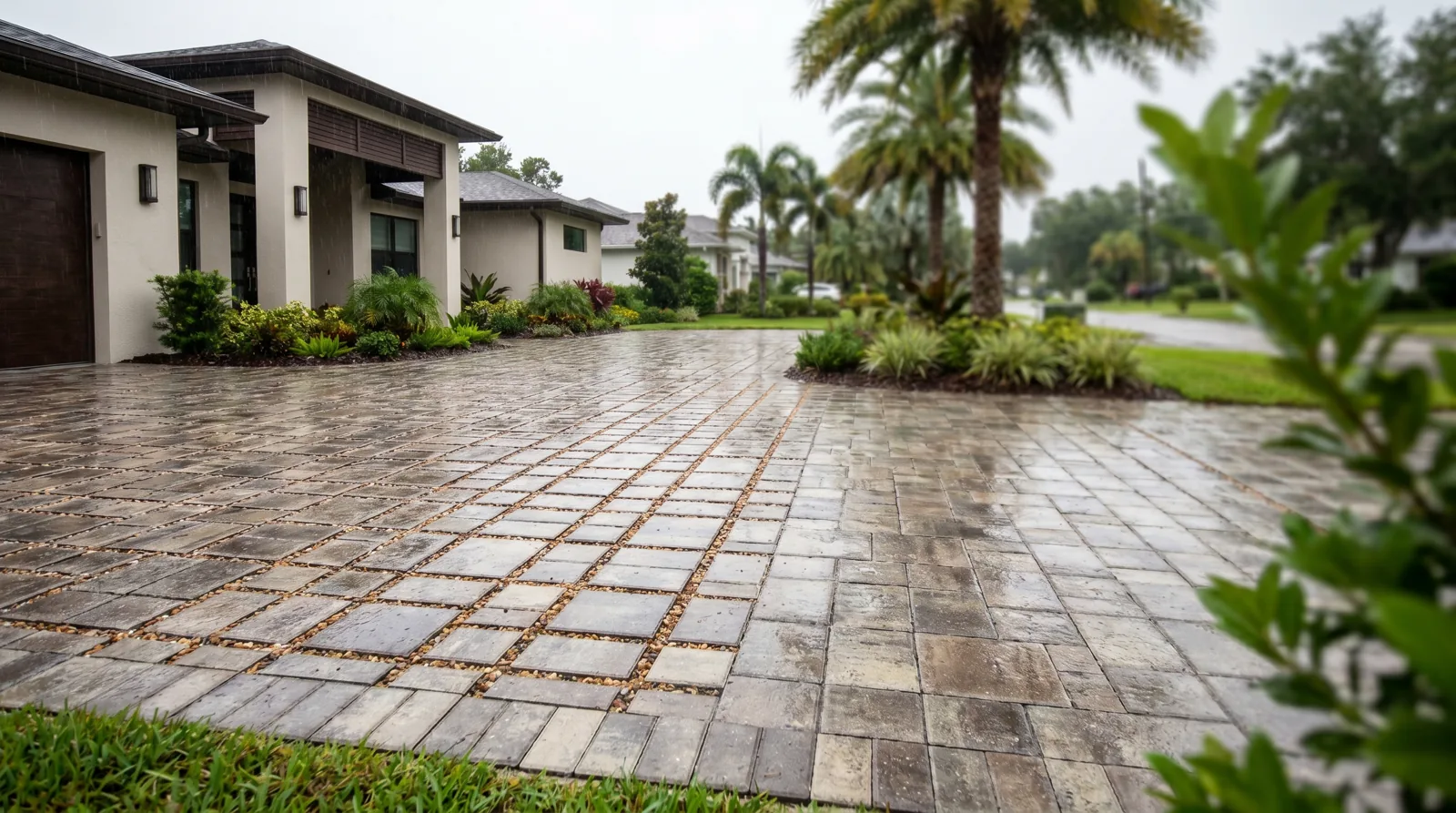
Permeable pavers flip that. The pavers themselves are solid, but they’re set with slightly wider joints filled with small, angular gravel instead of fine sand. Underneath, we build a deep base of open-graded crushed stone. When rain hits the surface, it runs into those gravel joints, trickles down into the stone reservoir, and slowly releases into the sandy soil below.
That layered base is the part that does the real work. A properly built system can hold a surprising amount of water during a downpour and then let it drain out over the next few hours, long after the storm has passed. We saw exactly this last August when we replaced a cracked concrete drive in DeBary — the homeowner’s old slab funneled water straight into the garage during every storm, and the new permeable surface kept the whole apron dry through a week of daily thunderstorms.
It’s the same root-cause thinking we bring to any yard that floods after every rain: move the water down and away before it has a chance to pool.
Compared to Concrete and Standard Pavers
People usually weigh three surfaces for a Florida driveway or patio: poured concrete, standard pavers, and permeable pavers. Here’s how they stack up for our climate.
| Feature | Poured Concrete | Standard Pavers | Permeable Pavers |
|---|---|---|---|
| Surface drainage | Sheds all water to edges | Mostly sheds to edges | Absorbs through joints |
| Cracking in FL heat | Common over time | Rare (individual units flex) | Rare |
| Repairs | Patch or re-pour | Lift & reset units | Lift & reset units |
| Look | Plain gray | Wide range of styles | Wide range of styles |
| Stormwater benefit | None | Minimal | Significant |
Concrete is cheap up front, but it cracks in our heat-and-rain cycle and gives you zero help with drainage. Standard pavers look great and flex with the ground, but the surface still sends most of the rain rolling toward the nearest low point. A permeable surface gives you that same upscale look while actually managing the water — which, in a place that gets summer rain almost daily, is a real advantage rather than a luxury.
The Stormwater and Lot-Coverage Angle
There’s a less obvious reason this option is worth a look here. A lot of Central Florida municipalities and HOAs limit how much of your lot you’re allowed to cover with impervious (water-shedding) surface. Driveways, patios, pool decks, and roofs all count against that cap.
Because water passes through them, these surfaces are often treated more favorably than solid concrete when a community or county calculates lot coverage and stormwater impact. If you’re trying to add a wider driveway, a bigger patio, or a parking pad without blowing past a coverage limit, a permeable surface can sometimes be the difference between an approval and a denial. The EPA’s overview of permeable pavement explains why these surfaces are credited as a green-infrastructure stormwater tool.
We always recommend confirming the specifics with your city or HOA before you design the project — the rules vary by jurisdiction across Seminole, Volusia, and Orange counties, and we’re happy to help you sort out what applies to your address.
Maintenance: What These Surfaces Actually Need
The number-one myth we hear is that these systems are high-maintenance. They’re not — but they do need different care than a sealed concrete slab.
- Keep the joints clear. The system drains through the gravel in the joints, so the goal is to keep that gravel from clogging with leaves, grass clippings, and fine dirt. For most home driveways, a yearly blow-off and a periodic deep clean is plenty.
- Avoid sealing the joints shut. Standard paver sealers can clog a permeable surface. If you want a sealed look, use a product rated for permeable systems — this is one big way the job differs from a standard paver sealing project.
- Refresh the joint gravel as needed. Over years, some of the joint stone works its way out. Topping it up keeps the surface draining at full capacity.
- Watch what you pile on it. Mounding mulch, soil, or yard debris on a permeable surface is the fastest way to choke the joints, so keep landscaping beds tidy at the edges.
Done right, the upkeep is minimal — and it’s a small trade for a surface that earns its keep every time the sky opens up.
What Permeable Pavers Cost in Central Florida
A permeable system usually runs a bit more than standard pavers, mostly because the base is the expensive part. A permeable system needs a deeper, thicker bed of open-graded stone than a standard paver install, and that extra excavation and material is where the cost lives.
In our experience around Heathrow and the surrounding Lake Mary area, the things that move the price most are:
- Square footage — driveways cost more than a small patio, simply because of area.
- Base depth and soil — if your sub-soil drains poorly, the reservoir base has to be deeper.
- Demolition — tearing out and hauling an old concrete slab adds cost over a fresh install.
- Paver style — premium textures and patterns run higher than basic units.
- Edge restraints and grading — getting the surrounding grade right so water flows into the system, not around it.
Rather than quote you a number that doesn’t fit your lot, we come out, look at your soil and drainage, and give you a free written estimate. Active military and veterans receive a 10% discount on every project we do.
Frequently Asked Questions
Do permeable pavers work in Florida’s sandy soil?
Yes — and sandy soil is actually ideal. Sand drains well, so the water that passes through the pavers and into the stone base soaks away quickly into the ground. The main thing we check is whether there’s a clay or hardpan layer underneath that could slow drainage; if there is, we design the base to compensate.
Will permeable pavers get clogged with dirt?
They can over many years if the joints are never cleaned, but routine maintenance prevents it. A yearly blow-off plus an occasional deep clean keeps the gravel joints open. The biggest culprits are leaves and yard debris piled on the surface, so keeping the area tidy goes a long way.
Can I put a permeable paver driveway over my old concrete?
We don’t recommend it. The whole system depends on water passing down into a stone reservoir, and a solid concrete slab underneath blocks that path. We remove the old concrete first, build the proper open-graded base, then set the pavers.
Are permeable pavers more expensive than regular pavers?
Usually a little, yes — mostly because of the deeper stone base and extra excavation. But for a Florida property with drainage headaches, that upfront difference often saves money down the road by preventing erosion, foundation pooling, and the cost of adding a separate drainage system later.
Get a Free Permeable Paver Estimate Today
If summer storms keep flooding your driveway or patio, a permeable surface might solve two problems at once — better drainage and better curb appeal. At DeAngelo’s Land Services, we handle the whole job: removal, grading, base, and paver install, all built for Florida’s rainy season. We’re BBB A+ rated, Google Guaranteed, and proud of our 5.0-star rating across 211+ reviews from homeowners around the area.
Ready to get started? Contact us online or call (386) 675-2303 today for a free estimate. Active military and veterans receive a 10% discount on every job. As a veteran-owned landscape contractor, we serve Heathrow, Lake Mary, Sanford, Longwood, DeBary, Deltona, and surrounding communities.
About the Author
Mark DeAngelo is the founder of DeAngelo’s Land Services and an ISA Certified Arborist with years of hands-on experience building drainage-friendly hardscapes, paver driveways, and patios throughout Seminole and Volusia counties. Mark personally inspects every job site and stands behind every project his crews complete.