Best Shade Trees to Plant in Central Florida (and When)
Best Shade Trees to Plant in Central Florida (and When)
The best shade trees for Central Florida are the ones that grow big enough to cool your home, stand up to hurricane-season winds, and thrive in our sandy soil — and at the top of that list are the live oak, southern magnolia, bald cypress, red maple, and elm. Plant the right one in the right spot and you’ll knock down your summer cooling bills, shade your roof and patio, and add real value to your property.
As an ISA Certified Arborist, the question I get most from homeowners in Lake Mary, Sanford, and the surrounding area isn’t whether to plant a shade tree — it’s which one, and where. The wrong tree too close to the house becomes a hurricane liability or a foundation problem. The right one becomes the best thing in your yard for the next fifty years.
The short answer: live oak is the gold standard for Central Florida shade, but red maple, elm, and bald cypress are excellent faster-growing alternatives depending on your yard.

The Best Shade Trees for Our Climate, Side by Side
Every tree on this list earns its place for a different reason — speed, size, wind resistance, or look. Here’s how the top picks compare for a Central Florida yard.
| Tree | Growth Rate | Mature Size | Wind Resistance | Notes |
|---|---|---|---|---|
| Live Oak | Moderate | 40–60 ft tall, very wide | Excellent | The classic. Long-lived, storm-hardy, huge canopy. |
| Southern Magnolia | Slow–Moderate | 40–60 ft | Good | Evergreen, fragrant blooms, year-round shade. |
| Bald Cypress | Moderate–Fast | 50–70 ft | Excellent | Loves wet/low spots, surprisingly drought-tough too. |
| Red Maple | Fast | 40–60 ft | Moderate | Quick shade, fall color, likes moist soil. |
| Winged / Drake Elm | Fast | 40–60 ft | Moderate–Good | Fast, tidy shade tree; Drake elm is a popular compact pick. |
A quick word on the trees people want but I steer them away from: the Bradford pear and the silver maple grow fast but split apart in storms, and the laurel oak — while a beautiful, fast shade tree — is short-lived and far more likely to fail in a hurricane than its cousin the live oak. If wind resistance matters to you (and in Florida it should), see our breakdown of which trees fall in a hurricane before you plant.
Why Live Oak Is Still the King of Central Florida Shade
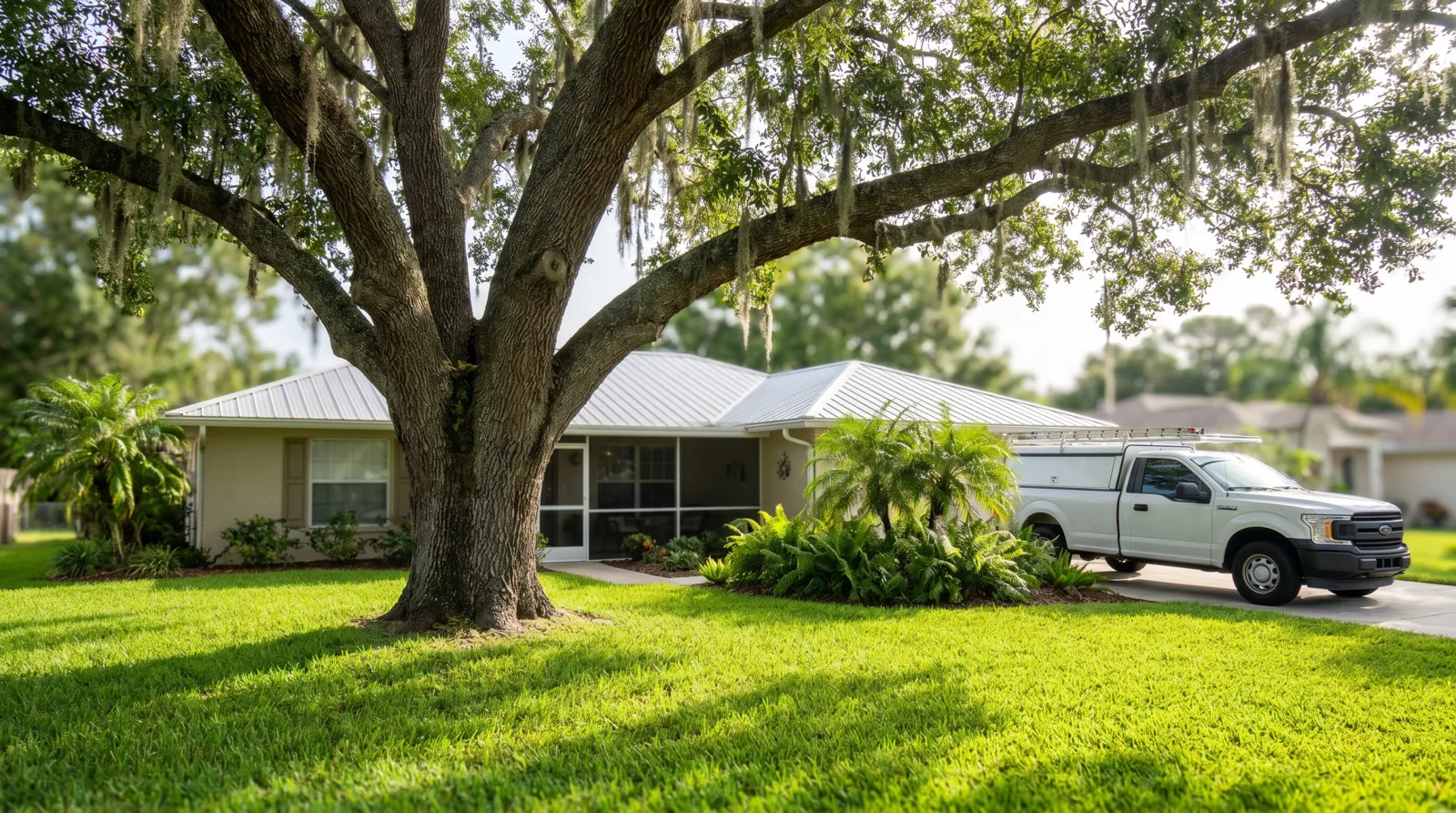
If you only plant one shade tree, make it a live oak. It checks every box that matters here: it’s native, it tolerates our sandy soil and heat, it shrugs off hurricane winds better than almost any other tree, and a healthy one can live for centuries. The spreading canopy throws an enormous footprint of shade — far wider than it is tall — which is exactly what you want cooling a roof and a yard.
The one catch is patience and space. A live oak isn’t a fast tree, and it needs room — plant it 20 feet or more from your house and well clear of power lines, because that canopy is going to spread. We pulled a storm-split laurel oak off a roofline in Longwood last August, and the homeowner’s biggest regret wasn’t that the tree fell — it was that someone had planted such a brittle species so close to the house decades earlier. A live oak in the same spot would have ridden out the storm.
For homeowners who want shade sooner, a red maple or an elm gives you usable canopy in a handful of years rather than a decade. Many of our customers plant a fast grower for quick relief and a live oak for the long haul — and let the live oak take over as the fast tree ages out.
When to Plant Trees in Central Florida
Here’s the part people get backwards: the best time to plant a shade tree in Central Florida is the cooler, drier months — roughly November through February, not summer.
It feels counterintuitive because summer is when you’re craving shade the most. But a tree planted in the brutal heat of July spends all its energy just trying to survive, fighting heat stress before its roots ever establish. A tree planted in the cool season has months to settle its roots into the soil before the next summer’s heat and the next hurricane season arrive. By the time it really needs to perform, it’s anchored and ready.
If you do plant in the warm months, it can work — but you’ll need to water diligently through establishment, and you’re accepting more risk. When a homeowner asks me in July, I usually say: pick your tree and your spot now, and let us put it in the ground when the weather turns. The UF/IFAS guidance on planting and establishing trees backs this up.
Placement: Get This Right Before You Dig
Where you plant matters as much as what you plant. A few rules we never break:
- Mind the mature size, not the nursery size. That little tree will be 50 feet wide someday. Give it room.
- Keep big trees 15–20+ feet from the house so roots stay clear of the foundation and the canopy stays off the roof.
- Look up. Never plant a tall shade tree under power lines — it leads to ugly utility pruning and conflict down the road.
- Match the spot to the tree. Bald cypress and red maple love your low, wet areas; live oak and magnolia want better-drained ground.
- Call before you dig. Underground utilities are no joke — a free 811 locate keeps you safe.
Good placement is also a Florida-friendly landscaping move — the “right plant, right place” rule applies to shade trees as much as anything. If you’re rethinking the whole yard, our guide to Florida-friendly landscaping ties it all together.
Frequently Asked Questions
What is the fastest-growing shade tree for Central Florida?
Red maple and elm (including the popular Drake elm) are among the fastest, giving you usable shade in just a few years. Bald cypress also grows quickly, especially in moist soil. The trade-off with the fastest growers is that they generally don’t live as long or stand up to wind as well as a live oak.
How far from my house should I plant a shade tree?
For a large shade tree like a live oak or magnolia, keep it at least 15 to 20 feet from the house — and farther is better for the biggest species. This keeps the roots clear of your foundation and the canopy off your roof, which also matters during hurricane season.
Is laurel oak a good shade tree?
Laurel oak grows fast and throws nice shade, but it’s short-lived and one of the species most likely to fail in a hurricane. For a long-term, storm-resistant shade tree, live oak is the far better choice. We often recommend planting a live oak even if it means waiting a little longer for full shade.
Can you plant a large tree for me, or just remove them?
Both. We handle planting, placement consultation, and ongoing care — not just removals. We’ll help you pick the right species for your soil and sun, place it correctly, and plant it in the proper season so it establishes well.
Get a Free Tree Planting Estimate Today
The right shade tree, in the right spot, planted in the right season, is one of the smartest things you can add to a Central Florida property. At DeAngelo’s Land Services, our ISA Certified Arborist will help you choose a species that fits your yard, your soil, and our storms — then plant it to last. We’re BBB A+ rated, Google Guaranteed, and proud of our 5.0-star rating across 211+ reviews.
Ready to get started? Contact us online or call (386) 675-2303 today for a free estimate. Active military and veterans receive a 10% discount. We serve Lake Mary, Sanford, Longwood, Oviedo, Winter Springs, Heathrow, and the surrounding communities — see all the areas we serve.
About the Author
Mark DeAngelo is the founder of DeAngelo’s Land Services and an ISA Certified Arborist with years of hands-on experience selecting, planting, and caring for shade trees throughout Seminole, Volusia, and Orange counties. Mark personally evaluates every planting site for soil, drainage, sun, and storm exposure before a single tree goes in the ground.