Which Trees Fall Most in a Florida Hurricane?
Which Trees Are Most Likely to Fall in a Florida Hurricane?
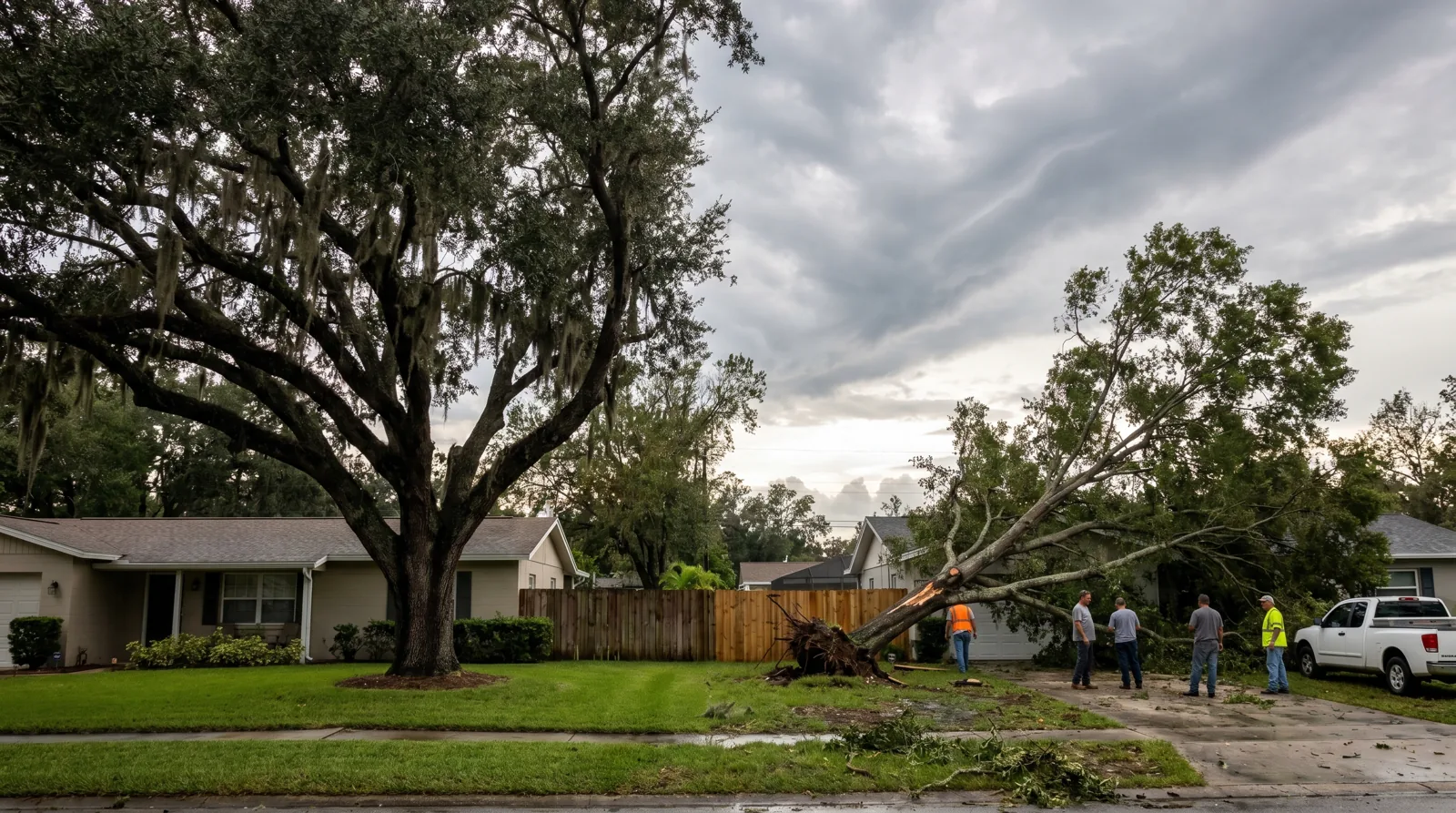
The trees that fall in hurricanes are rarely a surprise to anyone who works with them — they’re usually the fast-growing, shallow-rooted, or brittle species that look great in a few years but give out when the wind really blows. Across Central Florida, the worst offenders are laurel oaks, water oaks, sand pines, Bradford pears, and top-heavy queen palms. The trees that ride out the same storm standing tall tend to be live oaks, sabal palms, and bald cypress.
Quick takeaway: Wind survival comes down to root depth, wood strength, and canopy shape. Brittle, shallow-rooted species like laurel oak and water oak fail first; deep-rooted, flexible natives like live oak and sabal palm hold up best.
We’ve cleaned up after enough storm seasons in Seminole and Volusia counties to see the same pattern repeat every time. Knowing which trees on your lot are the high-risk ones is the first step to deciding what to inspect, what to thin, and what — if anything — to remove before the next storm.
Which Trees That Fall in Hurricanes Top the High-Risk List?
A few species account for a big share of the failures we clean up. If you have one of these near your house, give it extra attention before storm season peaks.
Laurel oak. This is the poster child for storm failure around here. Laurel oaks grow fast and provide shade quickly, which is why they were planted all over older Central Florida neighborhoods — but they’re short-lived, prone to internal decay, and form weak forks that split in high wind. By the time many are 30 to 40 years old, they’re hollowing out from the inside. A huge percentage of the trees we remove off rooflines are laurel oaks.
Water oak. A close cousin to the laurel oak with the same weaknesses: fast growth, weak wood, included bark at the branch unions, and a tendency to decay early. Water oaks shed large limbs in even moderate storms.
Sand pine. Common on Florida’s sandy ridges, sand pines have shallow roots and a tall, top-heavy form. In sustained wind they snap or uproot readily, especially on the saturated soil our summer rains leave behind.
Bradford pear. A landscape favorite for its spring flowers, and a structural disaster. Bradford pears grow with tight, crowded branches all attached at nearly the same point, so they essentially fall apart in storms — often splitting right down the middle.
Queen palm. Unlike our native sabal palm, queen palms are top-heavy and can have weaker root systems, especially if they’re potassium-deficient (very common in our sandy soil). A heavy crown on a slender trunk catches a lot of wind.
Anything already compromised. Species aside, any tree with existing decay, a previous lean, root damage from construction, or a heavy one-sided canopy is a candidate to fail — which is exactly why a pre-season tree risk assessment is worth doing before the storms arrive.
The Trees That Hold Up: Wind-Resistant Species for Florida
The flip side is just as useful — some trees are genuinely built for our weather. University of Florida researchers studied which species survived major hurricanes, and their wind-resistant tree findings line up with what we see in the field. The standouts for Central Florida:
- Live oak. The gold standard. Deep, wide-spreading roots, dense and flexible wood, and a low, rounded canopy that sheds wind. Healthy live oaks routinely survive hurricanes that flatten the trees around them.
- Sabal palm (cabbage palm). Florida’s state tree, and one of the most wind-tolerant plants there is. The flexible trunk bends in gusts instead of snapping, and the root system holds firm.
- Bald cypress. Naturally adapted to wet, windy conditions. Deep roots and a tapered, flexible form make it a strong, storm-worthy shade tree.
- Southern magnolia and dahoon holly also tend to perform well thanks to strong wood and manageable canopies.
If you’re planning new plantings, leaning toward these species is one of the smartest long-term storm-prep moves you can make. We dig into the full lineup in our guide to the best shade trees for Central Florida.
What to Inspect on Your Property Right Now
You don’t have to wait for a storm warning to act. Walk your yard and look for:
- Species first. Identify whether you have any of the high-risk trees above near the house, the driveway, or where people gather.
- Lean. Any tree leaning toward a structure, especially with a new or worsening tilt.
- Decay signs. Mushrooms or conks at the base, hollow-sounding trunks, cavities, or peeling bark.
- Weak forks. Tight V-shaped unions with bark squeezed in between — these split first.
- Deadwood. Dead limbs in the canopy that will become projectiles.
- Root issues. Soil heaving, cut roots from recent construction, or roots circling at the base.
A little selective thinning to let wind pass through the canopy — done correctly, not topped — can meaningfully reduce a tree’s sail and its odds of failing. The key word is correctly: over-thinning or topping makes trees more dangerous, not less. That’s a job for a certified arborist, and it’s part of what we handle for homeowners all over our Central Florida service area.
Frequently Asked Questions
Are oak trees safe in a hurricane?
It depends entirely on the species. Live oaks are among the most wind-resistant trees you can have. Laurel oaks and water oaks are among the least — they look similar but behave very differently in a storm, so identifying which oak you have matters.
Should I cut down my laurel oak before hurricane season?
Not automatically. A healthy laurel oak far from any structure may be fine to keep and monitor. One that’s leaning toward your house, showing decay, or large enough to reach your roof is worth having an arborist evaluate — sometimes a removal is the right call, sometimes careful pruning buys time.
Do palm trees survive hurricanes?
Native sabal palms are extremely wind-tolerant and usually ride out storms by bending. Top-heavy non-natives like queen palms are more vulnerable, and a nutrient-deficient palm with a weak root system is at higher risk.
Can thinning a tree’s canopy really help it survive wind?
Yes, when it’s done right. Properly reducing canopy density lets wind flow through instead of pushing the whole tree like a sail. But topping or over-thinning backfires badly — it stresses the tree and promotes weak regrowth. Always use a certified arborist.
Which trees should I plant instead?
For storm resilience, go with live oak, sabal palm, bald cypress, or southern magnolia. They combine strong wood, good root systems, and canopy shapes that handle Florida wind.
Worried About a Tree on Your Property? Call (386) 675-2303
If you’ve got a laurel oak leaning over the bedroom or a top-heavy palm by the driveway, the time to deal with it is before the next storm, not during it. DeAngelo’s Land Services is a veteran-owned, BBB A+ rated crew with an ISA Certified Arborist on staff, and we hold a 5.0-star rating across 211+ reviews for giving homeowners straight, no-pressure answers about their trees.
Call us today at (386) 675-2303 for a free tree risk evaluation anywhere in Central Florida. We’ll tell you which trees are worth protecting, which need thinning, and which should come down — and we offer a 10% veteran discount on every job.
About the Author: Mark DeAngelo is the owner of DeAngelo’s Land Services and an ISA Certified Arborist serving Central Florida. His veteran-owned team is BBB A+ rated, Google Guaranteed, and holds a 5.0-star rating across 211+ reviews.