
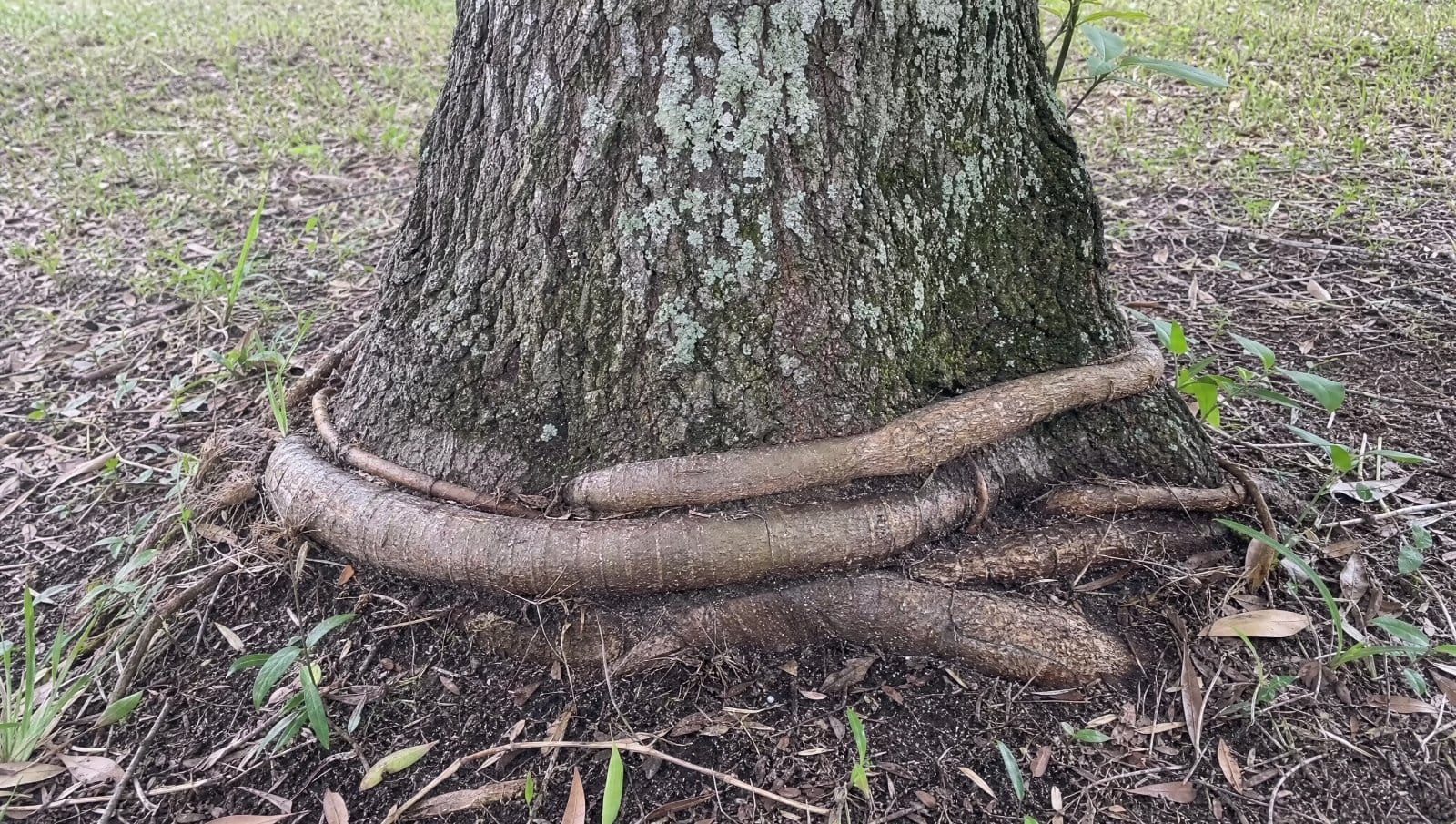
Girdling roots slowly choke a tree from the base.
Girdling Roots: The Hidden Cause of a Declining Florida Tree
Some trees die from something obvious — a lightning strike, a beetle infestation, a hurricane snapping the trunk. But a lot of the slow, mysterious declines we see across Central Florida have a quieter cause: girdling roots. These wrap around the base of a tree and slowly choke it from below the soil line, often years before anyone notices a problem above ground.
At LandTree, working trees from Orange City and DeLand through Oviedo, Apopka, and the Orlando metro, we see this constantly — especially on trees planted from nursery containers into our sandy zone 9b soil. The good news: girdling roots are often catchable, and sometimes correctable, if you know what to look for.
What Are Girdling Roots?
A girdling root grows in a circle around the trunk or other roots instead of radiating outward the way it should. As both the trunk and the root thicken year after year, they press against each other. Eventually the encircling root acts like a tightening belt, compressing the phloem and cambium just under the bark — the living layer that carries sugars down from the leaves — and as that pressure builds, it also disrupts the tree’s water transport in the wood beneath.
Cut off that flow and the tree slowly starves on one side or all the way around. Because it happens underground and unfolds over years, the tree can look “fine” right up until it is clearly not.
Why Central Florida Trees Are Especially Prone
A few local realities stack the deck:
- Container-grown nursery stock. Most landscape trees here are sold in pots. Inside a pot, roots hit the wall and start circling. If they are not corrected at planting, that circular pattern continues into the ground and becomes a girdling root years later.
- Sandy soil. Our fast-draining sand encourages shallow, spreading roots — good for stability, but it means problem roots often form right in the surface zone where girdling does the most damage.
- Planting too deep. When a tree is set too low or piled with mulch against the trunk — the dreaded “mulch volcano” — the root flare gets buried, hiding circling roots and encouraging more.
Some species are also more prone than others. Extension specialists consistently flag maples as the classic stem-girdling-root tree, along with lindens and elms — so if you have a maple in your yard, the base is well worth a close look.
The Warning Signs to Watch For
Trees rarely announce this problem loudly. They drop hints — and once you know them, you spot them everywhere on your street.
Look at the Base of the Trunk
A healthy tree widens where it meets the ground, flaring like the bell of a trumpet — the root flare. A tree with girdling roots often does the opposite, going straight into the soil like a telephone pole, with little or no flare. Sometimes you can even see a root crossing the base or a flattened, sunken spot on one side of the trunk.
Watch the Canopy
Above ground, the symptoms are easy to blame on something else:
- Sparse, undersized, or off-color leaves, often worse on one side
- Early fall color or early leaf drop on part of the canopy
- Branch dieback in the upper crown that creeps downward over several seasons
- A general slow decline with no obvious pest, fungus, or storm damage to explain it
That last one — a tree quietly failing for “no reason” — is the classic signature of this problem. The reason is there; it is simply below the soil.
The One-Sided Decline Clue
Because a girdling root usually compresses one part of the trunk, the dieback it causes is often lopsided. If half your maple or oak is thinning while the other half looks normal, gently clear the mulch and soil from the base on the struggling side and look for an encircling root pressing into the trunk.
What You Can Do About Girdling Roots
The right move depends entirely on how far along the problem is — this is where honest assessment matters more than a quick fix. A root that took years to form does not get fixed overnight.
Catch It Early at Planting
The cheapest cure is prevention. When a new tree goes in, the circling roots from its container should be teased apart, sliced, or shaved off so they grow outward. The root flare should sit at or slightly above the soil line, never buried. Mulch should be a loose two-to-three-inch ring kept a few inches off the trunk — never a volcano. Getting this right at day one prevents the whole problem.
Corrective Root Pruning on Established Trees
On a tree caught before serious damage, a trained arborist can often perform root collar excavation — removing soil from the base to expose the root flare and identify the offending root. If that root is not yet load-bearing or structurally critical, it can sometimes be cut to relieve the pressure and let the trunk recover.
This is genuinely delicate work. Cutting the wrong root, or cutting too aggressively, can destabilize the tree or open it to decay — one of the few jobs that belongs in trained hands, not a weekend project.
When It Is Too Late
If a girdling root has already compressed most of the trunk’s circumference and the canopy is well into decline, the tree may not be recoverable. In that case the conversation shifts to safety — whether a weakened tree near a house, driveway, or power line should come down before our summer storms and hurricane season test it. We will always tell you straight whether a tree is worth saving or whether removal is the responsible call.
Frequently Asked Questions
Can a tree recover from girdling roots?
Often yes, if caught before the root has compressed most of the trunk. Corrective root pruning by a trained arborist can relieve the pressure and let the tree rebuild its vascular flow. Trees in advanced decline are much harder to save.
How do I know if my tree has girdling roots?
Check the base. A healthy tree flares outward at the ground; a girdled tree often goes straight in like a pole. Pair that with one-sided canopy thinning or unexplained slow decline, and girdling roots are a strong suspect.
What causes girdling roots in the first place?
Most commonly, circling roots from container nursery stock that were never corrected at planting — made worse by planting too deep, mulch piled against the trunk, and our shallow sandy soil. Maples, lindens, and elms are especially prone.
Is mulching bad for my tree?
Proper mulching is great — it conserves moisture and moderates soil temperature in our hot summers. The danger is the “mulch volcano” piled against the trunk, which buries the root flare and encourages girdling and rot. Keep mulch a few inches off the bark.
The Bottom Line
This hidden root problem is one of the most under-diagnosed reasons a Central Florida tree slowly fades, and because the cause hides underground, the tree often gets blamed for problems it cannot explain. The encouraging part is that it is a knowable, often manageable issue — if you check the root flare, watch for one-sided decline, and act before the trunk is fully choked. For a deeper technical read, Iowa State University Extension’s All About Stem Girdling Roots and the International Society of Arboriculture’s research on girdling-root injury both confirm what we see in the field every week.
If you have a tree thinning out for no clear reason, or you are not sure whether that buried trunk base is hiding a problem, let us take a look. Contact LandTree for a free estimate and an honest assessment — we will tell you whether your tree can be saved, what it would take, and exactly where it stands. No pressure, just a straight answer from people who do this work every day.