
Does Insurance Cover Tree Removal in Florida?
Does Insurance Cover Tree Removal After a Hurricane in Florida?
The question we hear most after every storm is simple: does insurance cover tree removal in Florida? The short version is this — insurance usually does cover tree removal when the tree damages a covered structure like your house, garage, or fence, but it usually does not cover a tree that simply falls in your yard without hitting anything. There are limits and a deductible in play either way, so the difference between a paid claim and an out-of-pocket cost often comes down to what the tree landed on and how well you documented it.
Quick takeaway: Tree hit your house, garage, or fence? Removal is typically covered (minus your deductible, up to a cap). Tree fell harmlessly in the yard? Usually not covered. Documentation makes or breaks the claim.
We’re not your insurance company, and every policy reads a little differently — but after years of helping Central Florida homeowners through storm claims in Lake Mary, Sanford, and across Seminole and Volusia counties, we can tell you how this generally plays out and how to give yourself the best shot at coverage.
When Does Insurance Cover Tree Removal in Florida?
Coverage almost always turns on one thing: did the tree hit something insured? Here’s the general pattern most Florida policies follow.
Covered, in most cases:
– A tree falls on your house, roof, or attached structure — removal of the tree off the structure and repair of the damage are typically covered.
– A tree hits a detached garage, shed, or fence — usually covered under “other structures” coverage.
– A tree blocks your driveway or a ramp for a disabled resident — many policies cover removal even if nothing was damaged, because access is affected.
Usually NOT covered:
– A healthy tree falls in your yard and hits nothing — most policies won’t pay to haul it away, because there’s no covered damage.
– A tree that came down due to neglect or known disease — insurers can deny claims if the tree was clearly hazardous and ignored.
– Routine removal of a living tree you just want gone — that’s standard maintenance, not a claim.
There’s an important nuance: even when a tree falls and damages nothing, some policies include a small debris-removal allowance (often a few hundred dollars) if the fallen tree blocks a driveway or handicap ramp. It’s worth reading your declarations page for that line. The Florida Department of Financial Services and the Insurance Information Institute’s tree-damage claims guidance are solid, neutral resources for understanding the standard language.
Typical Limits, Deductibles, and the Hurricane Deductible
Here’s where Florida homeowners get caught off guard. A few things to know:
- There’s usually a per-tree and total cap. Many policies cap debris removal at something like $500 to $1,000 per tree and a total limit per storm, regardless of the actual cost. A large removal can exceed that cap, leaving a balance you cover.
- Your deductible comes off the top. If your removal and repair total less than your deductible, you’re effectively paying out of pocket and there’s nothing to claim.
- Hurricanes can trigger a separate, higher deductible. Most Florida policies carry a hurricane or windstorm deductible that’s a percentage of your home’s insured value — often 2% to 5% — and it’s typically much larger than your standard deductible. After a named storm, that’s the number that applies, which surprises a lot of homeowners.
Because of these caps and deductibles, it’s smart to get an itemized estimate before assuming the whole bill is covered. When a tree comes down on your house, knowing your deductible and your debris-removal cap up front tells you what your real out-of-pocket exposure is.
How to Document and File a Tree-Damage Claim
The homeowners who get paid quickly are the ones who built a clean record before cleanup started. Do this:
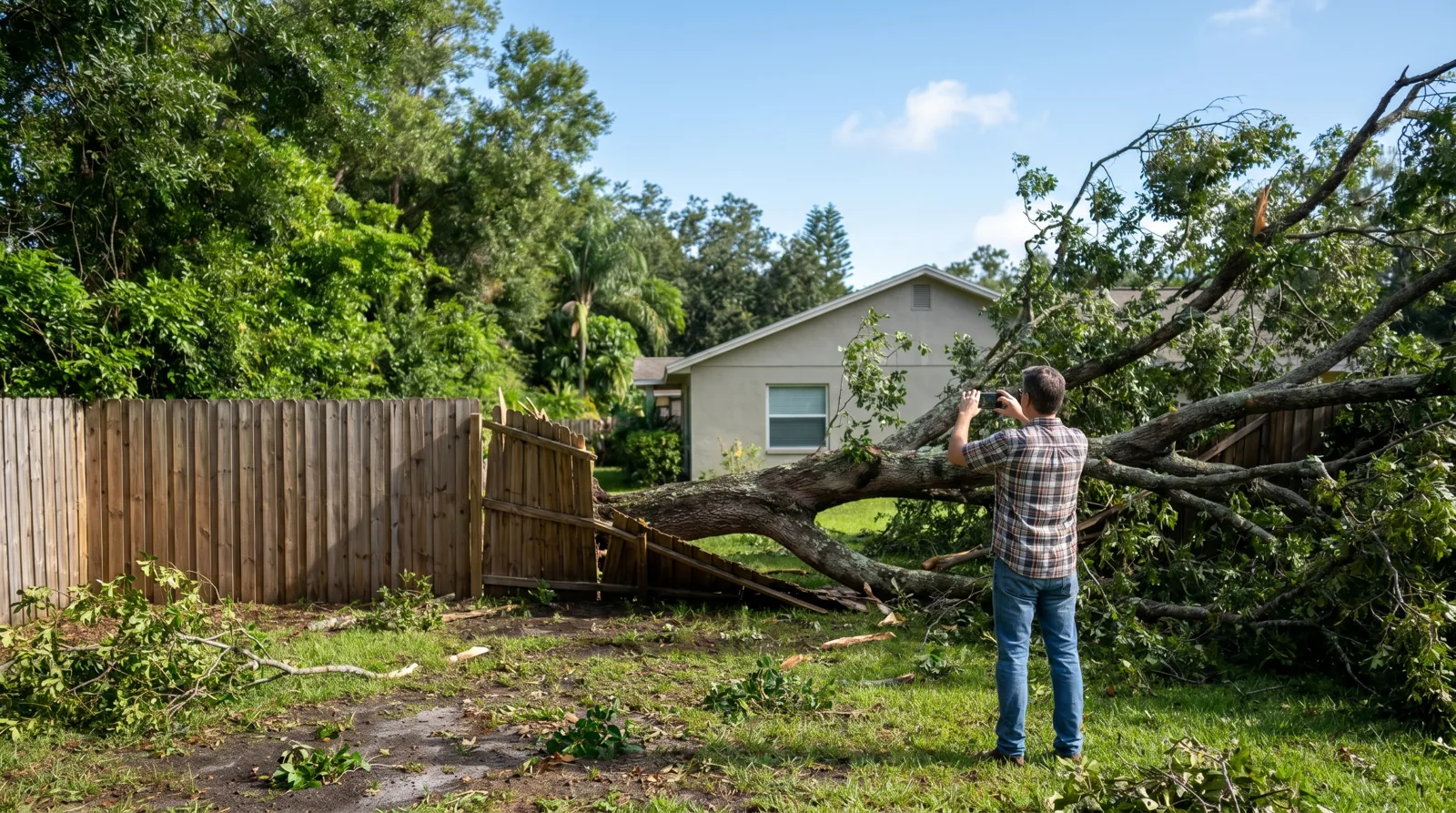
- Photograph everything before anyone cuts. Wide shots and close-ups of the tree, the damaged structure, and any belongings. Add a short video narrating what happened.
- Note the date, time, and the storm. A named storm with a clear date strengthens the claim.
- Make safe temporary repairs. Tarp the roof, cover broken windows — and keep the receipts. Insurers generally expect you to prevent further damage, and reasonable temporary fixes are reimbursable.
- Don’t haul it all off before the adjuster sees it unless it’s an immediate safety hazard. If it must be moved for safety, your photos become the evidence.
- File promptly and keep every estimate and receipt. Get an itemized written estimate for the removal and repair.
This is exactly why a fast, professional response helps — when our crew handles emergency tree removal after a storm, we document the damage as we go and provide a clear, itemized estimate you can hand straight to your adjuster.
Where an Arborist Report Strengthens Your Claim
Sometimes a claim hinges on why the tree fell. If an insurer suspects the tree was dead or diseased before the storm, they may push back. A written assessment from an ISA Certified Arborist documenting the tree’s condition, the storm damage, and the cause of failure can be the piece of evidence that gets a borderline claim approved. It’s also useful in reverse — if a neighbor’s tree fell on your property, an arborist report helps sort out responsibility. We provide these reports as part of our storm-response work, and they carry weight precisely because they come from a certified professional, not a guess.
Frequently Asked Questions
Does insurance pay to remove a tree that fell in my yard but hit nothing?
Usually not. With no damage to a covered structure, most policies won’t pay for removal — though some include a small debris-removal allowance if the tree blocks your driveway or a ramp. Check your declarations page.
My neighbor’s tree fell on my house. Whose insurance pays?
Generally your own homeowners policy handles the damage to your property and the removal, even though it was their tree. Your insurer may later seek reimbursement from the neighbor’s insurer if the tree was clearly neglected, but you typically start with your own claim.
Will filing a tree claim raise my rates?
It can, like any claim — but a single storm-related claim after a named hurricane is common and weighed differently than repeated claims. Weigh the deductible and cap against the cost before deciding to file.
What’s a hurricane deductible and how is it different?
It’s a separate deductible — usually a percentage of your insured home value rather than a flat dollar amount — that kicks in for named-storm damage. It’s typically much higher than your standard deductible, so a tree job that “should be covered” can still fall largely on you.
Do I need an arborist report to file a claim?
Not always, but it helps a lot when the cause of failure is in question or the insurer suspects pre-existing decay. A certified arborist’s written assessment can turn a denied or disputed claim into an approved one.
Storm Damage? Get a Free, Insurance-Ready Estimate — (386) 675-2303
Dealing with a fallen tree is stressful enough without fighting your insurance company over the paperwork. DeAngelo’s Land Services makes it easier — our veteran-owned, BBB A+ rated crew documents the damage, provides itemized estimates your adjuster can use, and writes arborist reports when your claim needs one. We hold a 5.0-star rating across 211+ reviews for exactly this kind of honest, no-runaround service.
Call us today at (386) 675-2303 for a free, insurance-ready estimate anywhere in Lake Mary and Central Florida. We offer a 10% veteran discount on every job, and we’ll give you a straight answer about what’s covered and what isn’t.
About the Author: Mark DeAngelo is the owner of DeAngelo’s Land Services and an ISA Certified Arborist serving Central Florida. His veteran-owned team is BBB A+ rated, Google Guaranteed, and holds a 5.0-star rating across 211+ reviews. This article is general information, not insurance or legal advice — always confirm coverage with your own carrier.