Storm-Damaged Tree? How to Tell If It Can Be Saved
Storm-Damaged Tree? How to Tell If It Can Be Saved or Must Come Down
After a Central Florida summer storm rolls through, the first thing most homeowners want to know is simple: can my storm damaged tree be saved, or does it have to come down? The honest answer is that it depends on a handful of specific signs — and you can spot most of them yourself before you ever pick up the phone. A tree that lost a few small limbs is usually fine. A tree with a split trunk, a lifted root plate, or a sudden lean is a different story.
Quick takeaway: Minor canopy and limb damage is often repairable, but structural failures — split trunk, major cracks, more than 30% canopy loss, or a root plate pushed out of the ground — almost always mean the tree needs to come down.
We walk a lot of yards in Lake Mary, Sanford, and Longwood the morning after a storm. Below is the same triage our crew runs when we step onto a property — use it to read your own tree, then call us if anything on the “must come down” list shows up.
What Are the Signs a Storm Damaged Tree Must Come Down?
Not every damaged tree is dangerous, but six warning signs tell us a tree has lost the structural integrity that keeps it standing. If you see any of these, keep your distance and treat the tree as a hazard until a professional looks at it.
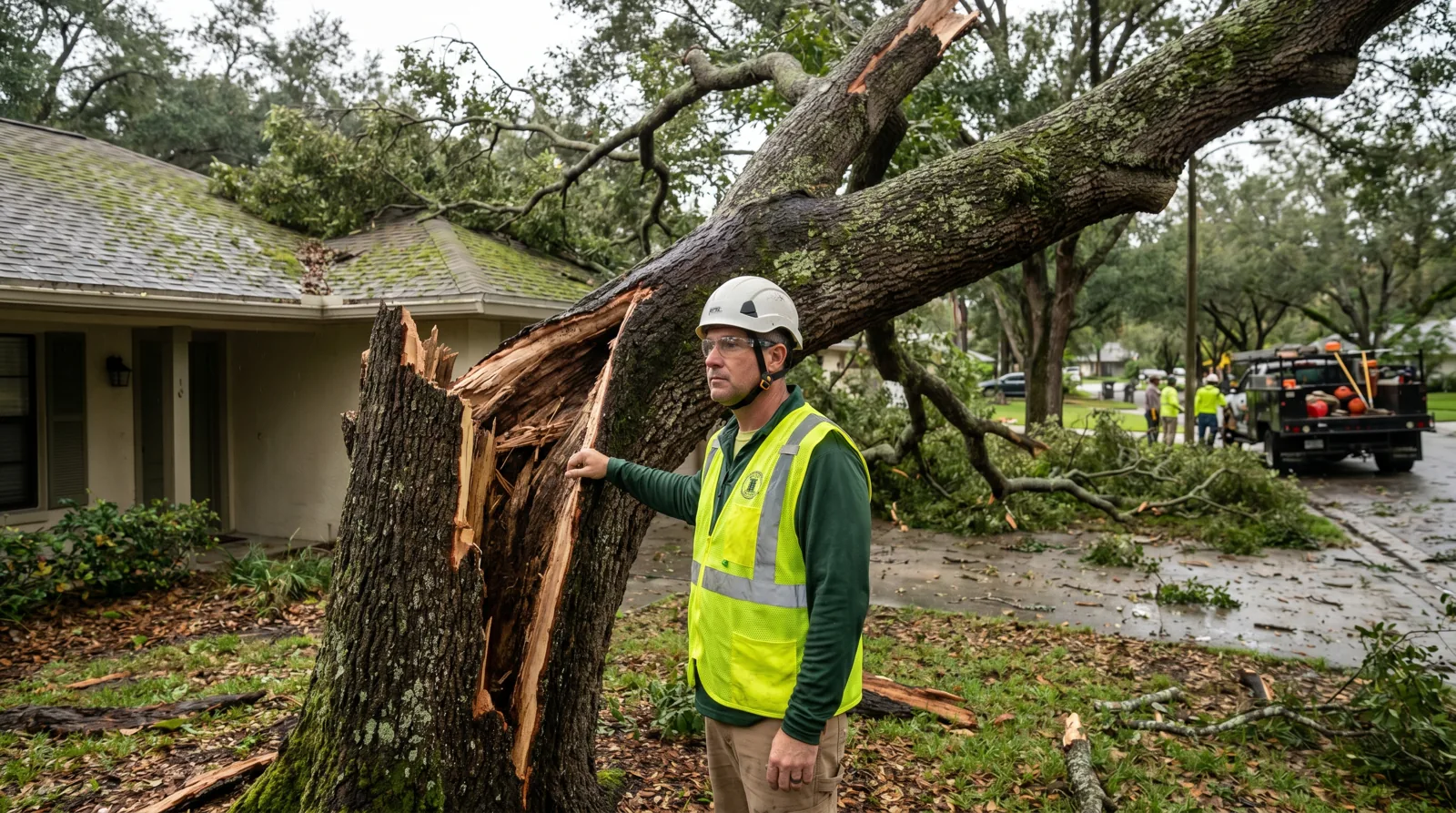
1. A split or cracked trunk. When the main trunk splits — especially down the middle where two large stems meet — the tree has lost its central support. Water oaks and laurel oaks are notorious for this around here because they form weak, included bark at those forks. A split trunk rarely heals, and the tree can fail without warning.
2. More than 30% of the canopy is gone. A tree can usually recover from losing a quarter of its branches. Once it loses roughly a third or more, it struggles to produce enough energy to heal, and the remaining limbs are often stressed and unstable. We see this a lot with brittle species after a band of afternoon thunderstorms parks over a neighborhood.
3. The root plate has lifted. Look at the base. If the ground on one side is heaved up, cracked, or you can see roots that used to be buried, the tree’s anchor system has been compromised. Florida’s sandy soil and high water table make root failure especially common — a saturated lot lets a big tree tip over in wind that wouldn’t have moved it in dry conditions.
4. Large cracks in major limbs. A long crack running down a major scaffold limb means that limb is one gust away from coming down. Over a roofline, a driveway, or a play area, that’s a removal-grade hazard even if the rest of the tree looks healthy.
5. A sudden new lean. Trees that have leaned the same direction for years are usually fine. A tree that leaned overnight is not — it means the roots let go. If you notice fresh soil cracking on the high side of the lean, that tree is actively failing.
6. Damage near power lines or your home. Even repairable damage becomes a removal call when broken limbs are tangled in service lines or hanging over the part of the roof where people sleep.
If you’re seeing more than one of these, don’t wait. This is exactly the kind of situation where emergency tree removal after a storm is the safest path, and our crew handles those calls every storm season.
When a Storm Damaged Tree CAN Be Saved
Now the good news — plenty of trees we get called out to look at don’t need to come down at all. A tree is usually a strong candidate for saving when:
- It lost only small or medium branches and the main trunk is intact.
- Less than a quarter of the canopy is damaged.
- The breaks are clean and can be pruned back to healthy collars.
- The root plate is firmly in the ground with no heaving.
- It’s a fundamentally strong species — a mature live oak or bald cypress will take a beating and bounce back.
In those cases, the right move is corrective pruning: cleaning up the torn wood, reducing weight on stressed limbs, and giving the tree a fair shot to wall off the wounds and recover. We cleared a wind-snapped laurel oak off a roofline in Longwood last August, but the live oak two doors down only needed its torn limbs cleaned up — and it’s thriving today. Same storm, two very different outcomes.
Why a Same-Day Arborist Inspection Matters
Here’s what’s tricky about storm damage: the most dangerous failures often aren’t the obvious ones. A tree can look fine from the street while a hairline crack at a major union, or a root plate that shifted an inch, is quietly waiting for the next gust. An ISA Certified Arborist is trained to read those subtle signals — internal decay, hidden cracks, soil heave — that a quick glance misses.
Time matters too. A compromised tree gets weaker with each storm, and Central Florida rarely gives you a dry week in summer. Getting eyes on it the same day means you learn whether you’re facing a quick prune or a removal before the next round of weather decides for you. The University of Florida’s guidance on assessing storm-damaged trees covers the same structural questions we use in the field.
Frequently Asked Questions
Is a leaning tree always dangerous after a storm?
Not always. A long-standing lean the tree grew into is usually stable. A new lean that appeared after a storm is the red flag — it means the roots failed, and that tree should be inspected right away and likely removed.
Can a tree heal a split trunk?
No. Trees don’t heal wounds the way people do; they compartmentalize, or wall off, damage. A split through the main trunk removes the structural support the tree needs to stand, and no amount of cabling or bracing reliably fixes it. That tree is a removal.
How fast can you come out after a storm?
We prioritize storm calls and aim for same-day or next-day inspections across Seminole, Volusia, and Orange counties. If a tree is on a structure or tangled in power lines, tell us when you call at (386) 675-2303 so we can move you up the list.
Will I need a permit to remove a storm-damaged tree?
Often there’s an emergency or hazard-tree exception that waives the normal permit, but it varies by city. Our crew documents the damage and handles the paperwork — including the permitting for protected trees in Sanford and the surrounding area — so you don’t have to figure it out mid-cleanup.
Should I prune the broken limbs myself?
For small, low branches you can safely reach from the ground, sure. But anything overhead, anything near power lines, and any cut on a major limb should be left to a pro. Storm-damaged wood is under tension and can snap back or fall unpredictably — that’s where most after-storm injuries happen.
Get a Free Storm-Damage Tree Inspection — Call (386) 675-2303
If a storm just rolled through and you’re staring at a damaged tree wondering what to do next, let an ISA Certified Arborist take a look before you make any decisions. DeAngelo’s Land Services is a veteran-owned, BBB A+ rated crew serving Lake Mary and all of Central Florida, and we’re proud to hold a 5.0-star rating across 211+ reviews because we show up fast and give you the honest call — repair when it’s safe, removal only when it has to come down.
Call us today at (386) 675-2303 for a free inspection and estimate. We offer a 10% veteran discount on every job, and there’s never any pressure — just a straight answer about your tree.
About the Author: Mark DeAngelo is the owner of DeAngelo’s Land Services and an ISA Certified Arborist serving Central Florida. His veteran-owned team is BBB A+ rated, Google Guaranteed, and holds a 5.0-star rating across 211+ reviews.