
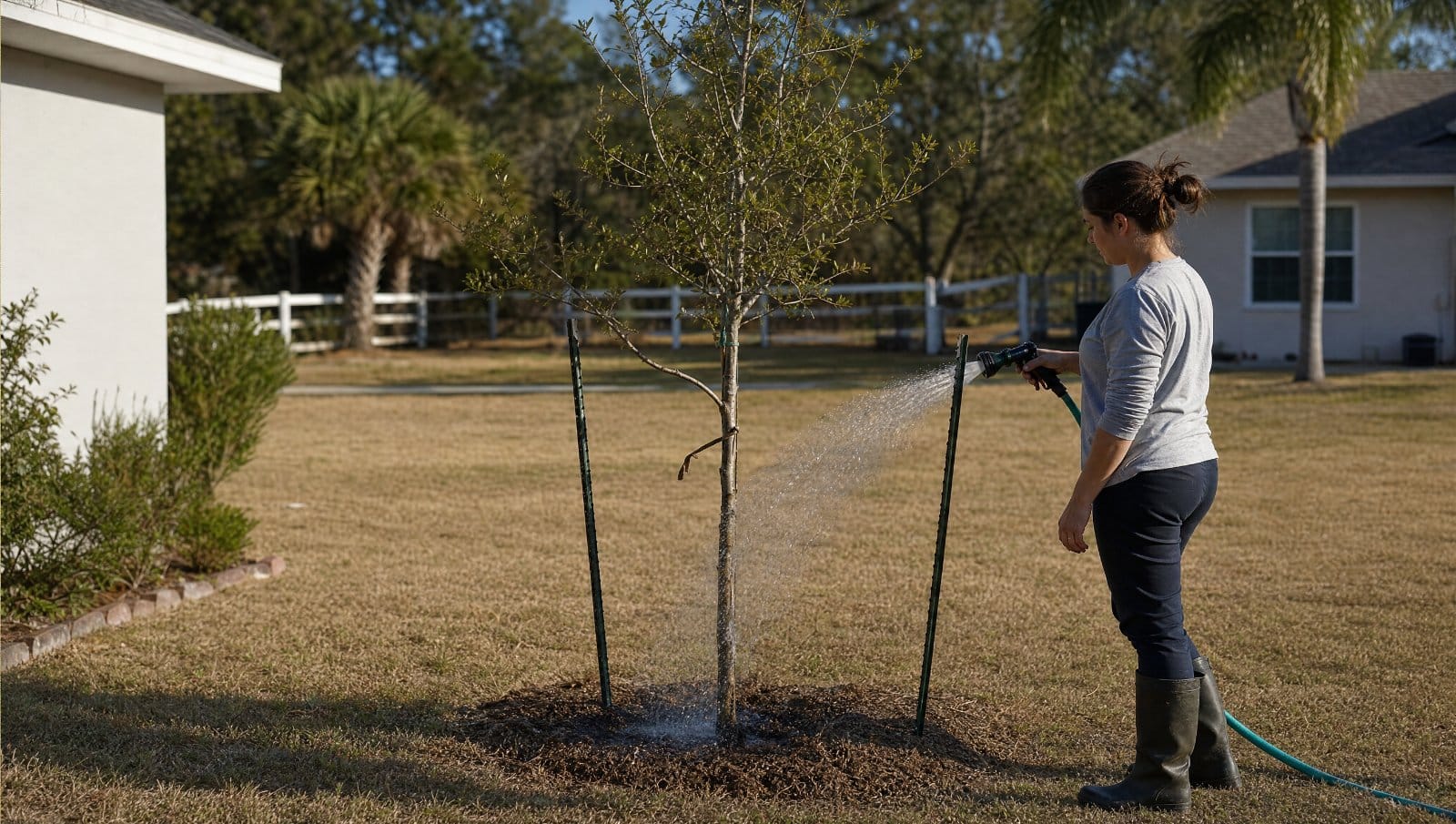
Young trees need deep, regular water through Florida droughts.
Tree Watering Drought Florida: How Much Your Trees Really Need
When the rain shuts off in spring and the ground goes crispy, a lot of Central Florida homeowners ask us the same thing: how much should I really be watering my trees? Good news — most established trees need far less than people think, and a little knowledge saves both water and worry. Smart tree watering during a Florida drought comes down to a few principles that fit our zone 9b heat and fast-draining sandy soil. Here’s a practical, honest guide for yards in Orange City, DeLand, Lake Mary, Sanford, Oviedo, and the wider Orlando area.
Why our sandy soil changes the watering game
Central Florida sits on sand that drains quickly. That sounds like a problem, but it actually shapes a simple rule: water deeply and infrequently rather than a little every day. A short daily sprinkle only wets the top inch or two, which dries out fast and trains roots to stay shallow — exactly what you don’t want when a dry spell hits.
A deep soak, by contrast, pushes moisture down to where the real roots live and encourages them to grow deeper, making the tree far more self-sufficient. In our soil, a slow, thorough watering once or twice a week beats daily light sprinkling every time.
Tree watering in a Florida drought: how much by age
The single biggest factor is how long the tree has been in the ground. Newly planted trees have tiny root balls and need help. Established trees have spread their roots wide and need very little.
Newly planted trees (first year)
This is when watering matters most. A young tree’s roots haven’t reached out yet, so it depends on you. A common contractor rule of thumb is about two to three gallons of water per inch of trunk diameter (caliper), applied at each watering:
- First couple of weeks: Water every two to three days.
- Rest of the first few months: Taper to once or twice a week.
- After that, through year one: Roughly weekly, adjusting down when summer rains take over.
Apply the water slowly right over the root ball and just past it, letting it soak in rather than running off across our sand.
Young trees (years two and three)
The roots are spreading now, so you can stretch the interval. A deep soak every week or two during a genuine dry spell is usually plenty. Pay attention to the tree, not just the calendar — wilting or curling leaves on a young tree means it’s time.
Established trees (three-plus years)
Here’s the part that surprises people: a well-established oak, maple, or pine in Central Florida often needs no supplemental water at all, even in a moderate drought. Their roots reach deep and wide. In an unusually long, harsh dry stretch, a deep soak every few weeks is a generous insurance policy — but daily watering of a mature tree is simply wasted water.
Water at the dripline, not the trunk
One of the most common mistakes we see is watering right against the trunk. A tree’s active feeder roots aren’t at the base — they’re out near the dripline, the imaginary circle on the ground beneath the outer edge of the canopy. That’s where your water should go.
A few ways to get water where it counts:
- Soaker hose: Loop it around the dripline and let it run slowly for an hour or so.
- Slow hose trickle: Move a slowly running hose around the root zone every fifteen minutes.
- Watering bags: For young trees, a slow-release bag delivers a deep soak over several hours with no runoff.
Mulch: the cheapest drought protection you have
A good mulch ring does more for a thirsty tree than almost anything else. Two to three inches of organic mulch over the root zone holds moisture in our fast-draining sand, keeps roots cooler through the July heat, and cuts down on competing weeds.
One important caution: keep mulch off the trunk. Piling it up against the bark — the so-called mulch volcano — traps moisture against the trunk and invites rot and pests. Spread it in a wide, flat doughnut with a few inches of bare space right around the base. A proper mulch ring can noticeably reduce how often you need to water at all.
How to tell if a tree actually needs water
Rather than guessing, read the tree and the soil:
- Check the soil: Push a screwdriver or your finger several inches into the ground near the dripline. If it’s dry down there, it’s time to soak.
- Watch the leaves: Wilting, curling, drooping, or unusually early color change are signs of drought stress.
- Mind the season: During our June-through-September rains, most trees need no help. The spring dry months and any long rain gap are when supplemental watering matters.
Keep in mind the St. Johns River Water Management District, covering Volusia, Seminole, and Orange counties, sets watering-day restrictions that can change seasonally, with short establishment exemptions for new plantings. Hand-watering a tree’s root zone is typically treated differently than sprinkler use, but it’s always worth checking the current rules for your address.
Frequently asked questions
Can I overwater a tree in a drought?
Yes. Constant daily watering in our sandy soil can keep the root zone soggy and starve roots of oxygen, leading to root rot. Deep and infrequent is healthier than frequent and shallow.
Do palms need different watering?
Newly planted palms need consistent moisture while they establish, but most mature palms common here are quite drought-tolerant once rooted in.
My established tree’s leaves are wilting — is it dying?
Usually not. Wilting is the tree’s way of conserving moisture. A deep soak at the dripline and a fresh mulch ring will typically perk it back up.
Not sure whether your trees are thirsty or just fine? LandTree can assess your specific trees, soil, and exposure and give you a straight answer — no upselling, just a clear watering plan. Reach out for a free, friendly consultation and we’ll help your trees ride out the dry season in good shape.