
Sanford Tree Removal Permit: Heritage Trees & Rules
Sanford Tree Removal Permit: Heritage Trees & Rules
You generally need a Sanford tree removal permit before taking down a healthy protected tree above the city’s size threshold — and Sanford takes its larger “heritage” trees and its historic district especially seriously. Dead, diseased, and genuinely dangerous trees usually qualify for an exemption, but for most mature shade trees in the city, the rule is: get approval before you cut.
The short version: Sanford protects mature and heritage trees over a defined trunk size, with extra scrutiny inside the historic district. Removal often comes with a replacement or mitigation requirement. Dead and hazardous trees are typically exempt. Confirm the current code for your address first.
We pull tree permits in Sanford regularly and know the rhythm of the city’s process — including the added care the historic district demands. Here’s how it works, and how we handle it so you don’t have to.

When a Sanford Tree Removal Permit Is Required
Sanford’s tree protection lives in the city’s land development code, and it generally works on the same DBH principle as the rest of Central Florida: a tree’s diameter at breast height (about 4.5 feet up the trunk) determines whether it’s protected. Above the city’s threshold, a healthy tree typically needs a permit to come down.
What makes Sanford distinct is its emphasis on heritage trees — the larger, older specimens that give neighborhoods like the historic district their character. Heritage and specimen trees face the strictest review and the biggest replacement requirements. The city is not eager to lose a grand oak, and the ordinance reflects that.
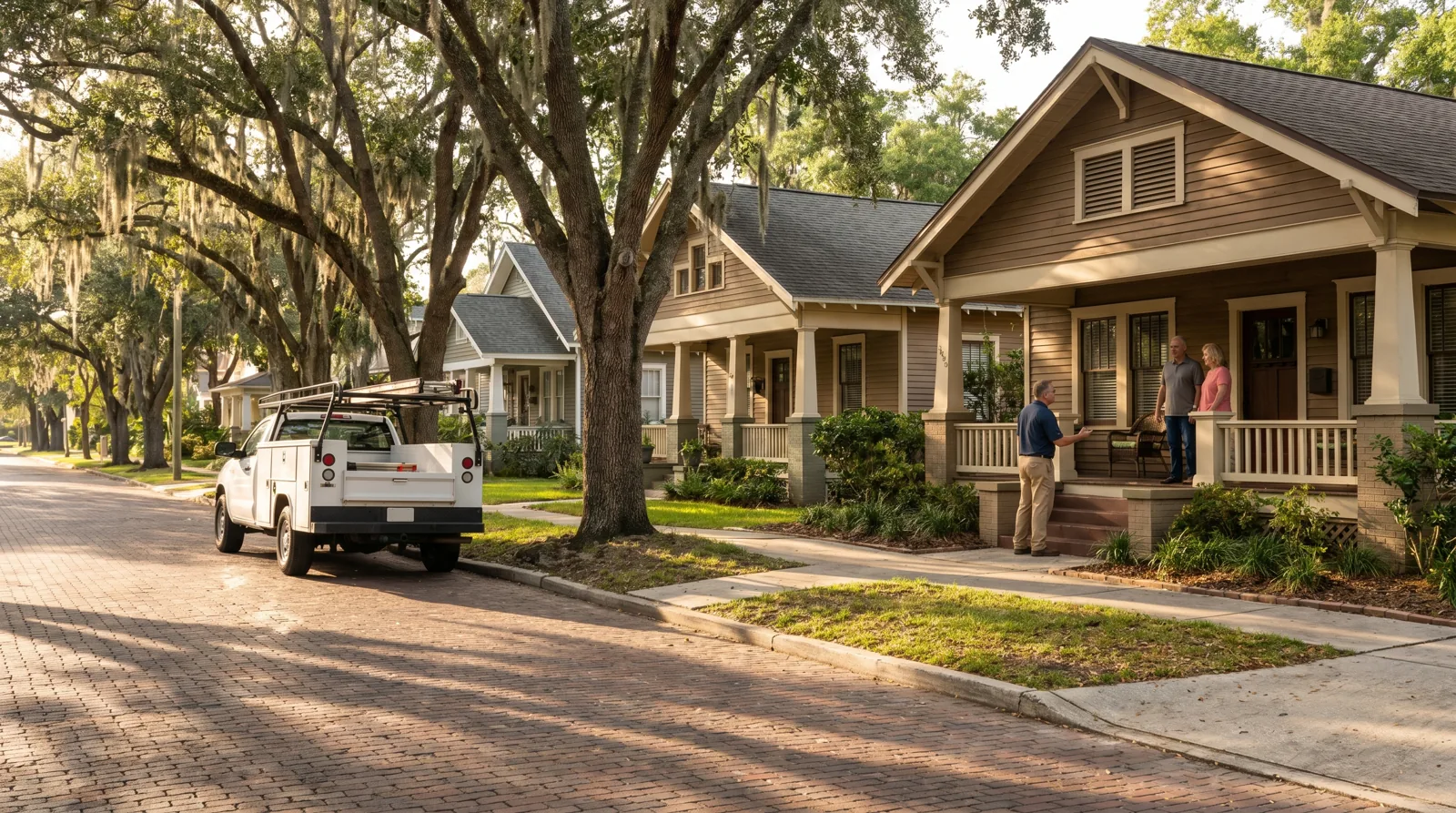
The historic district adds a second layer. Sanford’s downtown and surrounding historic residential areas can carry additional design and preservation review, and the trees there are part of the district’s protected character. A removal that might be routine elsewhere in the city can require extra steps inside the district. If your property sits in or near the historic district, assume the process is more involved — and plan accordingly.
Because thresholds, the heritage-tree definition, and historic-district procedures are set by the city and updated over time, the reliable move is to confirm the current rules against the City of Sanford permitting and development services before scheduling work. We verify this for every Sanford job, including whether the property falls inside the historic district.
What Triggers Mitigation
When you remove a protected tree in Sanford, the city commonly requires mitigation — replacement plantings of a specified size and number, or, where on-site replanting isn’t workable, a contribution to a tree fund. The general pattern across Central Florida cities is straightforward: the bigger the tree, the bigger the replacement obligation. Heritage trees, being the largest, carry the heaviest mitigation.
This is why removing one large oak in Sanford is rarely just “the cut.” We map out the mitigation up front so you understand the full commitment — tree plus replanting — before any saw runs.
Fees, Timeline, and Emergency Exceptions
Fees. Permit fees in Sanford vary and are updated periodically, so we don’t publish a hard dollar figure here that could be wrong by the time you read it. Instead, we confirm the current fee on the city’s applicable schedule for your specific removal. Treat any fee you see quoted online as a starting point to verify, not a fixed fact.
Timeline. A standard residential permit moves faster than a heritage-tree removal or anything inside the historic district, which may involve additional review. Building in lead time matters — especially if you’re trying to clear a tree before a project or before storm season. Booking the assessment early gives the process room to breathe.
Emergency and dead-tree exceptions. Here’s the relief valve homeowners most need to know: trees that are dead, diseased, or an imminent hazard — particularly after a storm — generally qualify for exempt or expedited removal, even in Sanford and even inside the historic district. The key is documentation. We photograph and record the tree’s condition before an emergency removal so there’s a clear, defensible record that the work was justified. That documentation is what keeps an emergency removal from turning into a code problem later.
We recently handled a storm-cracked laurel oak threatening a porch roof on a historic Sanford street. Because we documented the failure and the imminent danger, the removal proceeded under the hazard exception — fast, legal, and on the record. That’s the difference between knowing the process and guessing at it.
How DeAngelo’s Pulls the Permit for You
You don’t have to decode Sanford’s code or stand in line at city hall. When you call us, our ISA Certified Arborist:
- Identifies the tree and measures DBH to determine whether it’s protected or heritage.
- Checks whether your property is in the historic district and what extra review, if any, applies.
- Confirms the current fee and rules for your specific address.
- Prepares and submits the permit, including any required site plan or tree survey.
- Plans the mitigation so the replacement obligation is clear before work starts.
- Removes the tree safely and completes any required replanting or inspection — or, for a dead/hazardous tree, documents the condition and proceeds under the exemption.
For dead-tree and storm-related work across the broader area, see how we handle tree removal in Sanford. And if your project involves clearing more than a single tree, our land clearing in Sanford page covers larger jobs. To see how a neighboring Seminole County city handles the same process, our Oviedo tree permit guide breaks down that city’s rules step by step.
Frequently Asked Questions
Do I need a permit to remove a tree in Sanford?
For a healthy protected tree at or above the city’s size threshold, yes — generally you do. Heritage trees and anything in the historic district face the strictest review. Dead and hazardous trees usually qualify for an exemption, but confirm before cutting.
What is a heritage tree in Sanford?
A heritage tree is one of the larger, older, more significant trees the city singles out for the strongest protection. Removing one is harder to get approved and carries the heaviest replacement requirement. Many of Sanford’s grand oaks fall into this group.
Are the rules different inside the historic district?
Often, yes. Sanford’s historic district can add preservation and design review on top of the standard tree permit, so removals there can be more involved. We confirm whether your property is in the district and handle the extra steps.
Do I have to replant after removing a tree?
Frequently, yes. Sanford typically requires mitigation — replacement plantings or a tree-fund contribution — when a protected tree is removed, with larger trees carrying larger obligations. We plan this up front so there are no surprises.
Can DeAngelo’s handle the whole permit process?
Yes. We identify the tree, confirm the current code and fee, check the historic-district status, submit the permit, plan any mitigation, and do the removal — so you never have to navigate the city process yourself.
Removing a Tree in Sanford? Call (386) 675-2303
DeAngelo’s Land Services is a veteran-owned, BBB A+ rated, Google Guaranteed tree service with an ISA Certified Arborist on staff and a 5.0-star rating across 211+ reviews. We know Sanford’s heritage-tree rules and historic-district process, and we pull the permit, plan the mitigation, and do the removal safely and legally.
Before you take down that oak, let us confirm whether it’s protected and handle the city’s process for you.
Call us at (386) 675-2303 or request a free estimate online. Be sure to ask about our 10% veteran discount.
About the Author
Mark DeAngelo is an ISA Certified Arborist and the founder of DeAngelo’s Land Services in Lake Mary, Florida. A USAF combat veteran, Mark leads a BBB A+ rated, Google Guaranteed crew that handles tree removal and permitting for homeowners and businesses across Seminole, Volusia, and Orange counties — including Sanford and its historic district.