Clearing an Overgrown Lot in Florida: Permits & Species
Clearing an Overgrown Lot in Florida: Permits & Species
Overgrown lot clearing in Florida is not just “send in a machine and knock it down” — before a single palmetto comes out, you have to check for permits, protected species, and buried utilities, or you can land a fine that dwarfs the cost of the work. A neglected Florida lot fills in fast: palmetto, Brazilian pepper, smilax vines, scrubby oaks, pines, and a tangle of brush hiding everything underneath. Our crew clears lots like this across Volusia County every week, and the jobs that go smoothly all start the same way — with a little homework before the equipment shows up.
Before you clear an overgrown Florida lot, confirm the local clearing permit, check for gopher tortoises and wetlands, call Sunshine 811, and pick the right method — forestry mulching or grub-and-haul — for what you plan to build.
Here in Central Florida, that “homework” isn’t optional paperwork. We’ve got gopher tortoises (a state-protected species), wetlands tied to the St. Johns River Water Management District, specimen trees protected by local ordinances, and buried gas, water, and fiber lines. Skip a step and you’re looking at stop-work orders, restoration costs, or wildlife violations.

The Steps to Overgrown Lot Clearing, Done the Right Way
Every lot is different, but the order of operations rarely changes.
1. Define the scope and walk the property. Whole parcel, or just a building pad, driveway, and yard? Full clearing costs more and triggers more rules than a partial clear. We walk the lot with you, flag what stays (good shade trees, a road buffer, anything protected), and mark what goes. We recently took a half-acre Deltona lot that had gone to seed — palmetto chest-high, Brazilian pepper swallowing the back line — and it cleared up beautifully once the permits and tortoise survey were done first.
2. Check the permits. This is where the job gets Florida-specific. Most jurisdictions require a land clearing or tree removal permit before you disturb a vegetated lot, and the rules vary. Unincorporated Volusia County and cities like Deltona, DeLand, and Orange City each have their own land development codes. Specimen and historic trees (usually large oaks above a set trunk diameter, or DBH) are often protected even on a lot you own, and removing one without a permit can mean steep per-inch fines plus mandatory replacement trees. Wetlands and floodplain add a second layer of permitting through the water management district. We pull permits as part of the job so you’re not decoding an ordinance at the county counter, and our team handles this routinely for land clearing in Sanford and across the region.
3. Check for protected species — the gopher tortoise especially. This surprises most first-time lot owners. The gopher tortoise is protected under Florida law, and you can’t bulldoze a burrow. The lot has to be surveyed for active and inactive burrows; if tortoises are present, they generally must be relocated by a permitted agent under a state permit before any ground disturbance — not a same-day process. The FWC gopher tortoise permitting guidelines spell out what’s required, and wetland species, eagle nests, and scrub-jay habitat can carry their own protections too.
4. Call Sunshine 811 before any digging. Florida law requires you to call 811 (or submit online) at least two full business days before disturbing the ground. Sunshine 811 notifies the utilities, who mark the buried gas, electric, water, and communication lines. Grubbing without locating them first is how people hit a gas main. It’s free, it’s the law, and we do it on every job.
5. Clear with the right method, then finish. Once permits, species, and utilities are squared away, we clear (the method matters — more below), then grub roots, haul debris, and rough-grade, leaving the lot ready for a survey, a slab, or new sod.
Forestry Mulching vs. Grub-and-Haul: Picking the Method
The two main ways to clear an overgrown Florida lot fit different goals and budgets.
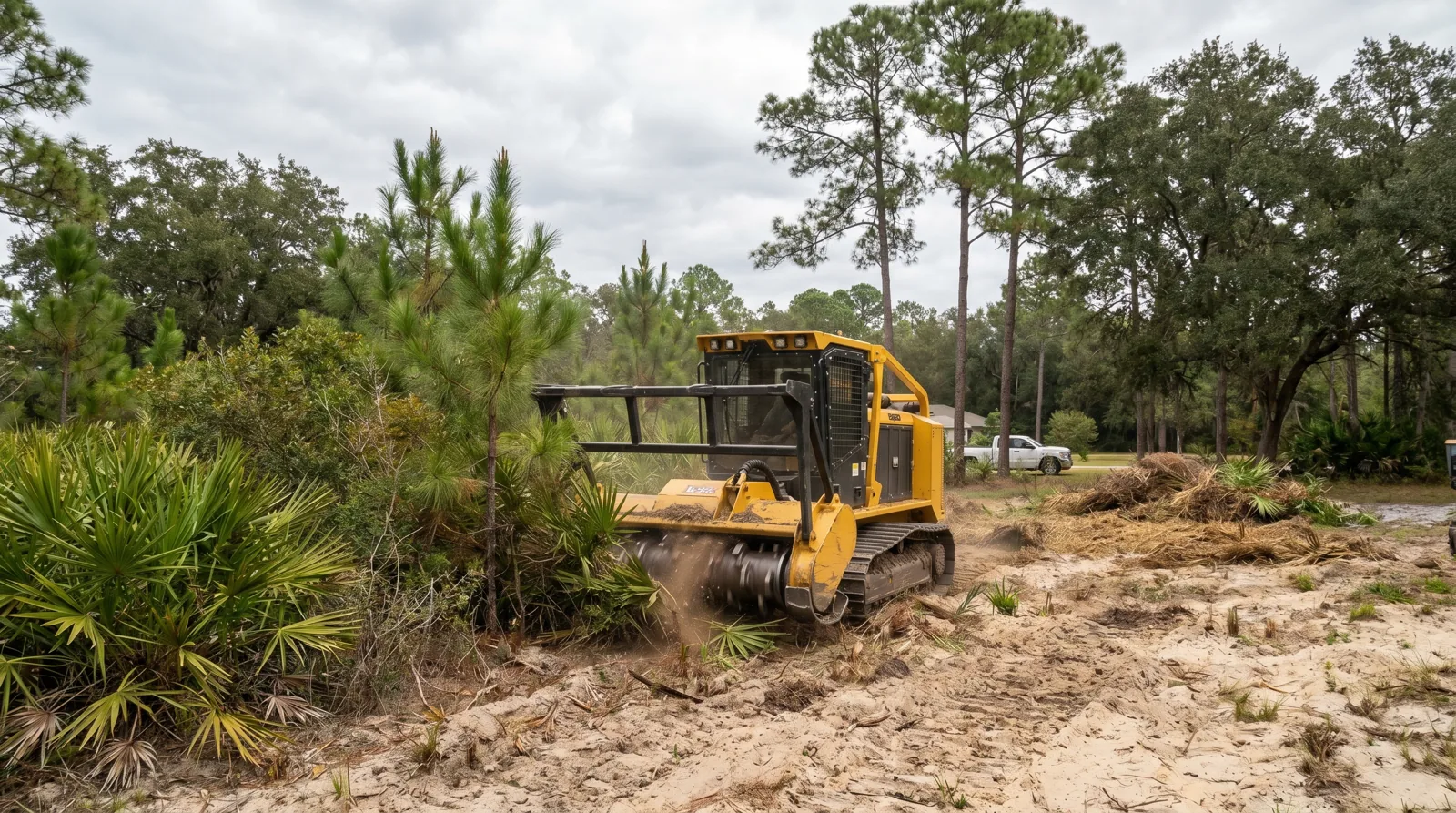
Forestry mulching uses one machine with a rotating drum to grind brush, palmetto, small trees, and undergrowth right into a layer of mulch left on the ground. It’s our go-to for selective clearing, trails, fence lines, fire-break work, and lots where you want to keep the larger trees. The advantages are real here: no hauling, no burn piles, and fewer truck trips, because the material stays on site as erosion-controlling mulch; far less soil disturbance, which keeps sandy Florida soil from washing out in the first thunderstorm; and it’s faster and often cheaper for brush and small-diameter growth. The limit is that it leaves roots and stumps in the ground, so it’s not for a clean building pad.
Grub-and-haul (conventional clearing) uses excavators and dozers to push, pull, and grub out everything — vegetation, stumps, and roots — and haul the debris off site. This is what you need when you’re pouring a foundation, driveway, or pad and need bare, compactable ground, or when you want the parcel completely cleared and graded. It costs more, disturbs more soil, and requires erosion control, but it delivers a true blank slate.
A lot of our Volusia County jobs end up a hybrid: mulch the understory, haul the trees that have to go, and grub only the building footprint. If you only need the boundary opened up rather than the whole parcel, see our guide to fence line clearing instead.
What drives the cost. We don’t quote lot clearing sight-unseen or throw a fake per-acre number at you, because honest pricing depends on what’s actually out there. The real drivers are lot size and density, what’s being removed (palmetto mulches fast, large trees and stumps don’t), method (mulching is generally cheaper than full grub-and-haul), access and terrain (a tight, wet, or fenced lot slows everything), permitting and protected-species work (surveys and relocation permits add cost and time), and disposal. The accurate way to know your number is to have us walk the lot — you’ll get an honest estimate based on what we see, not a guess.
Frequently Asked Questions
Do I need a permit to clear an overgrown lot in Florida?
Almost always, yes. Most Central Florida cities and counties require a land clearing or tree removal permit before you disturb a vegetated lot, especially if protected, specimen, or historic trees are present or the lot touches wetlands or floodplain. The threshold varies by jurisdiction — we check the local code and pull the permits as part of the job.
What is a gopher tortoise and why does it stop my project?
The gopher tortoise is a state-protected species that digs deep burrows in dry, sandy Florida uplands — exactly the kind of lot people want to clear. You can’t legally disturb an occupied burrow. The lot has to be surveyed, and if tortoises are present they generally must be relocated under a state permit by an authorized agent before clearing. Plan extra time for this.
What does Sunshine 811 do and when do I call?
It’s Florida’s free utility-locating service. By law you call (or submit online) at least two full business days before any digging or grubbing, and utility crews come mark the buried gas, electric, water, and communication lines. We place the ticket on every job.
Should I choose forestry mulching or full clearing?
Choose forestry mulching to keep the big trees, clear brush, and avoid hauling — it’s faster and easier on the soil. Choose full grub-and-haul if you need bare, buildable ground for a slab or driveway, since mulching leaves stumps and roots in place. Many lots get a hybrid.
How much does lot clearing cost in Volusia County?
It depends on size, density, what’s being removed, the method, access, permitting, and disposal, so we don’t quote a flat per-acre price sight-unseen. We’ll walk the lot and give you an honest estimate based on real conditions.
Get Your Overgrown Lot Cleared — Free Estimate
Whether it’s a quarter-acre choked with palmetto in Deltona or a multi-acre parcel you’re prepping to build on, our Central Florida crew handles the whole job: permits, protected-species coordination, 811, clearing, and grading. We’re veteran-owned, BBB A+ rated, Google Guaranteed, and 5.0-star rated across 211+ reviews from property owners throughout Volusia, Seminole, and Orange counties.
We also offer a 10% veteran discount on every service.
Call us at (386) 675-2303 or request a free estimate online. We’ll walk your lot, sort out the rules, and turn that overgrown tangle into usable ground.
About the Author
Mark DeAngelo is an ISA Certified Arborist and the founder of DeAngelo’s Land Services in Lake Mary, Florida. A USAF combat veteran, Mark leads a BBB A+ rated, Google Guaranteed crew trusted by hundreds of property owners across Seminole, Volusia, and Orange counties for land clearing, tree removal, and site prep.