Fence Line Clearing in Central Florida: Prep & Cost
Fence Line Clearing in Central Florida: Prep & Cost
Fence line clearing means removing the brush, vines, small trees, and roots along your property line so a fence crew can run a clean, straight, properly set fence — and in Central Florida it almost always needs to happen before the fence contractor ever shows up. A fence builder is not going to fight through smilax vines, palmetto, and volunteer cherry laurels to dig post holes. They need an open, level, accessible line. That prep work is exactly what our crew does across Deltona and the rest of the region.
Before a fence goes in, clear the line of brush and small trees, confirm your surveyed property line, call Sunshine 811 to mark buried utilities, and sort out any overhanging branches with the neighbor — in that order.
Around here, an unmaintained property line disappears under growth in a couple of seasons — by the time you decide to fence, you’ve got a green wall of brush hiding the boundary, the post holes, and whatever’s buried underneath. Getting it right means knowing where your line is, what’s legal to cut, and what utilities run along it before anybody swings equipment.

Why You Clear the Line Before You Fence
Clearing first isn’t busywork — it solves the problems that turn a simple fence job into an expensive headache. Here’s why our crews always handle the line before the fence crew arrives, and how we work it.
A clear line means a straight, correctly placed fence. Posts have to run along your actual boundary, and the installer needs to see and reach it. Brush in the way leads to crooked runs and posts set short of the line “to be safe.” Open the line and the fence goes in straight, plumb, and where it belongs.
Confirm the surveyed property line first. This prevents the worst fence disputes. You’d be surprised how often the “obvious” boundary — an old tree row, a worn path, a previous fence — is several feet off the legal line. If you have a recent boundary survey, we work to those pins. If you don’t, we strongly recommend a licensed surveyor flag the corners before a permanent fence goes in: clearing or fencing on the wrong side, even by a foot, can mean tearing it out and rebuilding, plus an unhappy neighbor. We’ll clear right up to the surveyed line, but we won’t guess at a boundary or clear onto a neighbor’s property without their say-so.
Call Sunshine 811 before any digging or grubbing. Property lines are exactly where buried utilities run — the side or rear easement often carries gas, electric, cable, fiber, or irrigation. Florida law requires a call to 811 (or an online ticket) at least two full business days before disturbing the ground. Sunshine 811 dispatches the utilities to mark their lines, and we wait for those marks before grubbing roots or pulling stumps. It’s free, it’s required, and it’s how you avoid cutting your own internet line on day one.
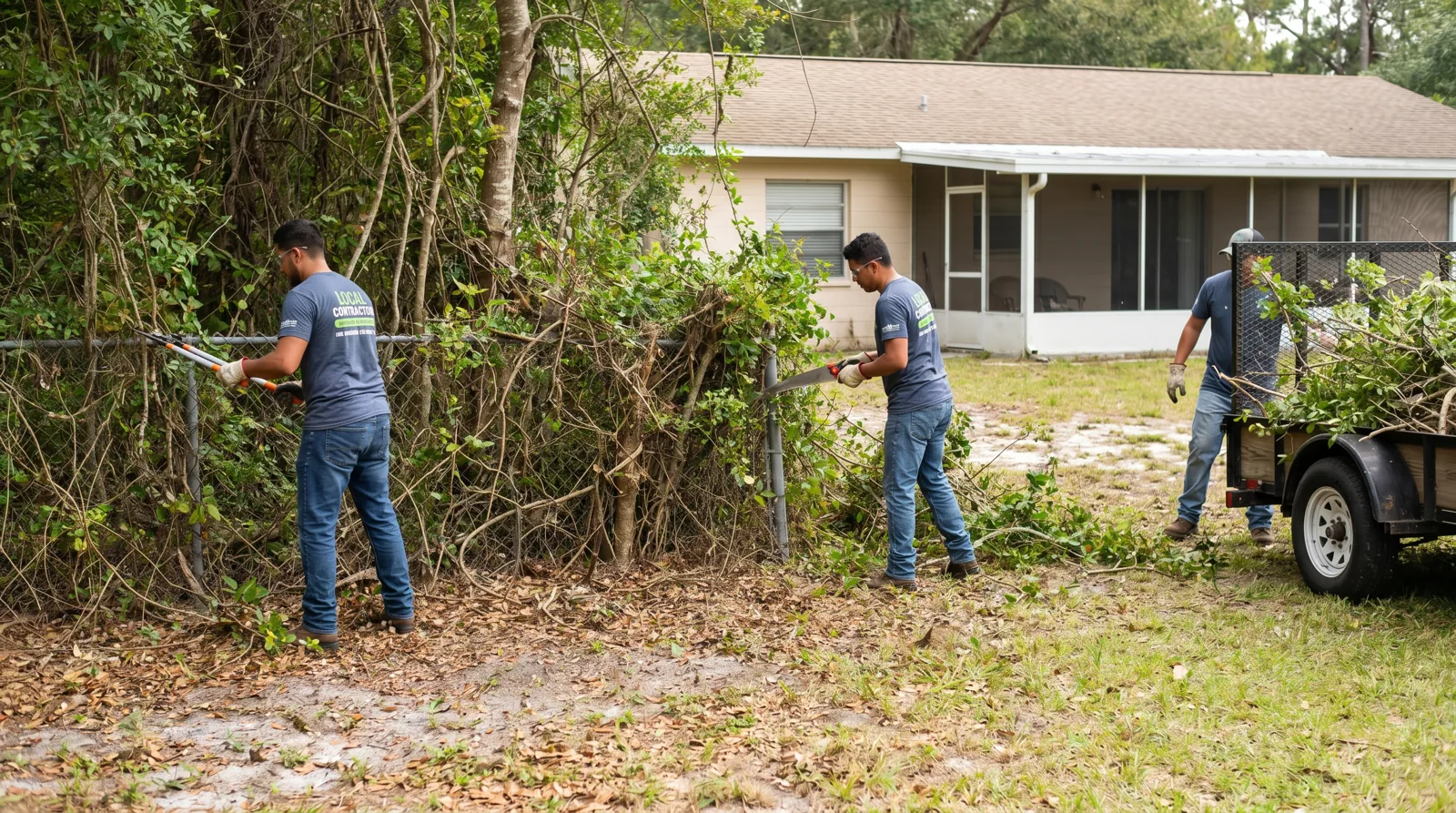
What we remove along a fence line. Once the boundary and utility marks are confirmed, out comes the brush and undergrowth (palmetto, scrub, weeds, and seedlings choking the line), the vines (smilax, Virginia creeper, and the ever-present Brazilian pepper, pulled and cut back so they don’t immediately reclaim the new fence), the small trees and saplings (volunteer cherry laurels, camphor, water oaks, and pines sitting right where posts need to go), and the roots and small stumps in the post path — so the installer can auger clean holes instead of hitting a root ball every six feet.
For heavier or wider clearing — a long rural line or a thickly wooded boundary — we may bring in the same equipment we use for land clearing in Sanford, or recommend the approach from our overgrown lot clearing guide if the whole parcel needs attention, not just the line.
Handle overhanging branches and the neighbor with etiquette. Fence lines are shared by definition. In Florida you’re generally allowed to trim a neighbor’s branches and roots back to the property line — but only up to the line, never crossing it, and never harming the tree’s health. Talk to the neighbor first if growth on their side affects the line; a heads-up beats a surprise. Don’t cut their tree down or top it from your side. And watch protected trees: large specimen oaks may be protected by city or county ordinance even along a fence line, so removing one can require a permit — when that comes up, we sort out the rules the way we do for any tree removal job before anything comes down.
We recently opened a back property line in Deltona that had vanished under smilax and volunteer cherry laurels — once the survey pins and 811 marks were confirmed, the fence crew set posts on a clean, straight line two days later. Handled right, that’s what you get: an open, marked, utility-safe boundary a fence crew can build the same week.
What Fence Line Clearing Costs in Central Florida
We won’t post a fake per-foot price, because honest fence line clearing cost depends on what’s actually growing on your line. The real drivers are the length (a 100-foot side yard versus a 600-foot rural boundary), the density and type of growth (light brush mulches fast; a wall of mature Brazilian pepper and saplings takes longer), trees and stumps in the post path (small saplings are quick, larger ones add time and equipment), the width to clear (just enough for the installer, or a wider mowed buffer), access (a tight, gated, or wet line is slower), and disposal (hauling versus mulching in place). The accurate way to price it is to have us walk the line — we’ll give you a real estimate based on what’s there, and time it to land right before your fence install so the line is fresh when the fence crew arrives.
Frequently Asked Questions
Do I need a survey before fence line clearing?
We strongly recommend one for any permanent fence. With a recent boundary survey, we clear to those pins. Without one, a licensed surveyor flagging the corners first protects you from clearing or fencing on the wrong side — a mistake that can mean tearing the fence out and rebuilding it, plus a dispute with the neighbor.
Do I have to call 811 just to clear a fence line?
Yes, if any digging, grubbing, or stump pulling is involved — which fence prep almost always is. Florida law requires an 811 ticket at least two full business days before disturbing the ground, and utilities frequently run in the easement along property lines. We place the ticket on every job.
Can I cut my neighbor’s branches that hang over the fence line?
In Florida you can generally trim a neighbor’s branches and roots back to your property line at your own expense, but you can’t cross the line and you can’t harm the tree’s health. You can’t cut their tree down or top it from your side. The neighborly move is to talk to them first, and remember that large specimen trees may be protected by local ordinance.
Will you remove the stumps and roots in the post path?
Yes. Clearing the brush is only half the job — if there are roots and small stumps where posts need to go, we grub them out so the installer can auger clean holes and leave you an open, dig-ready line.
How wide do you clear for a fence?
Usually just enough for the crew to work the line and set posts cleanly. Want a wider mowed buffer or a maintained strip on your side? We can clear that too — tell us the width and we’ll factor it into the estimate.
Get Your Fence Line Cleared Before the Fence Goes In — Free Estimate
If you’re planning a fence in Deltona, DeBary, Orange City, Lake Mary, or anywhere across Central Florida, let us open the line first so your fence crew can build it straight and fast. We’re veteran-owned, BBB A+ rated, Google Guaranteed, and 5.0-star rated across 211+ reviews from property owners throughout Volusia, Seminole, and Orange counties.
We also offer a 10% veteran discount on every service.
Call us at (386) 675-2303 or request a free estimate online. We’ll walk the line, confirm the boundary, place the 811 ticket, and clear it clean — right on schedule with your fence install.
About the Author
Mark DeAngelo is an ISA Certified Arborist and the founder of DeAngelo’s Land Services in Lake Mary, Florida. A USAF combat veteran, Mark leads a BBB A+ rated, Google Guaranteed crew trusted by hundreds of property owners across Seminole, Volusia, and Orange counties for land clearing, brush removal, and fence-line prep.