
Hurricane-Season Yard Prep: 7 Things to Do This Week
Hurricane-Season Yard Prep: 7 Things to Do This Week
Florida hurricane season runs June 1 through November 30, but the smart prep window closes a lot earlier than people think. By the time a named storm is in the Gulf, the certified arborists are booked solid, the box stores are out of tarps, and your last chance to clear a French drain is gone.
I am Mark DeAngelo, owner of Deangelos Land Services in Lake Mary and an ISA Certified Arborist. We have worked every Central Florida storm season since 2018 — including Hurricane Ian in 2022 and the Helene/Milton one-two punch in fall 2024. The yards that came through with the least damage all had one thing in common: somebody walked the property before the storm season, not after the cone showed up on TV. Here are the seven things I would do this week.
1. Get a real tree inspection by a certified arborist
Not “my neighbor looked at it.” A real inspection. An ISA Certified Arborist is trained to spot the failures that drop a tree in 70-mph gusts — included bark unions, decay pockets at branch crotches, root plate movement, fungal conks at the base, and the silent killer in Central Florida: a leaning live oak with a saturated root zone.
Our pre-storm inspection walks every significant tree, photographs concerns, and gives you a written list of what to address and in what order. Lake Mary, Heathrow, and Markham Woods have hundreds of mature live oaks that simply cannot be evaluated from the curb. If you have any tree over 30 feet within striking distance of a roof, this is the first call you should make. Our tree care services page has the details.
2. Trim weak limbs and do honest pre-storm pruning
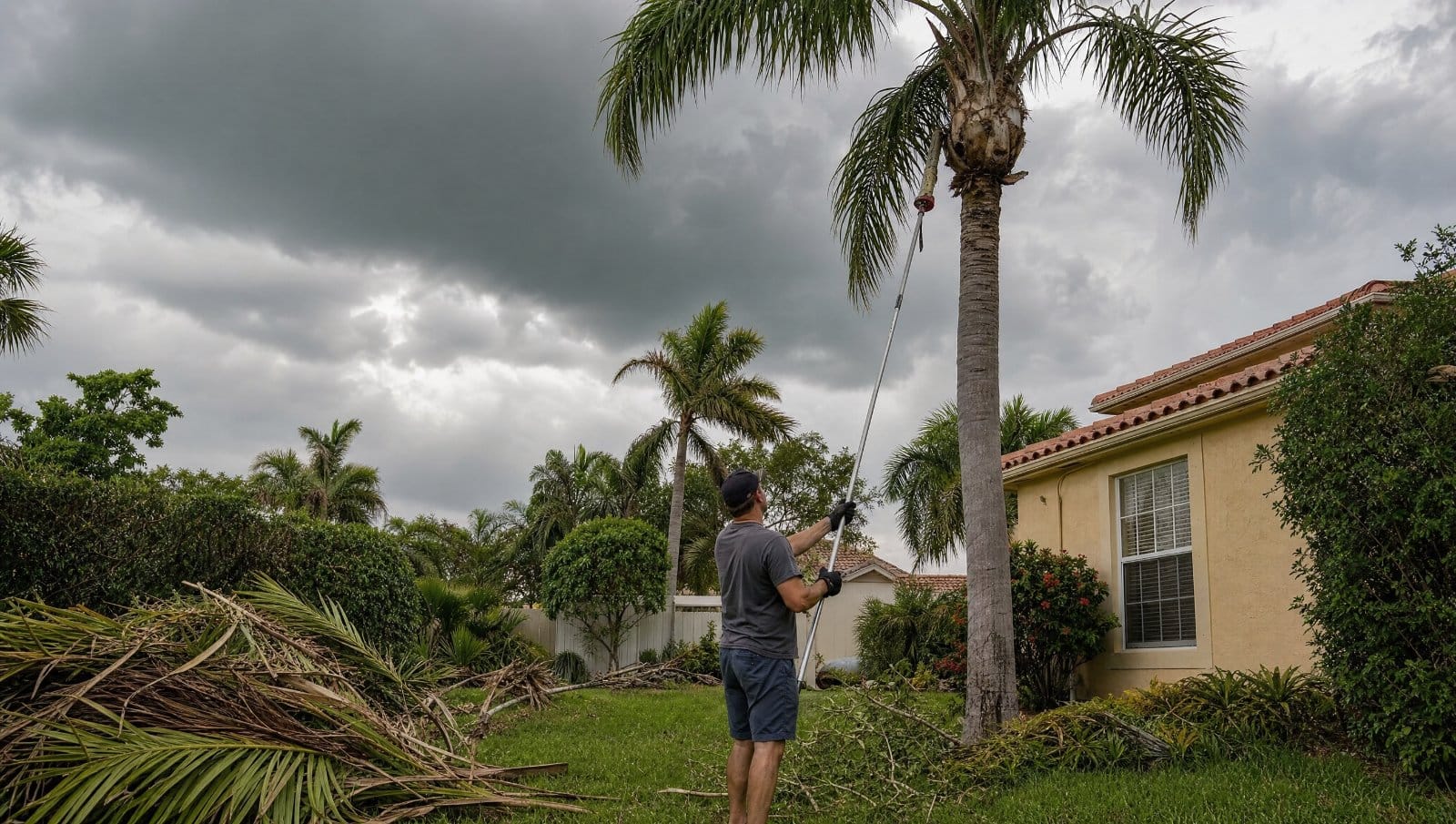
This is not cosmetic shaping. This is structural reduction — removing dead limbs, end-weight on long laterals, and any branch that crosses or rubs another. A properly pruned tree lets wind pass through it instead of catching it like a sail. What you should not do: “hat-rack” a live oak by topping it. That move makes the tree more dangerous in the next storm because the regrowth is weakly attached. Pre-storm pruning is a scalpel, not a chainsaw.
3. Secure loose hardscape and yard furniture
Walk the property looking for anything that becomes a missile at 80 mph. Pavers stacked behind the shed. The metal chiminea. The bird bath. The 5-gallon planter that was “fine last year.” Anchor it, store it, or get rid of it. While you are out there, check that your hardscaping is in good repair — loose pavers, lifting retaining wall blocks, and cracked stepping stones are exactly what wind and floodwater exploit.
4. Clear every drainage system you have
Central Florida storms drop water in volumes that catch people off guard — Helene dumped over 10 inches in parts of Volusia County in a single day. If your French drains are clogged, your downspouts run into nothing, or your yard grades back toward the foundation, that water has to go somewhere. Usually it goes into your living room.
Pull every gutter guard, jet the downspouts, walk the swales, and confirm your landscape drainage system is open end-to-end. If you cannot remember the last time anyone serviced it, assume it needs service.
5. Document the landscape with photos for insurance
This one takes 15 minutes and saves homeowners thousands every season. Walk the property with your phone, take wide shots and close-ups of every tree, every bed, every hardscape feature. If a storm takes out a 40-year-old live oak, your adjuster is going to ask what it looked like before. “Big and healthy” is not an answer. A timestamped photo is. Save them to the cloud — do not leave them only on the phone that might be underwater in three months.
6. Refresh mulch — thin, not thick
Counter-intuitive one. A 2-inch layer of properly applied mulch protects roots and holds the bed together in heavy rain. A 6-inch layer of fresh, dry mulch will blow halfway down your street in the first squall band and clog every storm drain it touches. Refresh, but go thin. Pull it away from trunks.
7. Test your sprinkler shutoff
Before the storm, you want to know exactly where the irrigation main valve is and that it actually turns. After the storm, with power out and broken heads spraying everywhere, you do not want to be learning. While you are at it, photograph the controller settings so you can restore them quickly when power comes back.
A short note on what to do AFTER the storm
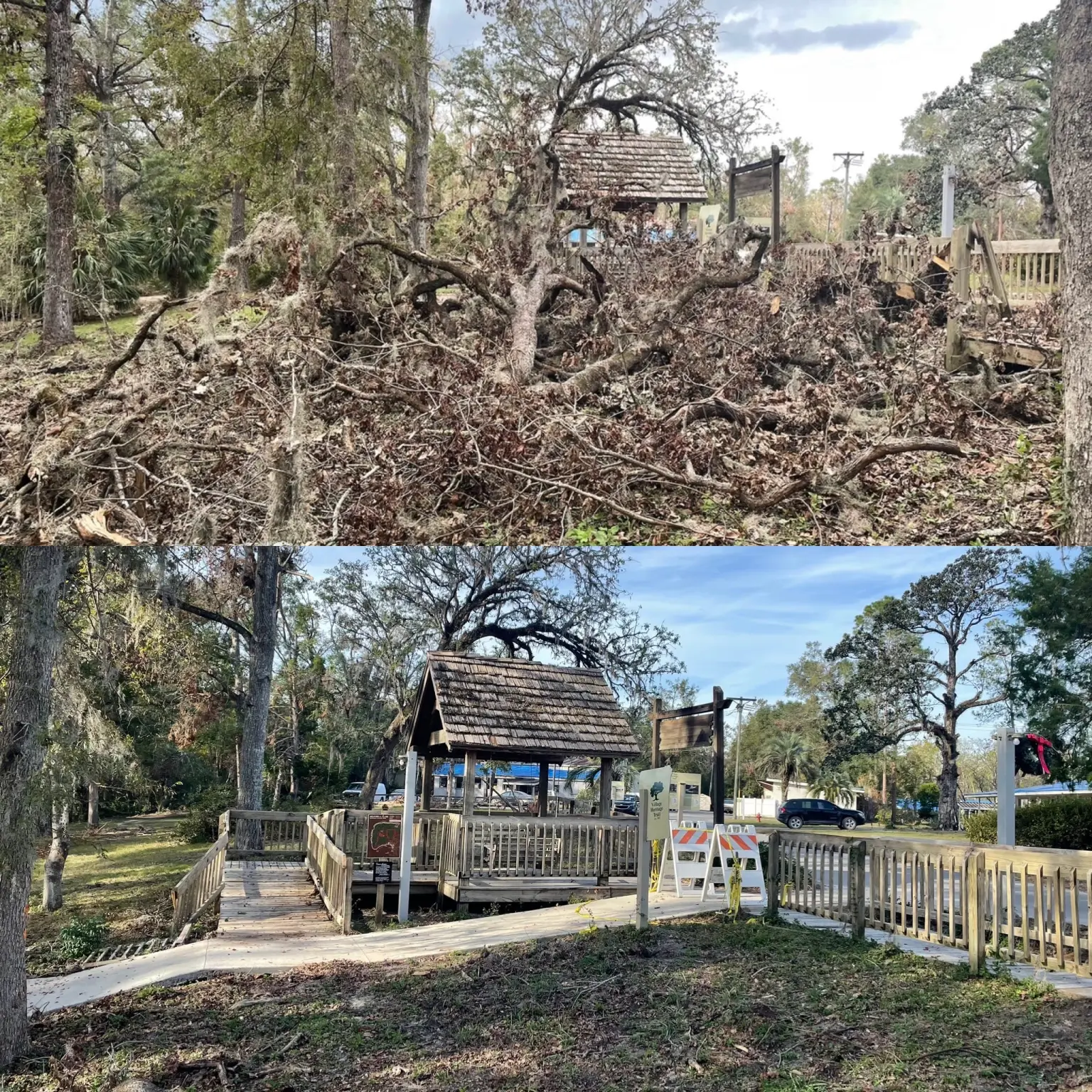
The first 24 hours after a hurricane are dangerous in ways that surprise people. Do not touch downed limbs near power lines — period. Do not climb on a tree on your roof. Do not crank up a chainsaw at 6 a.m. without eye and chap protection. Take photos of every damaged tree and structure before you move anything, because moving it changes the insurance conversation. Then call a licensed and insured crew for the heavy work — that is exactly what our storm damage cleanup services team is for. We were on the road clearing driveways within hours after Milton and we will be ready again.
You do not have to do this alone
Lake Mary and Central Florida throw harder hurricane seasons at us than most of the country sees in a decade. The yards that come through it best are the ones somebody actually prepared. If you want our crew to walk your property, do a pre-storm arborist inspection, clear your drains, and handle the pruning before June, give us a call at (386) 675-2303. Family-owned since 2018, licensed and insured, ISA Certified Arborist on staff, 10% Veteran Discount on every service. Get on our pre-season schedule and you will sleep better the next time a cone shows up on the news.