
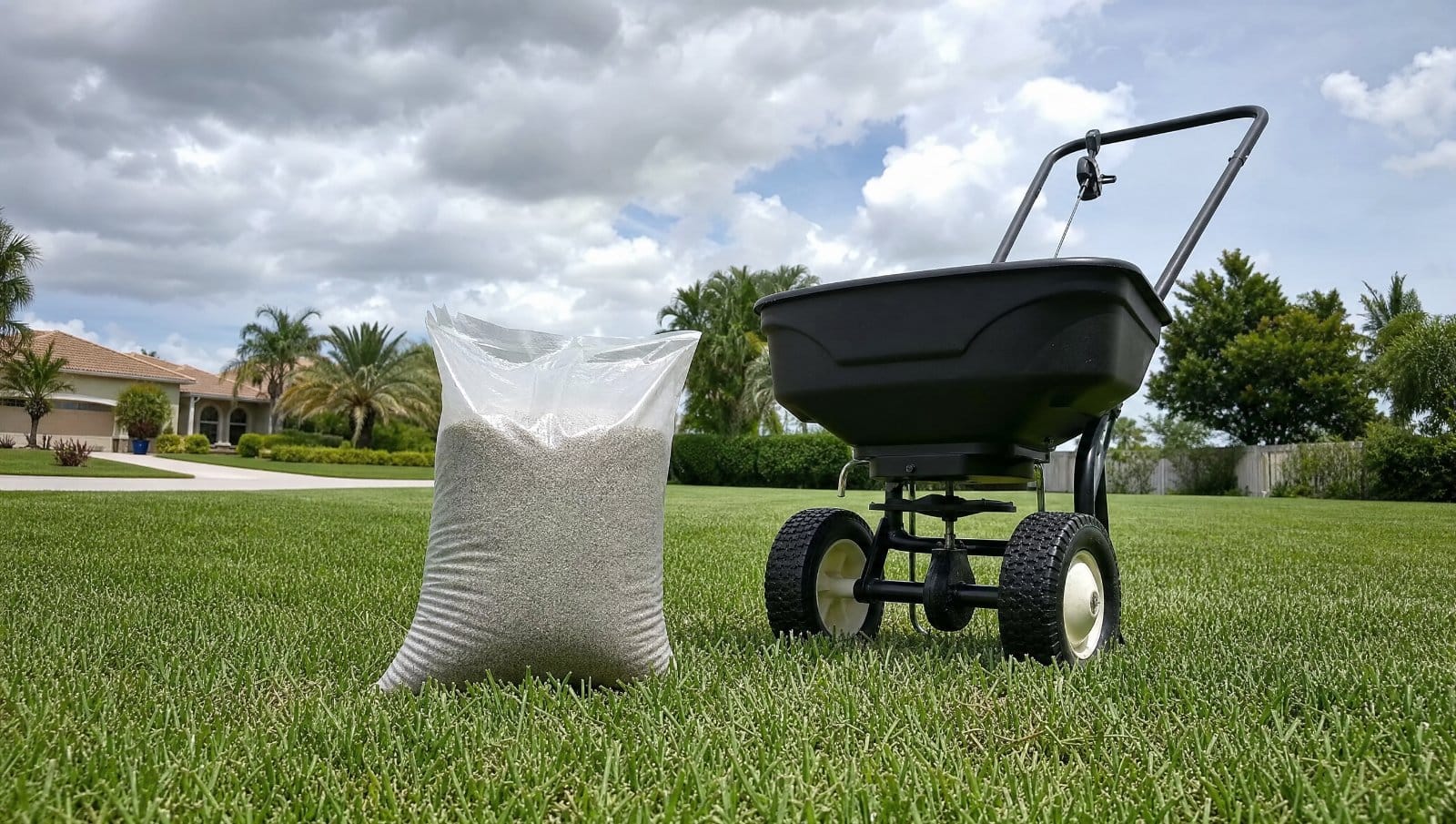
Many Central Florida counties restrict fertilizer in the rainy season.
Florida Summer Fertilizer Ban: What the Blackout Means for Your Lawn
If you live in Central Florida, you may have noticed the fertilizer aisle thins out every summer, and a lot of homeowners wonder why their usual bag of lawn food suddenly carries a warning. That is because of the Florida summer fertilizer ban, a set of county ordinances that restrict nitrogen and phosphorus fertilizer during our heaviest rain months. We work in lawns across Volusia, Seminole, and Orange counties every week, and the rules genuinely differ from one county line to the next. This guide explains what the blackout actually requires, what you can still apply, and how to keep your turf healthy without breaking the rule.
The short version: in the three counties we serve most, the restricted season runs June 1 through September 30. During that window, you cannot apply lawn fertilizer that contains nitrogen or phosphorus to your turf. The details below come straight from each county’s own ordinance pages, which we have linked so you can read them yourself.
Why the Florida summer fertilizer ban exists
This is not a random bureaucratic rule. Central Florida summers bring intense afternoon storms that can drop two or three inches of rain in an hour. Our soils are sandy and fast-draining, so nitrogen and phosphorus do not stick around in the root zone the way they would in heavy clay. Instead, a hard rain washes excess nutrients off the lawn, into storm drains, and out to lakes, the St. Johns River, our springs, and the Indian River Lagoon.
Once those nutrients reach the water, they feed algae blooms. State and university scientists have linked nutrient-driven blooms to fish kills, seagrass loss, and manatee starvation in the lagoon and to declines in some of our springs (see UF/IFAS, Effects of Urban Fertilizer Ordinances on Water Quality). The blackout simply lines up with the time of year when fertilizing is most likely to feed the water instead of your grass. As a contractor, we will be honest with you: applying nitrogen right before a summer downpour is also a waste of your money, because most of it leaves before the roots can use it.
The rules county by county
Here is where it pays to know exactly which jurisdiction you are in. Note that several cities run their own ordinances, which we cover below.
Volusia County (DeLand, Orange City, and most unincorporated areas)
- Restricted season: June 1 through September 30, plus any time a flood watch is in effect or soils are saturated. No nitrogen or phosphorus fertilizer on turf.
- Off-season nitrogen: Nitrogen may be applied October 1 through May 31, and it must contain at least 50% slow-release.
- Phosphorus: Not allowed unless a soil or tissue test verifies a deficiency.
- Water buffer: Keep fertilizer at least 15 feet from any water body.
This is County Ordinance 2014-09 (source: volusia.org Fertilizer Ordinance page). Important: some cities, including Deltona, are carved out and run their own ordinances, so if you live inside city limits, confirm with your city.
Seminole County (Lake Mary, Sanford, Oviedo, and unincorporated areas)
- Restricted season: June through September. No nitrogen or phosphorus fertilizer on lawns.
- Slow-release nitrogen: When you do feed in the application season, choose a fertilizer with at least 65% slow-release nitrogen per the Guaranteed Analysis on the label.
- Summer blends allowed: Iron and micronutrient “summer blends” (zero nitrogen, zero phosphorus) are permitted during the ban to green up the lawn.
- Phosphorus: The middle number on the bag should be 0 unless a soil test justifies it.
- Water buffer: Keep fertilizer 15 feet from ponds, lakes, canals, streams, and wetlands, and do not fertilize within 24 hours of heavy rain.
Source: Seminole County Fertilizer Ordinance page.
Orange County (Apopka, Orlando metro, and unincorporated areas)
- Restricted season: June 1 through September 30. No nitrogen on turf during this window.
- Phosphorus: Banned year-round (unless a soil test shows a deficiency).
- Off-season nitrogen: Outside the restricted season, nitrogen fertilizer must be at least 65% slow-release.
- Annual cap: No more than 3 pounds of nitrogen per 1,000 square feet per year.
- Water setback: Keep fertilizer at least 25 feet from natural water bodies, a wider buffer than the neighboring counties.
Source: Orange County newsroom announcement.
What you can still do during the blackout
The ban is not a sentence for a brown lawn. A healthy zone 9b lawn can coast through the summer with a few smart moves. Here is what we recommend to our own clients:
- Apply an iron supplement. Products with iron and other micronutrients but zero nitrogen and zero phosphorus are legal during the ban and give St. Augustine and zoysia a deep green color without pushing the growth that nitrogen would.
- Mow high and leave the clippings. Cutting at the higher end of your grass type’s range shades the soil and recycles nutrients back into the lawn for free. This matters more in summer than at any other time.
- Fix the problem, not the symptom. A yellowing summer lawn is often chinch bugs, fungus from our humidity, or a watering issue rather than a fertilizer shortage. Diagnosing correctly saves you a fall full of repair work.
- Plan your October application now. The blackout lifts October 1. A correct, slow-release feeding then sets the lawn up for the cooler, drier months when grass can actually use the nutrients.
Frequently asked questions
Does the ban apply to my landscape beds and trees, or just the lawn?
The ordinances are written primarily around turf, but the no-phosphorus and water-buffer rules generally apply across the landscape. Vegetable gardens and compost are typically exempt. Because the language varies, check your county page or ask us.
My city is not listed above. How do I find my exact rule?
Several cities run their own ordinances that can differ from the county. The fastest way to confirm your address-specific rule is the UF/IFAS Florida fertilizer ordinance lookup tool at ffl-apps.ifas.ufl.edu/fertilizer. When in doubt, call your city’s stormwater or public works office.
What happens if I fertilize during the ban?
Enforcement varies, and most counties lead with education, but ordinances do allow penalties. The bigger cost is usually wasted product and feeding the next algae bloom. We treat compliance as the baseline of doing this work right.
Let us keep your lawn green and compliant
The Florida summer fertilizer ban is one of those rules that is easy to follow once you know exactly what your county requires and what your specific lawn actually needs this time of year. As a veteran-owned company working right here in Volusia, Seminole, and Orange counties, we build summer lawn programs around the blackout, not against it. If you would like a free, no-pressure estimate for a summer-safe lawn plan tailored to your address and grass type, reach out to LandTree and we will walk your yard with you.