
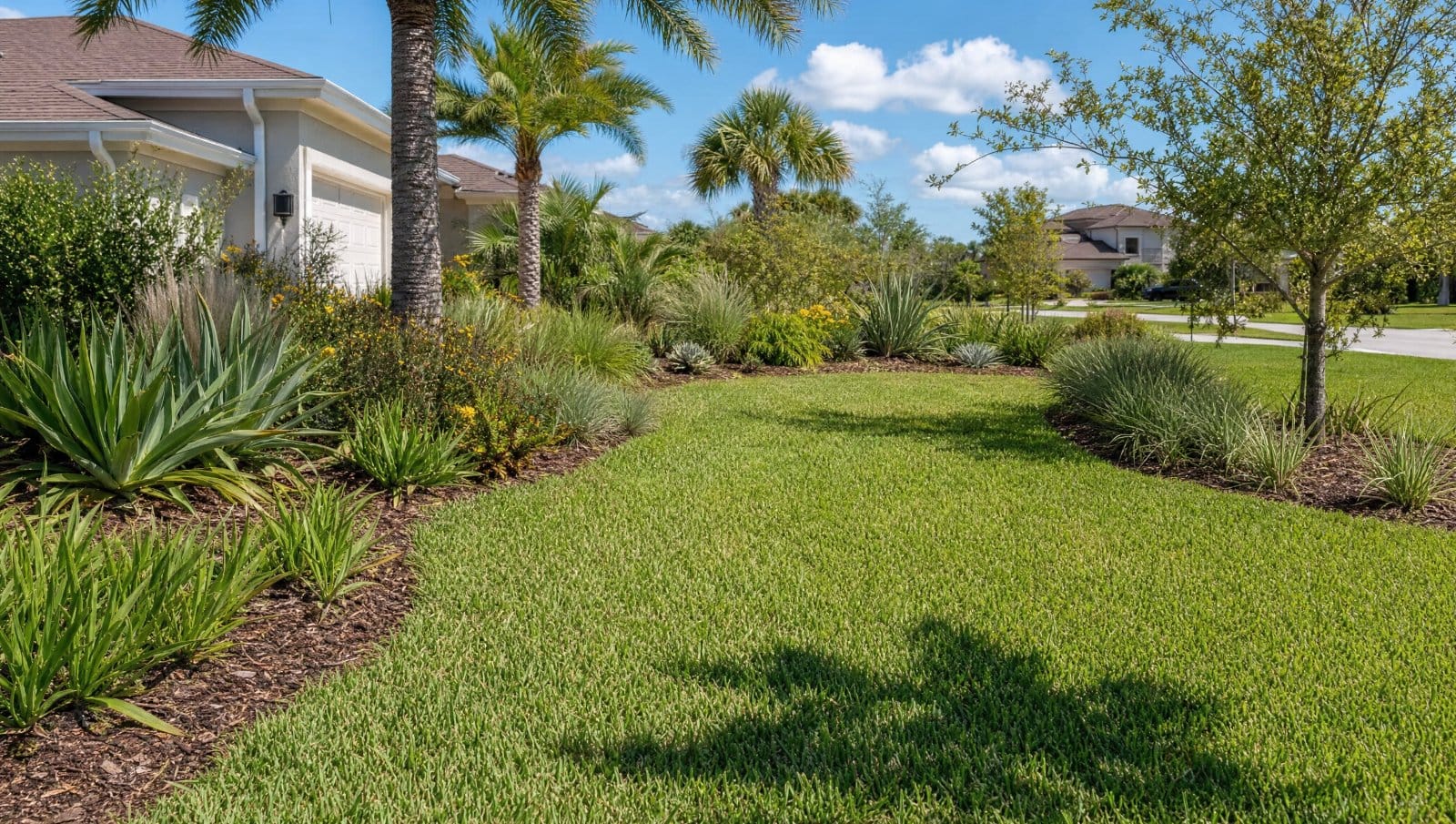
Drought-tolerant turf and plants slash summer water bills.
Drought Tolerant Lawn Florida: Best Low-Water Yard Alternatives
If you’re tired of dragging a hose around all summer, fighting brown patches, and watching your water bill climb, you’re not alone. A drought tolerant lawn in Florida isn’t a fantasy — it’s a smart, realistic goal for Central Florida yards in Orange City, DeLand, Lake Mary, Sanford, Oviedo, and across the Orlando metro. The trick is choosing the right groundcovers and turf for our zone 9b heat, sandy soil, and feast-or-famine rain pattern. Here’s what actually works.
Why Central Florida lawns struggle with water
Our soil is the first thing to understand. Most yards here sit on fast-draining sand that holds very little moisture. After a heavy August downpour, the top few inches dry out within a day or two. Add zone 9b heat, long daylight, and the standard summer pattern of soaking rain in June through September followed by a genuinely dry spring, and you get turf that’s either drowning or parched.
Standard St. Augustine grass — the default in most local sod jobs — is thirsty. It looks lush when it’s watered, but it’s the first thing to brown out when the rain stops and watering-day restrictions kick in. Choosing plants suited to our conditions is the difference between a yard that survives a dry spell and one that needs constant babysitting.
Building a drought tolerant lawn in Florida: your real options
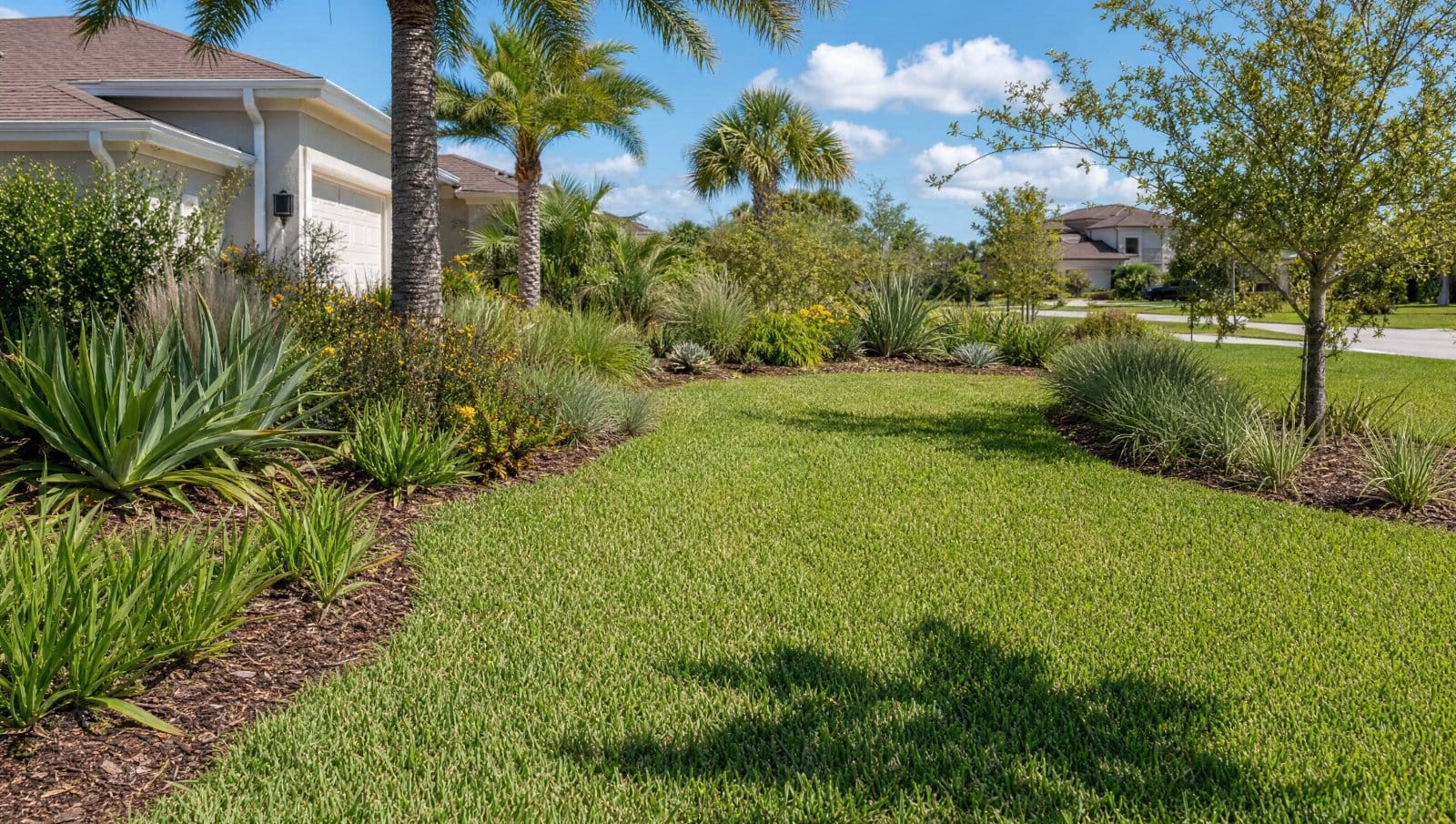
You don’t have to rip out every blade of grass. Most of the homeowners we work with land somewhere in the middle — a tougher turf in the play areas, low-water groundcovers in the spots that never looked good anyway, and mulched beds where grass was always a losing battle.
Tougher turfgrasses
If you want the look and feel of a traditional lawn with less water, switch the species:
- Bahiagrass: Deeply rooted and famously low-maintenance. It goes a little tan in a true drought, then bounces back fast. Great for larger, sunny lots where perfection isn’t the goal.
- Zoysiagrass: Dense, fine-textured, and handsome. It needs less water than St. Augustine once established and tolerates moderate foot traffic well.
- Bermudagrass: Extremely drought- and heat-tough for full-sun areas, though it wants regular mowing and full sun to look its best.
Native and adapted low-water groundcovers
For areas where you’d rather skip mowing entirely, groundcovers shine. These thrive in our sand and shrug off heat. A couple are true Florida natives and a couple are well-adapted introductions — we’ve noted which is which so you can plant with eyes open:
- Sunshine mimosa (powderpuff): A Florida native that spreads into a soft green carpet with pink puffball blooms, and it fixes its own nitrogen.
- Frogfruit (matchweed): A low, spreading Florida native that handles sun, light shade, and dry spells while feeding pollinators.
- Beach sunflower: A Florida native made for sandy, hot, sunny spots — it blooms nearly year-round with almost no help.
- Perennial peanut: A tough, mat-forming groundcover with cheerful yellow flowers. It’s a well-behaved South American introduction rather than a native, but once rooted it needs almost no irrigation and tolerates light foot traffic.
- Asiatic jasmine: A non-native, dense, glossy, evergreen mat that smothers weeds and asks for very little once established. Excellent under trees where grass refuses to grow.
Ornamental grasses, sedges, and mulched beds
For soft, meadow-like texture with minimal water, lean on the right low-water ornamental grasses and true sedges rather than marsh plants. Muhly grass (Muhlenbergia capillaris) is a Florida-native bunchgrass that throws clouds of pink in fall and asks for almost nothing once established — an excellent fine-textured choice for dry, sunny spots. If you specifically want true sedges, look to drought-adapted Carex species suited to your light; just match each one to its moisture preference, since sedges vary widely. One plant to skip for a low-water lawn is sand cordgrass (Spartina bakeri): despite the name it’s a coarse grass in the family Poaceae — not a sedge — and it grows into a tall four-to-five-foot clumping bunchgrass that naturally prefers moist or marshy ground, so it’s a poor fit for a dry, manicured yard.
And don’t underestimate a simple mulched bed: two to three inches of pine bark or pine straw over a few well-chosen shrubs cuts water use dramatically, suppresses weeds, and keeps roots cool through our brutal July afternoons.
The Florida-Friendly Landscaping approach
The University of Florida’s Florida-Friendly Landscaping principles are the backbone of any good low-water yard here. The core ideas are simple and they work:
- Right plant, right place: Match each plant to its sun, soil, and moisture needs so it can mostly take care of itself.
- Group by water need: Cluster thirstier plants together so you’re not over-watering tough ones to keep one fussy plant alive.
- Build the soil: Work compost into planting areas to help our sand hold moisture a little longer.
- Mulch generously: It’s the cheapest water-saving tool you own.
A quick note on watering rules: the St. Johns River Water Management District, which covers Volusia, Seminole, and Orange counties, typically limits lawn irrigation to set days each week, and the schedule can shift with the season. New plantings usually get a short establishment exemption. Always check the current restrictions for your address before you set a sprinkler timer.
How to transition without starting over
You don’t have to redo everything in one weekend. A phased plan keeps costs down and gives plants time to establish:
- Start with the worst-performing zones — the dry strip by the driveway, the shady patch under the oak, the slope that always washes out.
- Plant groundcovers and shrubs at the start of our rainy season so summer storms help them root in.
- Water new plantings deeply but briefly while they establish, then taper off as they take hold.
- Expand into new areas each season as you see what’s working.
Frequently asked questions
Will a low-water lawn look worse than my St. Augustine?
Different, not worse. Many homeowners actually prefer the texture and year-round color of mixed groundcovers and tougher turf, especially when they realize how little maintenance it takes.
Is sandy soil a problem for these plants?
It’s actually an advantage for most drought-tolerant species — they evolved for exactly these conditions. The plants that struggle in our sand are the thirsty ones, not the tough ones.
How long until a new groundcover fills in?
Most spreading groundcovers knit together within one to two growing seasons here, faster if they’re planted heading into the summer rains and kept weeded while young.
Ready to spend fewer weekends on the hose and more enjoying your yard? LandTree can walk your property, read your soil and sun, and map out a phased, low-water plan that fits how you actually live. Reach out for a free, no-pressure estimate and we’ll show you what’s possible.