
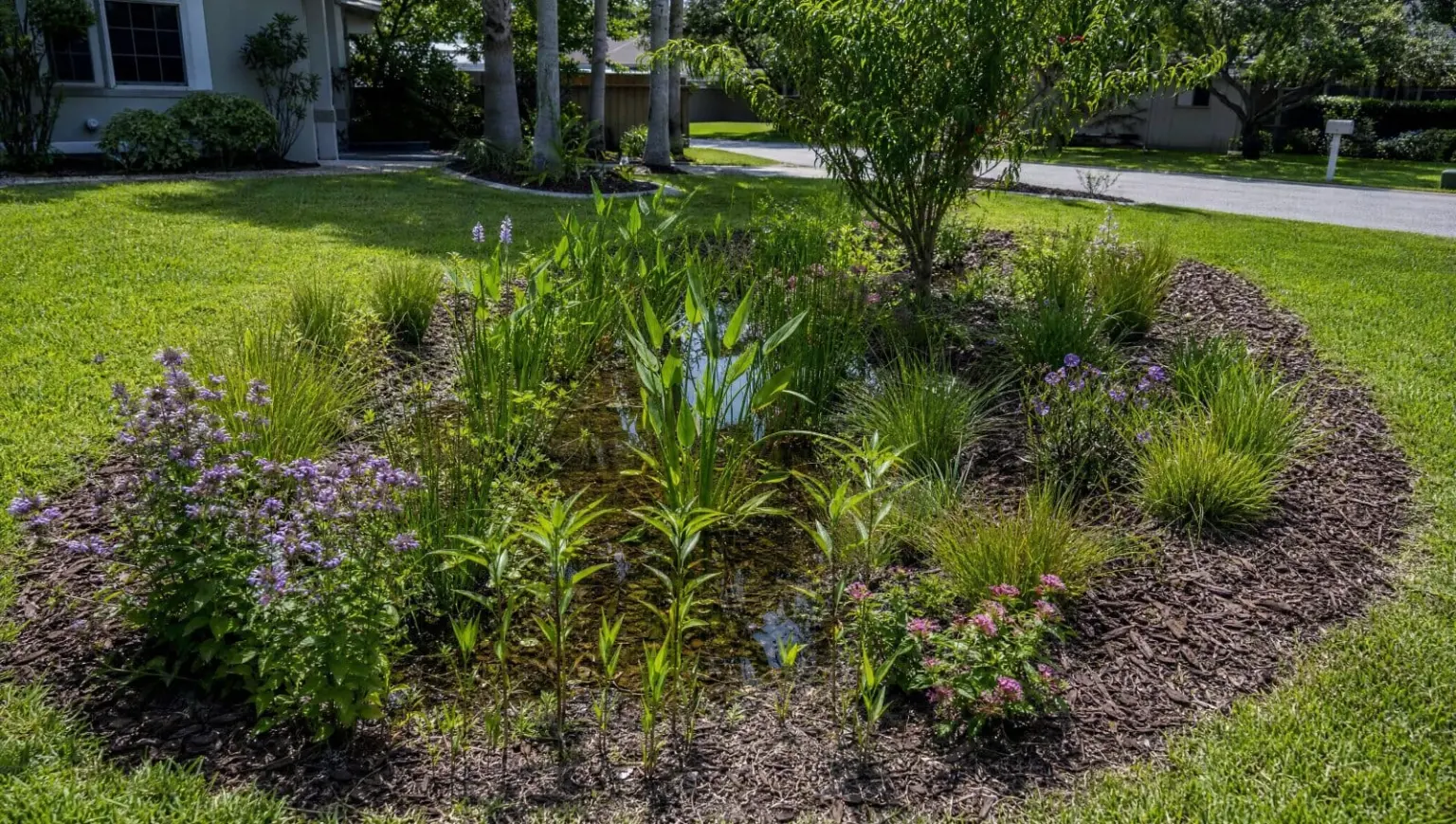
Rain Garden Florida Guide: Soak Up Central Florida’s Storms
When the afternoon storms build over Central Florida in summer, all that water has to go somewhere. Most of it sheets off our roofs and driveways and rushes straight to the storm drain, taking lawn fertilizer and yard debris along with it. A rain garden Florida homes can rely on gives that runoff a better place to land: a shallow, planted depression that catches the storm, holds it for a few hours, and lets it soak gently back into the sandy soil. It is one of the most rewarding, low-maintenance landscape features we install, and our zone 9b conditions are nearly perfect for it.
What a Rain Garden Actually Is
A rain garden is not a pond and it is not a wetland. It is a slight bowl in the ground, usually four to eight inches deep, planted with species that can handle a quick soaking and then dry out between rains. UF/IFAS Gardening Solutions recommends that four-to-eight-inch range, since anything deeper risks holding water long enough to become a problem. You position it to catch runoff from a roof downspout, a driveway, or a low area of lawn. After a storm, water collects in the basin and then infiltrates into the soil, typically within a day. Between rains, it just looks like an attractive bed of native plants.
Done right, you barely notice it is doing a job at all. It simply looks like a healthy, intentional planting that happens to stay green through our wet summers.
Why a Florida Rain Garden Pays Off Here
Our region is genuinely well suited to this. A rain garden built in Volusia, Seminole, or Orange County tends to perform better than the same feature would in a clay-heavy state, and here is why.
- Sandy soil drains fast. The biggest fear with a rain garden elsewhere is that it will hold water too long and become a mosquito pond. Our sand drains so quickly that proper infiltration is rarely the problem.
- We have plenty of rain to work with. From June through September, downpours arrive almost daily, so the garden stays lush without much supplemental watering.
- It keeps water on your property. Instead of rushing runoff to the storm system, you recharge your own ground and protect nearby waterways from yard chemicals.
- It thrives on neglect. Once the native plants are established, a rain garden needs far less attention than a thirsty turf lawn.
Where to Put It
Placement is where most do-it-yourself rain gardens go wrong. A few simple rules keep yours healthy:
Keep your distance from the house
Site the garden at least ten feet from your foundation so infiltrating water never works back toward the slab. The goal is to move water away from the structure, then let it soak in safely.
Stay off the septic drainfield
If you are on septic, never place a rain garden over the drainfield. Adding water there defeats the purpose of the field and can cause real trouble.
Catch the runoff, but pick a naturally lower spot
Position it downslope of a downspout or driveway so water flows in on its own. A spot that already collects a little water after storms is often a great candidate, as long as it drains out within a day.
Confirm it drains within 24 to 48 hours
This is the line between a rain garden and a stagnant pond. Mosquito larvae need several days of standing water to develop, so a basin that empties within a day or two never gives them the chance. In our sand it almost always passes, but we do a simple percolation check before planting. If water lingers longer than two days, the site or the depth needs adjusting.
Sizing It to Your Roof
A rain garden should be matched to how much water it will receive. Cooperative Extension guidance commonly sizes the basin to roughly five to ten percent of the roof or paved area that drains into it, with the exact figure depending on the basin’s depth and the soil’s drainage rate (see the Alabama Cooperative Extension sizing method). Because our sandy soil infiltrates so quickly, it can support a slightly deeper basin that drains fast, so Central Florida gardens often sit at the lower end of that range. We measure the contributing area and the soil’s drainage rate, then size the basin so it handles a typical summer storm without overflowing across the lawn.
The Best Plants for a Central Florida Rain Garden
The trick is choosing zone 9b natives that shrug off both wet feet during the rainy season and dry spells in spring. These are some of our go-to performers, several of which UF/IFAS recommends for Florida rain gardens:
- Muhly grass — tough, drought-hardy, and stunning with its pink autumn plumes around the upper, drier edges
- Fakahatchee grass — a robust native grass that anchors the garden and tolerates a range of moisture
- Blue flag iris — handles the wettest center of the basin and rewards you with blue spring blooms
- Swamp sunflower — bright fall color and very happy with periodic flooding
- Buttonbush — a native shrub that loves wet feet and draws in pollinators
- Cinnamon fern — lush texture for shadier, consistently moist spots
- Spider lily — fragrant native bloomer that thrives in the damp zone
- Walter’s viburnum — an adaptable native shrub for the drier perimeter
We plant the wettest-tolerant species, like blue flag iris and swamp sunflower, in the low center, and the more drought-tolerant ones, like muhly grass and Walter’s viburnum, around the higher rim. That way every plant sits in the moisture zone it prefers.
Caring for It Through the Seasons
The first few months are when a new rain garden needs attention. Water it during dry stretches until the plants establish their roots, and pull weeds so the natives can fill in. After that, the maintenance is light:
- Refresh mulch once a year to keep weeds down and moisture even
- Cut back grasses and perennials in late winter before spring growth
- Clear any leaves or debris from the inlet so water keeps flowing in cleanly
- Check after big storms that the basin still drains within a day or two
Frequently Asked Questions
Will a rain garden attract mosquitoes?
Not if it is built correctly. Because it drains within a day or two in our sandy soil, water never sits long enough for mosquitoes to breed, which takes several days of standing water.
Can a French drain feed my rain garden?
Yes, and it is a great pairing. A French drain can gather runoff from a wet area by gravity and channel it into the garden, where it soaks back into the ground instead of heading to the storm drain. If your trouble spot is too flat or low to drain on its own, our sump pump vs French drain guide walks through how to get the water moving toward the garden in the first place.
How big does it need to be?
It depends on the roof or pavement draining into it, but our fast-draining soil lets many Central Florida rain gardens stay compact. We size it to your specific runoff after a quick site look.
Ready to Soak Up the Storms?
A well-placed rain garden turns your summer downpours from a nuisance into something genuinely useful, all while looking great year round. If you would like to put one to work on your Central Florida property, contact LandTree for a free rain-garden design consultation. We will study how water moves across your yard, check your soil’s drainage, and lay out a planting that fits your space and thrives in our climate.