
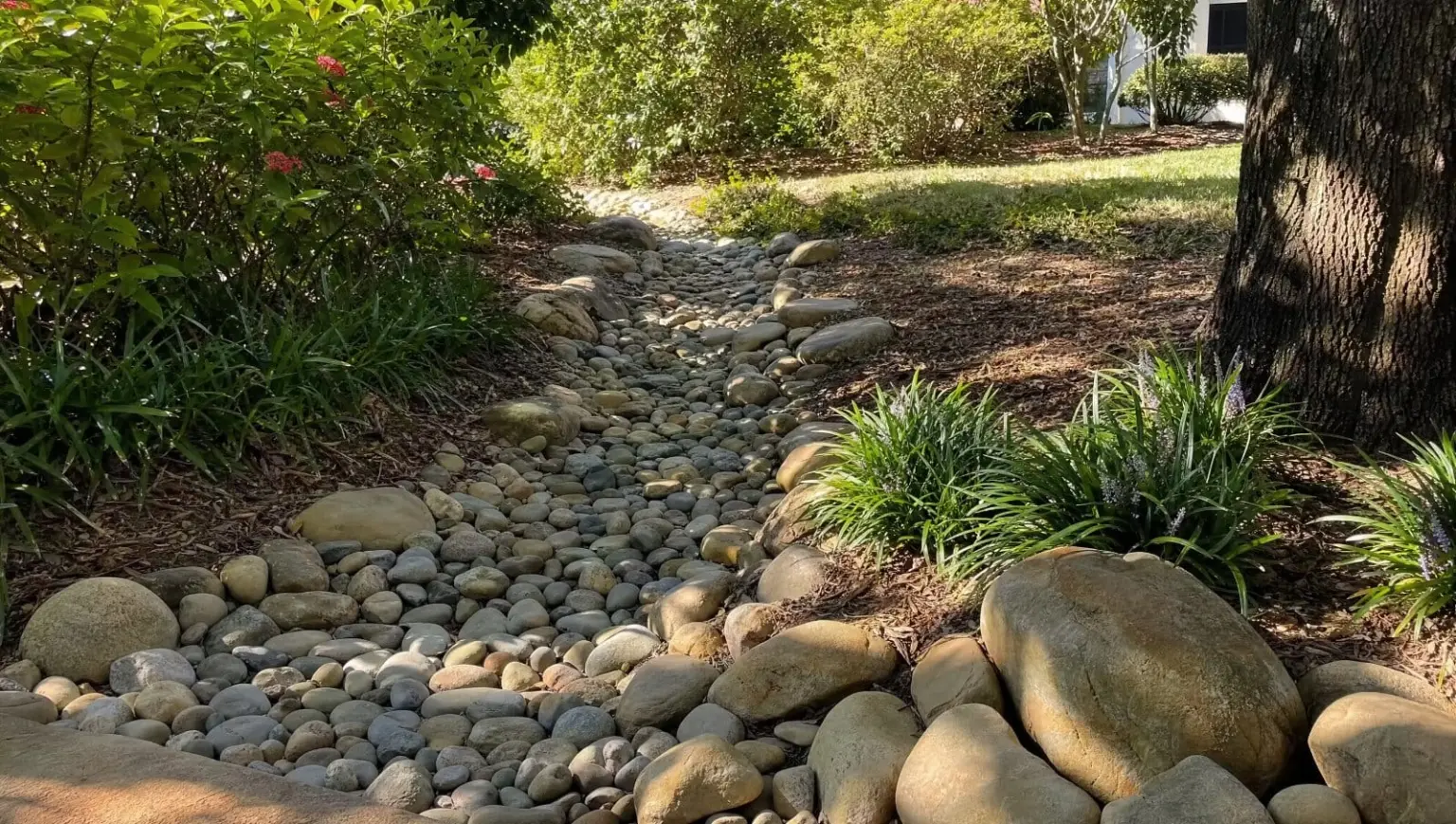
Dry Creek Bed Landscaping: Florida Drainage That Looks Good
If part of your yard turns into a shallow swamp every time a summer thunderstorm rolls through, you are not alone. Across Orange City, DeLand, and the rest of Central Florida, our flat lots and sandy soil mean water has to go somewhere — and it rarely picks the spot you want. Dry creek bed landscaping is one of the most reliable ways to move that water while actually making your yard look better. Done right, it reads as an intentional design feature, not a drainage repair.
At LandTree, we install these features on zone 9b properties where standing water, mosquitoes, and soggy turf are facts of life from June through September. Here is how a real dry creek bed works, how we build them, and what to plant alongside one.
What dry creek bed landscaping actually does
A dry creek bed is a shallow, rock-lined channel that mimics a natural streambed. Most of the year it sits dry and decorative. During heavy rain, it captures runoff and guides it away from your foundation, patio, or low spot and carries it toward a place where the water can safely soak in or drain off.
The point of good dry creek bed landscaping is that it solves a drainage problem and earns its keep as a design element most of the year. It is the rare yard upgrade that is both functional plumbing and curb appeal.
- Redirects runoff from downspouts, slopes, and chronic wet spots
- Reduces erosion in sandy soil that washes out easily
- Cuts mosquito habitat by keeping water moving instead of pooling
- Adds texture and structure to flat Central Florida yards that often feel featureless
Why these work so well in Central Florida
Our region throws a specific set of conditions at any drainage plan, and dry creek bed landscaping handles all of them gracefully.
Sandy soil drains fast — until it doesn’t
Much of Volusia, Seminole, and Orange county sits on sandy soil that normally percolates quickly. The catch is that during a 3-inch afternoon downpour, water arrives faster than even sand can absorb it, so it sheets across the surface. A creek bed gives that surface water a defined path instead of letting it carve random ruts across your lawn.
Flat lots have nowhere obvious for water to go
Many local properties have very little natural grade. A creek bed lets us build in a gentle, deliberate slope — even just an inch of fall per ten feet — so gravity does the work without an ugly trench.
It fits the look
River rock, native grasses, and the occasional boulder suit our landscape far better than a bare PVC pipe poking out of the lawn. You get drainage that looks like it belongs.
How we build a dry creek bed that lasts
A creek bed that fails usually fails because someone skipped the unglamorous steps. Here is the sequence we follow.
1. Map the water first
Before we move a single rock, we watch where water actually goes. We look at downspouts, the high and low points of the lot, and where you want the water to end up — often a swale, a rain garden, or a legal drainage easement. Never toward a neighbor’s property.
2. Dig with the right shape
We excavate a channel that is wider than it is deep, typically two to three times wider than deep, so it looks natural and carries volume during storms. A common size for a residential run is about 2 feet wide and 6 to 12 inches deep, scaled up where more water is involved.
3. Line it correctly
We lay landscape fabric to block weeds and keep the rock from sinking into our soft sandy soil. In high-flow sections we may set a perforated pipe under the rock so the bed can handle a true downpour, not just a drizzle. Where that pipe needs a clean exit, it ties into a pop-up drain emitter at the low end.
4. Layer the rock by size
- Larger boulders and cobble along the edges to define the banks
- Medium river rock through the main channel
- Smaller gravel to fill gaps and read as a streambed bottom
Mixing sizes is what separates a convincing creek bed from a gravel ditch.
5. Plant the banks
Planting is where the feature comes alive and stops looking like construction.
Best plants for a Florida dry creek bed
Good dry creek bed landscaping is finished with the right plants. You want species that tolerate both the occasional flooding and our long dry stretches, and that thrive in zone 9b heat and humidity. We lean on Florida-friendly and native options.
- Muhly grass — pink fall plumes, extremely drought-tough once established
- Fakahatchee grass — a sturdy native clump grass that handles wet feet
- Blue flag iris — loves the damp zones and adds spring color
- Coontie — a hardy native that anchors the drier banks
- African iris and liriope — reliable, low-fuss border plants
Cluster plantings at the bends and the outflow end, where soil stays a touch moister, and keep the channel itself open so water flows freely.
Common mistakes we get called to fix
- Too shallow. A bed dug only a few inches deep overflows in the first real storm.
- No fabric underneath. Rock sinks into the sand within a season and weeds take over.
- Pointing the outflow at the house or fence line. Water has to exit somewhere sensible, not just somewhere closer.
- All one rock size. Uniform gravel always looks like a utility trench, never a creek.
Frequently asked questions
Does a dry creek bed need maintenance?
Very little. Pull the occasional weed, rinse leaves and debris out a couple of times a year — especially after heavy oak and pine drop — and reposition any rock that shifts in a major storm.
Will it breed mosquitoes?
A properly built bed drains and dries between rains, so it actually reduces standing water compared to the soggy lawn it replaced. The key is correct slope so water never sits stagnant.
How long does one last?
With proper fabric and rock layering, a well-built creek bed can look good and function for well over a decade with only light upkeep.
Can it connect to my gutter downspouts?
Yes, and that is one of the most effective uses. We frequently tie downspout discharge into the head of the bed so roof runoff is carried away cleanly instead of pooling against the slab.
Let LandTree design your drainage feature
A wet spot, an eroding slope, or a downspout that turns part of your yard to soup every summer is exactly the kind of problem dry creek bed landscaping solves — while leaving the yard better looking than before. As a veteran-owned crew that lives and works in zone 9b, we build these to take a real Central Florida summer. Book a free on-site estimate and we will walk the property with you, trace where the water actually goes, and map out exactly what we would build for Orange City, DeLand, Lake Mary, Sanford, Oviedo, Apopka, and the greater Orlando area.