
Why Your Yard Floods After Rain in Florida (and Fixes)
Why Your Yard Floods After Rain in Florida (and How to Fix It)
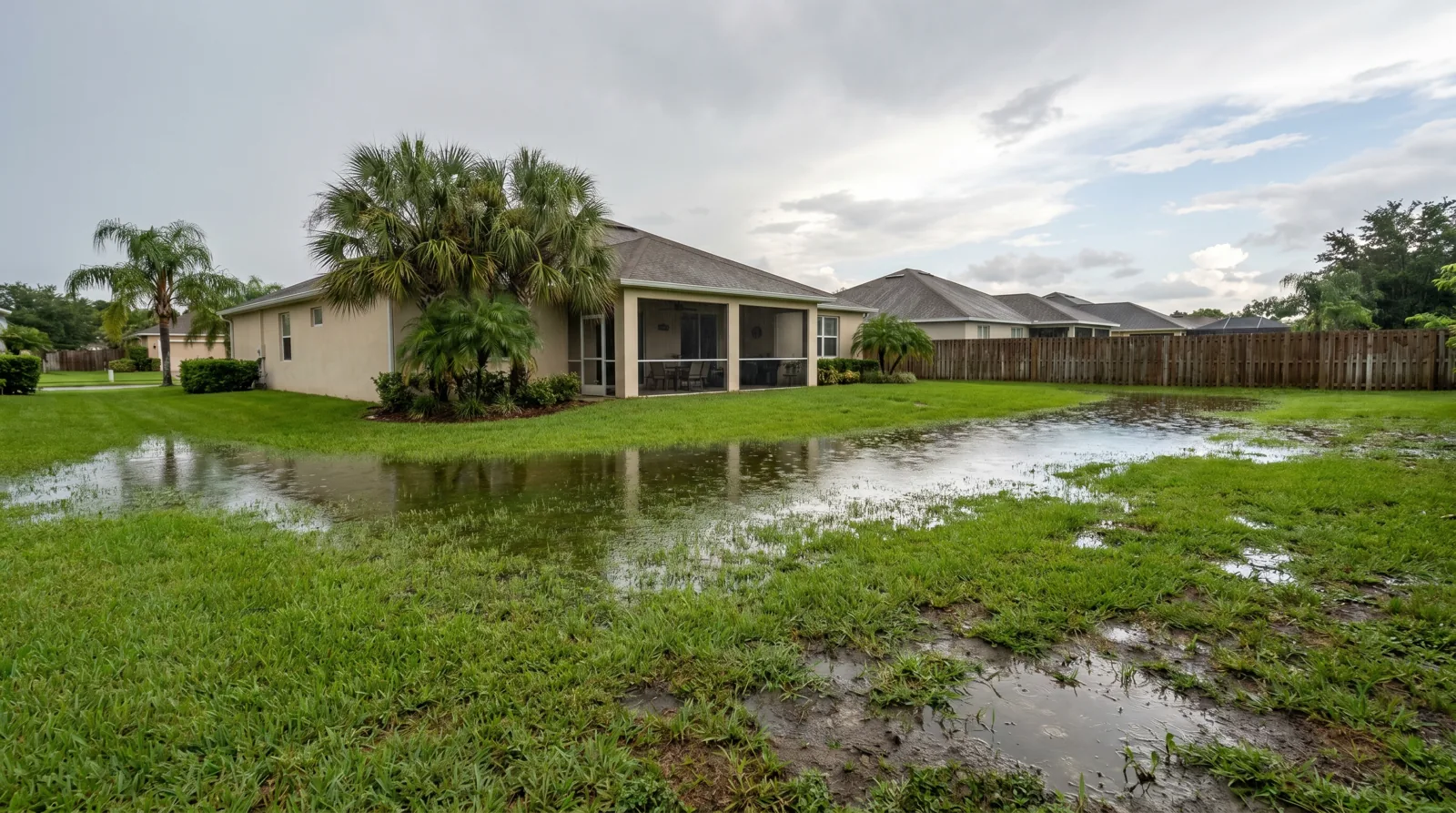
If your yard floods after rain in Florida and the water just sits there for hours — or days — you’re dealing with one of the most common problems we see across Central Florida. The short answer: our flat, sandy lots sit on a high water table, often with a clay or hardpan layer underneath, and our summer downpours dump rain faster than that ground can take it. The water has nowhere to go, so it pools.
The good news: almost every flooding yard has a fix. It’s usually one of five — regrading, a French drain, a catch basin, a dry well, or a swale — or a combination, matched to your specific lot.
Let’s break down why it happens and which fix actually solves it, because pouring money into the wrong one is the fastest way to still have a swamp after the next storm.
Why Your Yard Floods After Rain in Central Florida
It seems backwards. Sand drains great, right? Mostly — but three things gang up on us down here.
The lots are dead flat. Huge stretches of Seminole, Volusia, and Orange counties were graded nearly level when the neighborhoods went in. Without at least a gentle slope to carry water away from the house, even fast-draining sand can’t move water sideways — it just sits and soaks straight down until the ground is full.
The water table is high. Central Florida’s groundwater sits close to the surface, especially in the rainy season. After weeks of daily storms, the sand below your yard is already saturated. There’s no empty space left underground for new rain to soak into, so it backs up and ponds on top.
There’s often a clay or hardpan layer. Dig down a couple feet in many of our neighborhoods and you hit clay, organic muck, or compacted construction fill. Water races through the top layer of sand, hits that barrier, and stops. We’ve opened up “sandy” yards in Longwood and Deltona and found a clay shelf two feet down that turned the whole lot into a bathtub.
Add our afternoon thunderstorms — which routinely drop an inch or two of rain in under an hour — and you’ve got more water arriving in 30 minutes than a flat, saturated, clay-bottomed lot can absorb in a day. That’s why it pools.
And it’s not just an eyesore. Standing water rots your turf, drowns plant roots, undermines your foundation, kills patches of St. Augustine you may have just sodded, and — within days — breeds clouds of mosquitoes that thrive in standing water. UF/IFAS has a helpful free overview of residential stormwater and runoff if you want the science.
5 Proven Fixes for a Flooding Florida Yard
There’s no single magic fix — the right solution depends on where the water comes from and where it can safely go. Here are the five we install most, and what each is best at.
1. Regrading (reshaping the slope).
Often the first and simplest fix. We reshape the ground so water flows away from your home toward a safe discharge point instead of pooling against the foundation. Even a few inches of slope over several feet changes everything. If the whole yard sheets up, bad grading is usually the root cause.
2. French drain (underground collection).
A gravel-filled trench with a perforated pipe that collects water below the surface and carries it away. French drains are the workhorse for flat Florida lots — they pull standing water out of the soil without changing how your yard looks, and they’re ideal along fence lines, beside the foundation, or across a chronically soggy strip.
3. Catch basin (collecting a specific low spot).
A drainage box with a grate set into the exact spot where water always pools — a low patio corner, the bottom of a driveway, that one dip that’s always a puddle. It captures surface water and pipes it underground. Catch basins shine when most of the yard drains fine but one or two spots flood every time.
4. Dry well (giving water somewhere to go).
A buried, gravel-filled pit that collects runoff and lets it slowly percolate back into the ground. Dry wells are great when you can’t easily run a pipe to the street or a pond, and they work especially well in genuinely sandy areas without a shallow clay layer.
5. Swale (surface channel).
A shallow, wide, grassy channel that steers rainwater across the surface toward a storm drain or retention area. Many of our neighborhoods were built with swales between lots, and most have filled in, clogged, or been mowed flat over the years. Restoring an existing swale is often the cheapest big win available.
In practice, the best results usually combine a couple of these — say, regrading plus a catch basin tied into a French drain. That’s the kind of system our drainage and landscaping crew designs around your specific lot.
Which Drainage Fix Fits Your Yard?
| Your situation | Likely fix |
|---|---|
| Whole yard sheets with water; water runs toward the house | Regrading |
| One chronic soggy strip or fence line stays wet | French drain |
| One low spot/patio corner/driveway base always puddles | Catch basin |
| Nowhere to pipe water to; sandy soil | Dry well |
| Old grassy channel between lots is clogged or filled in | Restore the swale |
| Multiple problems at once | Combined system |
One more thing worth flagging before any major work: anything that alters where surface water leaves your property can require approval from the City or the St. Johns River Water Management District, and you never want to dump your runoff onto a neighbor’s lot — that’s how you get a code complaint or a dispute. We handle that permit research as part of the job.
Frequently Asked Questions
Why does my Florida yard flood even though the soil is sandy?
Because most Central Florida lots are nearly flat, the water table is high (so the ground is already saturated in the rainy season), and there’s often a clay or hardpan layer a couple feet down that water can’t penetrate. Our intense afternoon storms then deliver more rain than the saturated, flat lot can absorb, so it pools on top.
How long should water take to drain from my yard after rain?
Surface water should be gone within 24 hours of the rain stopping. If puddles or soggy spots linger longer than a day — or come back every storm in the same place — you’ve got a drainage problem worth fixing before it damages your turf, plants, or foundation.
What’s the cheapest way to fix a flooding yard?
It depends on the cause, but restoring an existing swale or correcting the grade is often the most cost-effective fix because it works with the land you already have. A catch basin in a single low spot is also relatively affordable. The right starting point is a proper assessment — throwing the wrong fix at it wastes money.
Will French drains work in Florida’s sandy soil and high water table?
Yes, when they’re designed for our conditions — proper slope, the right gravel and fabric, an adequate pipe size, and a real discharge point. The high water table actually makes professional design more important, because a poorly placed drain can sit in groundwater and never dry out.
Can yard flooding damage my home’s foundation?
Yes. Water that repeatedly pools against the foundation can lead to cracks, settling, mold, and moisture intrusion over time. That’s why we treat water sitting against the house as the most urgent kind of drainage problem to solve.
Stop the Standing Water — Call DeAngelo’s
At DeAngelo’s Land Services, we’ve solved flooding-yard problems on flat, sandy lots all over Lake Mary, Sanford, Longwood, Winter Springs, Deltona, and the rest of Central Florida. We’ll figure out why your yard floods — grade, water table, clay layer, or a clogged swale — and recommend the right fix, not the most expensive one. We’re veteran-owned, BBB A+ rated, Google Guaranteed, carry a 5.0-star rating across 211+ reviews, and offer a 10% veteran discount on every job.
Call us today at (386) 675-2303 for a free estimate. We’ll walk your property after the next storm if we have to, find where the water’s really going, and design a drainage system that finally keeps your yard dry.
About the Author: Mark DeAngelo is an ISA Certified Arborist and the founder of DeAngelo’s Land Services, a veteran-owned company serving Lake Mary, Sanford, and the greater Central Florida area. His team is BBB A+ rated, Google Guaranteed, and proud to offer a 10% veteran discount on every job.