Tree Risk Assessment: A Pre-Hurricane Checklist
Tree Risk Assessment Before Hurricane Season: A Homeowner’s Checklist
A tree risk assessment is simply a structured look at your trees to find the failures before the wind does — and the best time to do it is now, before hurricane season peaks. You can run a solid first pass yourself in about twenty minutes with the eight-point checklist below. The goal isn’t to diagnose every tree perfectly; it’s to flag the ones that need a certified arborist’s eyes before the next Central Florida storm tests them.
Quick takeaway: Walk each tree and check eight things — lean, deadwood, cracks, fungus, root heave, weak forks, canopy density, and clearance from structures. Any red flag near your home is a reason to call an arborist now, not after the storm.
We do this for homeowners all over Lake Mary, Heathrow, and the rest of Seminole County every June, because the trees that come down in August were almost always showing warning signs in early summer. Here’s the exact checklist our crew uses, translated into plain English so you can run it yourself this weekend.
What Should a Pre-Hurricane Tree Risk Assessment Check?
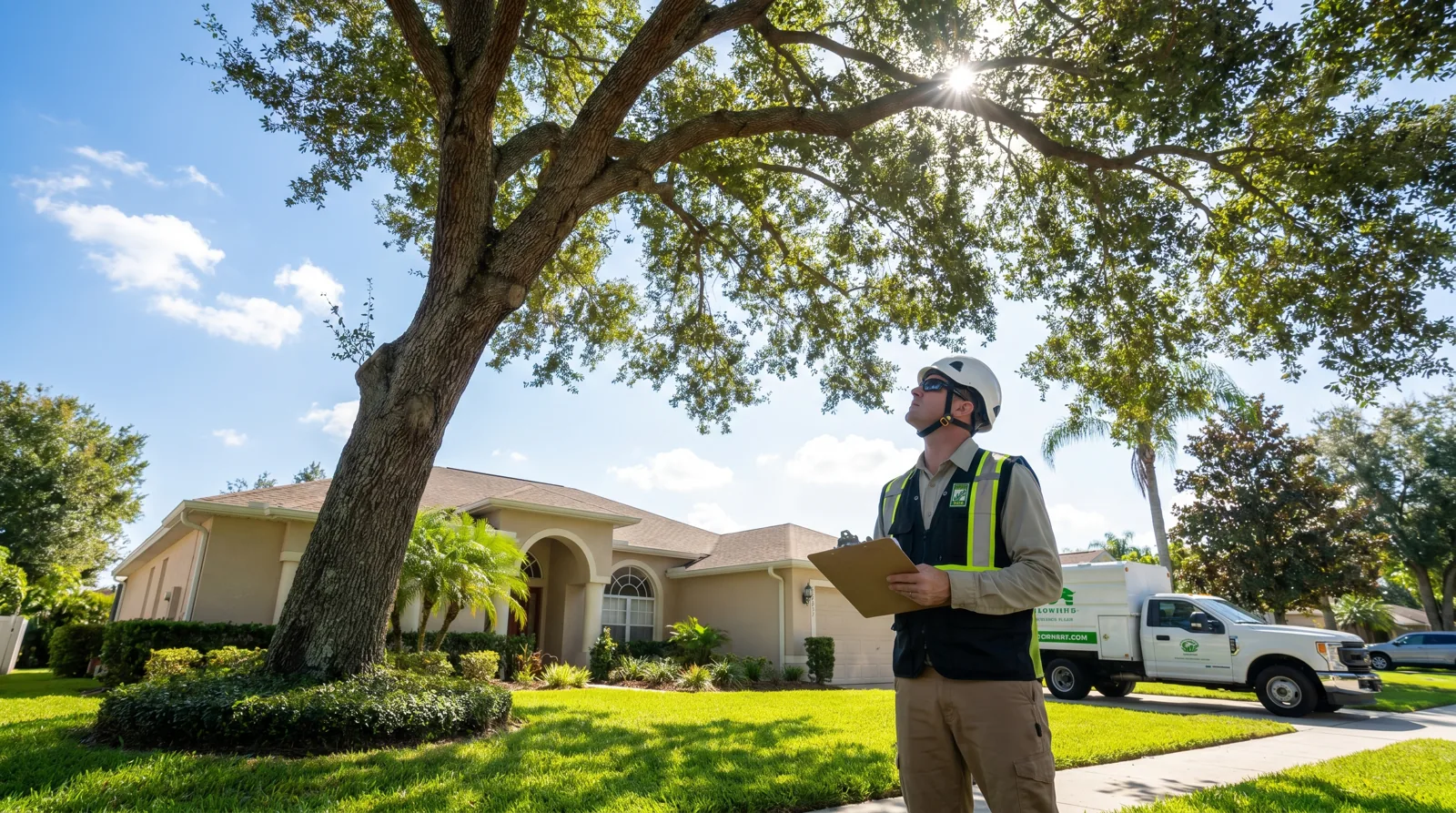
Go tree by tree, starting with the ones closest to your house, driveway, and anywhere people gather. For each, work through these eight points.
1. Lean. Is the tree leaning toward a structure? A gradual lean it grew into over decades is usually fine. A new or worsening lean — especially with cracked or heaved soil on the high side — is a serious red flag that the roots are failing.
2. Deadwood. Look up into the canopy for bare, leafless limbs. Dead branches become missiles in high wind and fall on their own in storms. A canopy that’s more than a quarter dead is a tree in decline.
3. Cracks and splits. Scan the trunk and major limbs for vertical cracks, seams, or splits. A crack running down the trunk or through a major branch union means the tree is already partly failed and the wind only has to finish the job.
4. Fungus and conks. Mushrooms, shelf-like conks, or soft spongy wood at the base or on the trunk signal internal decay. The hardest part is that the outside can look fine while the inside is hollowing out — fungal fruiting bodies are often the only visible clue.
5. Root heave and exposed roots. Walk the base. Is the soil mounded, cracked, or lifting on one side? Are major roots cut (common after recent construction or a new driveway)? Compromised roots are the number-one cause of whole-tree failure in our saturated, sandy soil.
6. Co-dominant stems and weak forks. Look for two large trunks splitting from nearly the same point with bark pinched between them (included bark). These tight V-shaped unions are structurally weak and are the first thing to split in a storm — water oaks and laurel oaks are notorious for it.
7. Canopy density. A dense, solid wall of canopy catches wind like a sail. Selectively thinned canopies let wind pass through. If a tree looks heavy and one-sided or hasn’t been pruned in years, it’s carrying more storm risk than it needs to.
8. Clearance from structures and lines. Note any limbs over the roof, touching the house, or growing into power lines. Even a healthy limb is a hazard if it’s hanging over where you sleep — and limbs in service lines are a utility-coordination issue, not a DIY one.
Mark down every tree that triggered a flag. If a single tree hit several points — say, a leaning laurel oak with deadwood and a conk at the base — treat it as a priority. That’s the profile of a tree most likely to be one of the species that fall in Florida hurricanes.
When to Stop Checking and Call an ISA Arborist
Your checklist gets you most of the way, but some calls genuinely require training and tools you don’t have at home. Bring in a certified arborist when:
- A tree near your home triggered two or more of the eight points.
- You see decay signs (conks, cavities, hollow sound) on a large tree.
- A tree has a new lean or visible root heave.
- Large limbs hang over the house, the bedroom, or power lines.
- You’re not sure whether the right move is thinning or removal — getting that wrong makes a tree more dangerous.
A professional risk assessment goes deeper than a visual scan: an arborist evaluates the tree’s species, its structural defects, the likelihood of failure, and what would be hit if it fell — the same framework the International Society of Arboriculture’s tree-risk guidance lays out for property owners. From there you get a clear recommendation: monitor, prune, cable, or remove. Many defects can be managed with proper summer thinning and structural pruning so the tree stays — removal is the last resort, not the default.
We recently ran a pre-season assessment on a big live oak in a Lake Mary front yard that the owner was sure needed to come down. It didn’t — it just needed deadwood cleaned out and a heavy limb reduced over the garage. That tree’s still shading the house, and it’s safer than it’s been in years.
Frequently Asked Questions
How often should I have my trees assessed?
For mature trees near structures, an annual look before hurricane season is ideal in Central Florida. Add a check after any major storm, and any time you notice a new lean, falling limbs, or fungus.
Can I do a tree risk assessment myself?
You can do a solid first pass with the eight-point checklist above, and you should — it catches the obvious hazards. But internal decay, root problems, and species-specific weaknesses often need a certified arborist to evaluate properly.
What does a professional tree risk assessment cost?
It varies with the number and size of trees and what access looks like. We give honest, itemized pricing up front, and for storm-prep season we often roll the assessment into the cost of any pruning or removal work you decide to do.
Does a healthy-looking tree still need checking?
Yes. Some of the most dangerous trees look perfectly healthy from the street while they’re decaying inside or sitting on a compromised root plate. The visible canopy doesn’t always reflect the structural condition.
Is it too late to assess my trees if a storm is already forecast?
It’s never too late, but don’t cut it close. Pruning and removals take scheduling, and crews book up fast when a storm is named. Early summer is the smart window — call before the rush.
Book a Free Pre-Hurricane Tree Assessment — (386) 675-2303
Don’t wait for a storm to find out which trees on your property were a problem. DeAngelo’s Land Services is a veteran-owned, BBB A+ rated crew with an ISA Certified Arborist on staff, and we hold a 5.0-star rating across 211+ reviews for giving homeowners honest assessments — keep the tree when we safely can, remove it only when we must.
Call us today at (386) 675-2303 for a free tree risk assessment in Lake Mary and across Central Florida. We’ll walk your property, flag every hazard, and give you a clear plan before hurricane season hits its peak — and we offer a 10% veteran discount on every job.
About the Author: Mark DeAngelo is the owner of DeAngelo’s Land Services and an ISA Certified Arborist serving Central Florida. His veteran-owned team is BBB A+ rated, Google Guaranteed, and holds a 5.0-star rating across 211+ reviews.