Tree Removal Permit Seminole County: What You Need
Tree Removal Permit Seminole County: What You Need
In most cases, yes — you do need a tree removal permit in Seminole County before taking down a healthy tree above a certain trunk size, especially on residential property in the unincorporated county. There are exceptions for dead, diseased, or dangerous trees and certain small or nuisance species, but the safe assumption is: check first, cut second.
The short version: Protected trees over the county’s size threshold generally need a permit; dead, hazardous, and some exempt species often don’t. The rules also change the moment you cross into a city limit — so confirm whether your address is unincorporated or inside a city before anyone fires up a saw.
We pull permits and navigate these rules every week for homeowners across Seminole County — Lake Mary, Sanford, Longwood, Winter Springs, Heathrow, Oviedo, and Altamonte Springs. Below is how the process actually works, written in plain English.

When Is a Tree Removal Permit Required in Seminole County?
The first question is always the same: is your property in unincorporated Seminole County, or inside a city? This matters more than anything else, because each city writes its own tree ordinance.
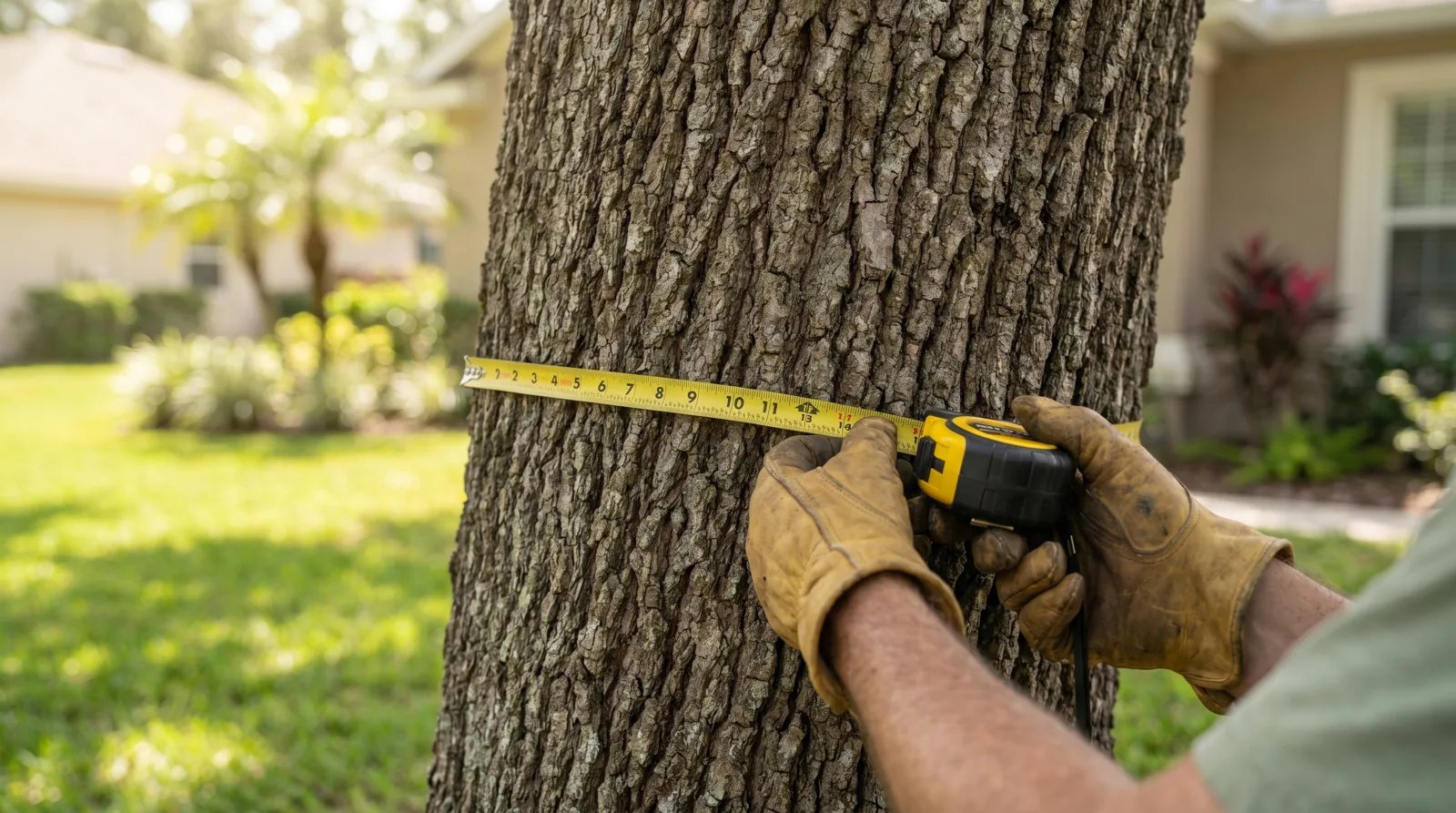
If you’re in unincorporated Seminole County, the county’s land development code governs your trees. The general principle: protected trees at or above a defined trunk size — measured as diameter at breast height, or DBH, roughly 4.5 feet up the trunk — require a permit before removal. Below that threshold, or for exempted species, a permit usually isn’t needed. Larger “specimen” trees can carry stricter review and replacement requirements.
If you’re inside a city — Lake Mary, Sanford, Longwood, Winter Springs, Casselberry, and so on — the city’s ordinance controls, not the county’s. A tree that’s freely removable under one city’s code may be protected under another’s. We cover two of the most-asked-about cities in our Lake Mary tree removal ordinance guide and our Sanford tree permit guide.
Because thresholds, fees, and exempt-species lists do get updated, always confirm the current numbers against the Seminole County tree permit and land development information before you commit to a removal. We do that verification as part of every job.
What Counts as a “Protected” Tree?
In Central Florida, the trees that typically trigger permit review are the mature shade and canopy species:
- Live oak, laurel oak, water oak — the big canopy trees, almost always protected once they reach size.
- Southern magnolia, bald cypress, hickory, and other native hardwoods.
- Specimen trees — exceptionally large or significant individuals, which face the strictest standards and the biggest replacement requirements.
Commonly exempt or lightly regulated trees include many smaller ornamentals, certain palms, and species the county classifies as nuisance or invasive — but “commonly” is not “always,” so don’t guess from this list alone.
When You Usually Don’t Need a Permit
There are real exceptions, and they’re the ones homeowners most need to know:
- Dead trees — a tree that’s already dead is generally removable, though you may need to document its condition.
- Hazardous or imminently dangerous trees — a tree threatening a structure or life, especially after a storm, typically qualifies for expedited or exempt removal. Document it with photos first.
- Trees below the protected size threshold.
- Listed nuisance/invasive species.
Even in an exempt case, documentation protects you. We photograph and record tree condition before emergency removals so there’s a clear record the work was justified.
What the Permit Process Actually Looks Like
When a permit is required, the process generally runs like this:
- Identify and measure. Confirm the species and measure DBH to see whether it crosses the protected threshold.
- Submit the application. This goes to the county (or city) with the tree details, a site plan or sketch, and the reason for removal.
- Pay the fee. Fees vary by jurisdiction and are updated periodically. We don’t quote a hard figure here because it changes — we confirm the current fee on the applicable schedule for your address.
- Review and approval. Staff review the request; larger or specimen trees may trigger an on-site review.
- Meet any mitigation condition. Many approvals require replacement trees or a tree-fund contribution. The bigger the tree, the more likely there’s a mitigation requirement.
- Remove, then close out. Do the work within the permit’s terms and complete any required inspection or replanting.
Skipping this process is an expensive mistake. Illegal removal of a protected tree can bring fines that dwarf the cost of doing it right, plus mandatory replacement. We’ve been called in after the fact to help homeowners sort out a removal that should have been permitted — it’s always cheaper to do it right the first time.
How DeAngelo’s Handles Permitting for You
This is the part homeowners are relieved to hear: we handle the permitting as part of the job. When you call us, our ISA Certified Arborist verifies whether your address is in the county or a city, identifies the species, measures DBH, and determines whether a permit is required under the current code.
If a permit is needed, we prepare and submit the application, confirm the current fee, and manage approval — including documenting any dead or hazardous tree that qualifies for an exemption. We recently removed a large declining laurel oak leaning toward a Lake Mary roofline; because we documented its condition and handled the paperwork, the homeowner never had to decode a single ordinance.
For homeowners who simply want it gone safely and legally, that end-to-end handling is the whole value. You can see the kind of removals we do on our tree removal in Sanford page, which covers our process across the surrounding Seminole County area. We extend a 10% veteran discount on every job.
Frequently Asked Questions
Do I need a permit to remove a tree in my own backyard in Seminole County?
Often, yes — owning the property doesn’t exempt a protected tree from the permit rules. If the tree is a protected species at or above the county’s size threshold, you generally need a permit even on your own residential lot. Dead and hazardous trees are usually the exception.
How do I know if my address is in the county or a city?
Your property tax record or the county’s GIS/property lookup will show whether you’re in unincorporated Seminole County or inside a municipality like Lake Mary or Sanford. We confirm this for you before any work — it determines which ordinance applies.
What happens if I remove a protected tree without a permit?
You can face significant fines and mandatory replacement plantings, and the penalty often far exceeds what a permit would have cost. It’s not worth the risk — confirming first is always cheaper.
Do dead or storm-damaged trees need a permit?
Generally no. Dead trees and trees that are an imminent hazard — especially after a storm — typically qualify for exempt or expedited removal. Photograph the tree’s condition first so you have documentation, then remove it.
Can DeAngelo’s pull the permit for me?
Yes. We verify the requirement, prepare and submit the application, confirm the current fee, and manage approval and any mitigation as part of the job, so you don’t have to navigate the county or city process yourself.
Removing a Tree in Seminole County? Call (386) 675-2303
DeAngelo’s Land Services is a veteran-owned, BBB A+ rated, Google Guaranteed tree service with an ISA Certified Arborist on staff and a 5.0-star rating across 211+ reviews. We handle tree removal — and the permits that come with it — across Seminole, Volusia, and Orange counties.
Before you cut, let us confirm whether your tree is protected, handle the paperwork, and do the removal safely and legally.
Call us at (386) 675-2303 or request a free estimate online. Be sure to ask about our 10% veteran discount.
About the Author
Mark DeAngelo is an ISA Certified Arborist and the founder of DeAngelo’s Land Services in Lake Mary, Florida. A USAF combat veteran, Mark leads a BBB A+ rated, Google Guaranteed crew that handles tree removal and permitting for homeowners and businesses throughout Seminole, Volusia, and Orange counties.