Stump Grinding vs Stump Removal: Which to Pick
Stump Grinding vs Stump Removal: Which Does Your Yard Need?
When you’re deciding between stump grinding vs stump removal, here’s the plain-English difference: grinding uses a machine to chew the stump down into mulch a few inches below grade and leaves the roots in the ground to decay naturally, while removal physically extracts the entire stump and its root ball, leaving a large hole. For the vast majority of Central Florida homeowners, grinding is faster, cheaper, and far less disruptive — but there are specific situations where full removal is the right call.
Grinding is the better choice for most yards; full removal makes sense mainly when you’re regrading, building, or putting hardscape where the roots are.
We do both at sites all over Winter Springs, Oviedo, and Seminole County, and the right answer almost always comes down to what’s going in that spot next. Let’s break it down.
What’s Actually the Difference?
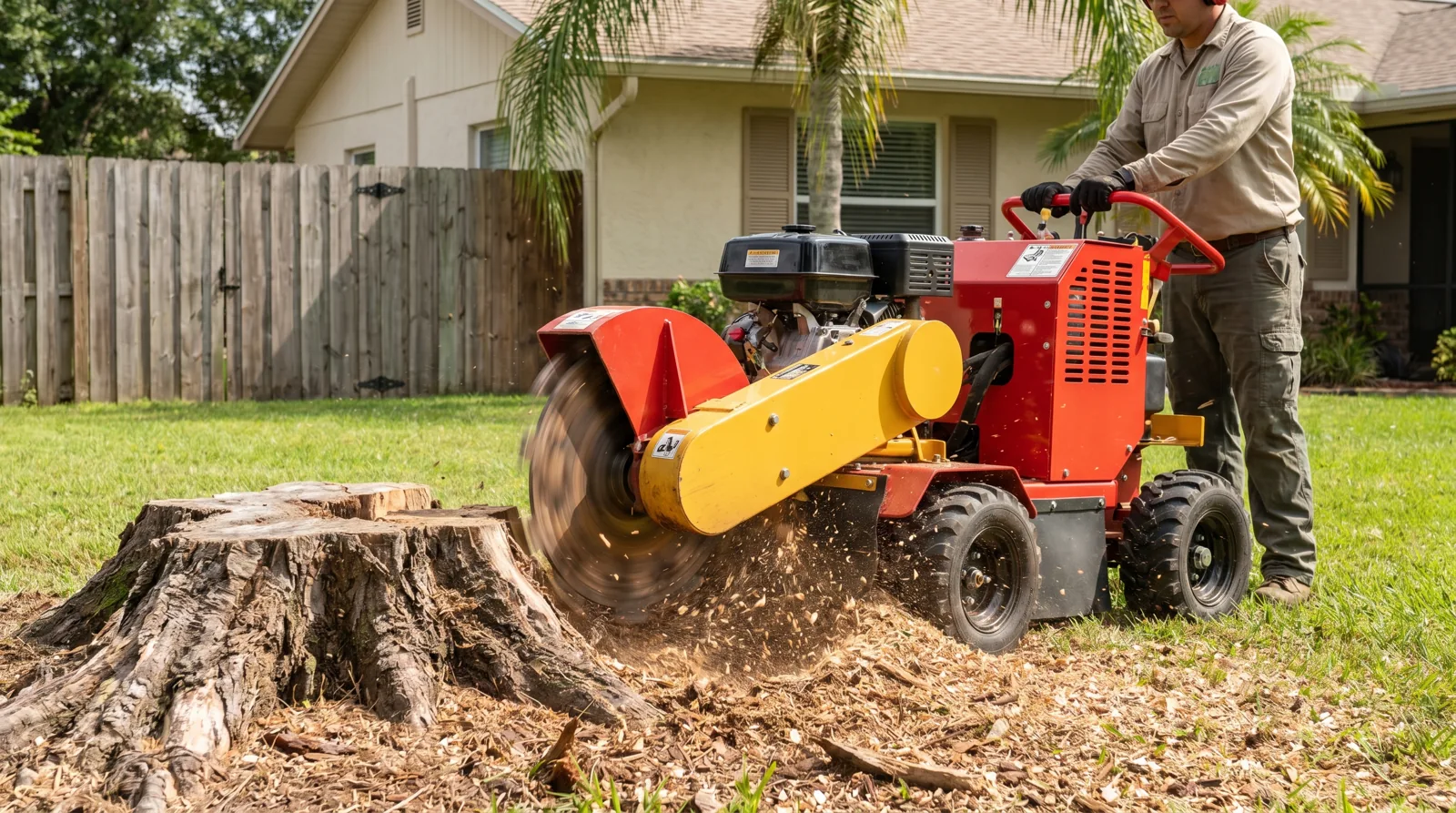
Stump grinding uses a machine with a rotating, carbide-toothed wheel that grinds the stump into wood chips, typically 4–12 inches below the surface (deeper if you’re planting). The visible stump disappears, the hole is small, and the roots radiating out are left in place to break down on their own over the following years.
Stump removal pulls the whole thing out — the stump plus the main root ball — usually with an excavator. You end up with bare ground and a big crater, but nothing left underground.
That single difference — roots left to rot vs. roots hauled out — drives almost everything else: cost, disruption, what you can plant, and how long it takes.
Stump Grinding vs Stump Removal: Pros and Cons
| Stump Grinding | Stump Removal | |
|---|---|---|
| Cost | Lower | Higher (heavy equipment, more labor) |
| Speed | Fast — often under an hour for a typical stump | Slower, more involved |
| Yard disruption | Minimal — small footprint | Major — excavator access, large hole, possible damage to surrounding lawn |
| What’s left | A pile of wood chips, small backfill area | A large hole that needs significant fill |
| Roots | Left to decay naturally | Fully extracted |
| Best for | Most homeowners; aesthetics, mowing, replanting nearby | Regrading, construction, pools, hardscape, persistent suckering species |
For nearly every routine situation — you removed a tree and just want the stump gone so you can mow over it or lay sod — grinding wins. It’s the standard the industry leans on for good reason; the ISA’s homeowner guidance on what to do after tree removal reflects the same practical logic.
When Full Removal Actually Makes Sense
Grinding is the default, but full removal earns its higher cost in a few specific cases:
- You’re building or paving where the roots are. Pouring a slab, setting a pool, installing a paver patio, or running a foundation through that spot means the whole root mass needs to come out, not just the top of the stump.
- You’re regrading the area. If you need to change the elevation significantly, leftover roots get in the way.
- Aggressive suckering species. A few species send up suckers from leftover roots after grinding. Where that’s a concern, full extraction stops the regrowth at the source.
- Disease or pest concerns. In some cases of root disease, getting the root mass out is part of managing the problem.
If none of those apply, you’re almost certainly looking at grinding.
What’s Left Behind — and What to Do With It
After grinding, you get a mound of wood chips and ground-up stump mixed with soil — surprisingly, more volume than the original stump, since ground wood fluffs up. We can rake the chips into the cavity, haul the excess, or spread them as mulch elsewhere.
One key point for replanting: don’t plant a new tree directly into fresh wood chips. As they decompose, they temporarily tie up soil nitrogen and leave the spot too loose and acidic for a young plant. We cover settling, fill, and timing in our companion guide on what happens to the hole after stump grinding. The short version: replace the chips with quality topsoil where you’re putting sod or a plant.
After removal, you’ve got a large hole that needs real fill — clean topsoil compacted in lifts so it doesn’t sink. In our sandy soil, un-compacted backfill can settle several inches over the first rainy season into a depression that collects water.
Cost Drivers in Central Florida
We don’t quote hard prices in a blog post, because honest pricing depends on the stump in front of us — but here’s what actually moves the number, so you can read a quote intelligently:
- Diameter and root flare. Stumps are usually priced by size — a big live oak with a wide flare is a different job than a small queen palm.
- Species and hardness. Dense hardwoods like live oak grind slower than softer wood or palms (palms are fibrous, not woody).
- How deep you need it. Grinding to mow over costs less than grinding deep enough to replant.
- Access. A stump the grinder can roll right up to is cheaper than one behind a fence, on a slope, or near utilities and irrigation we have to work around.
- Number of stumps and cleanup. Several stumps in one visit lowers the per-stump cost; hauling grindings vs. leaving them as mulch also affects price.
We recently ground a cluster of old laurel oak stumps for a homeowner re-sodding a back lawn in Winter Springs — grinding deep enough for fresh topsoil and sod cost a fraction of excavating them all, and the yard was usable the same day.
Replanting and Next Steps
If your goal is a fresh lawn or a new tree, plan the sequence: grind (or remove) → replace chips with topsoil → let it settle (or compact in lifts) → then sod or plant. Rushing sod over loose grindings is the most common reason a patch fails. When you’re ready to green it back up, we install sod across Lake Mary and Seminole County, and we can do the grinding and the sod as one coordinated job.
Frequently Asked Questions
Is stump grinding cheaper than stump removal?
Yes, almost always. Grinding uses a single machine and a fraction of the labor, leaves a small footprint, and is often done in under an hour for a typical stump. Full removal requires heavy equipment to extract the root ball and creates a large hole that needs significant fill, which adds equipment, labor, and material cost.
Do the roots keep growing after stump grinding?
No — once the stump is ground out, the tree is dead and the leftover roots simply decay in place over the next several years. The one exception is a handful of species that can send up suckers from leftover roots; for those, or where any regrowth would be a problem, full removal is the surer choice.
Can I plant a new tree where the stump was ground?
You can, but not directly into the fresh wood chips. As the grindings break down they tie up soil nitrogen and leave the spot loose and acidic, which stresses a young plant. Replace the chips in the planting area with quality topsoil first, and ideally give the ground a little time to settle before planting.
How deep does stump grinding go?
It depends on your goal. To simply mow over the spot, a few inches below grade is enough. To lay sod or plant, we grind deeper — usually 8–12 inches — so there’s room for clean topsoil. Tell us what’s going in that spot and we’ll grind to match.
Get Your Stump Handled the Right Way
Whether you need fast, low-impact grinding or a full extraction for a build or regrade, the right choice comes down to what’s going in that spot next — and we’ll tell you honestly which one your yard actually needs. No upselling you to removal when grinding does the job.
DeAngelo’s Land Services is veteran-owned, BBB A+ rated, Google Guaranteed, and proud to hold a 5.0-star rating across 211+ reviews. We grind and remove stumps across Winter Springs, Lake Mary, Oviedo, Sanford, Deltona, Orlando, and communities throughout Central Florida. Veterans and active military receive a 10% discount on all services.
Ready for a free estimate? Contact us online or call (386) 675-2303 today. We’ll look at your stump, talk through grinding vs. removal, and give you an honest quote with no surprises.
About the Author: Mark DeAngelo is the founder of DeAngelo’s Land Services and an ISA Certified Arborist serving Lake Mary, Winter Springs, Sanford, Orlando, and the greater Central Florida area. A USAF combat veteran with more than a decade of hands-on experience, Mark and his crew handle tree removal, stump grinding, and replanting across Seminole, Volusia, and Orange counties, earning a 5.0-star rating across 211+ reviews.