
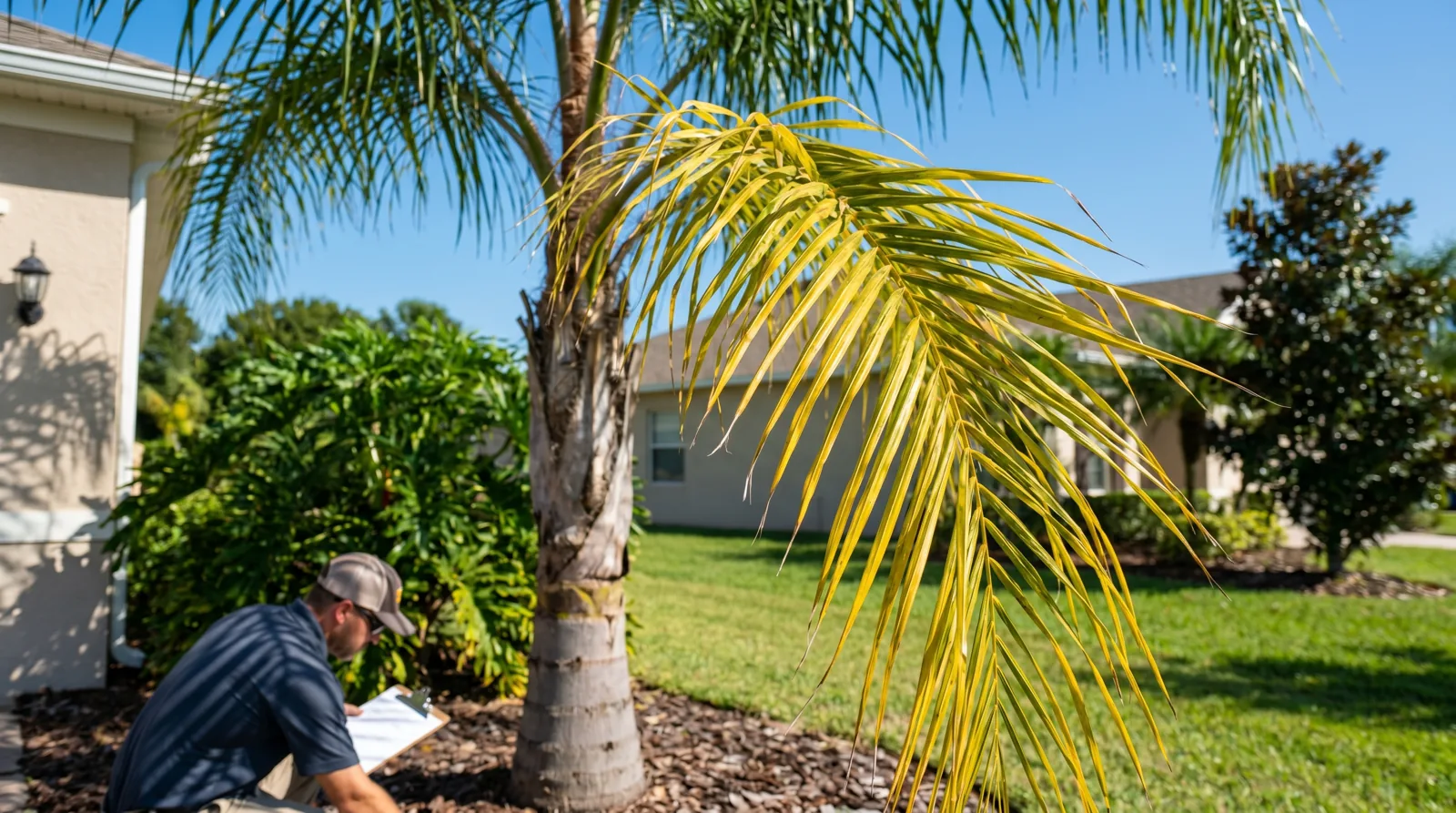
Why Are My Palm Fronds Turning Yellow?
Why Are My Palm Fronds Turning Yellow? A Florida Nutrient Guide
If your palm fronds are turning yellow, the cause in Central Florida is almost always a nutrient deficiency in our sandy soil — usually potassium or magnesium — not a watering problem. Our sand drains so fast that these mobile nutrients leach right out of the root zone, and palms respond by pulling them out of their older fronds to feed new growth. The result is the classic yellowing you see on the lower, oldest fronds first. The fix is the right fertilizer, applied the right way — not more water.
Yellowing that starts on the oldest, lowest fronds and works upward is the signature of potassium or magnesium deficiency — the most common reason Central Florida palms go yellow.
We diagnose this constantly across Lake Mary, Sanford, Deltona, and Orange City. Homeowners assume the palm is thirsty and crank up the irrigation, which does nothing — and sometimes makes things worse. Here’s how to read your palm correctly.
Why Sandy Florida Soil Starves Palms
Central Florida sits on deep, fast-draining sand. That’s great for keeping water moving away from your foundation, but it’s terrible for holding nutrients. Potassium (K) and magnesium (Mg) are highly mobile — water carries them right down past the root zone with every rain and irrigation cycle. In our heavy summer rains, that leaching accelerates.
Palms have a particular vulnerability here. When they run short, they cannibalize their oldest fronds — translocating potassium and magnesium out of the lower, older leaves to keep new growth alive. That’s why the yellowing always starts at the bottom of the canopy while the freshly emerging fronds at the top stay green. The palm is essentially robbing its old leaves to pay the new ones.
This is also why over-pruning a palm is so damaging: cutting off green and yellowing lower fronds removes the nutrient reserve the palm was planning to recycle, deepening the deficiency. We cover that mistake in our guide to what’s safe to cut on palms in summer.
Palm Fronds Turning Yellow: Identify the Deficiency by Pattern
The pattern of yellowing tells you which nutrient is short. Reading it correctly is the whole game.
| What you see | Likely cause |
|---|---|
| Yellow-to-orange spotting/translucence on oldest fronds, leaflet tips dying back, frizzled “ragged” look | Potassium (K) deficiency — the most common |
| Broad yellow bands along the edges of older fronds with a green center stripe down the middle | Magnesium (Mg) deficiency |
| Newest fronds yellow, stunted, or deformed (not the old ones) | Manganese (Mn) deficiency — “frizzle top,” a different and serious problem |
| Uniform pale-green/yellow across the whole canopy | Nitrogen (N) deficiency |
A few notes from the field:
- Potassium is by far the one we see most: orange-yellow speckling and dead, frizzled leaflet tips on the oldest fronds, working up the canopy over time. Severe, chronic K deficiency is a leading cause of palm death in Florida landscapes.
- Magnesium is the “green stripe” one — yellow margins, green middle, on older fronds. Especially common on queen palms.
- Manganese is the important exception: when the newest fronds emerge yellow, weak, withered, or “frizzled,” that’s frizzle top, and it can kill the palm. It needs manganese, not potassium.
Because the right fix depends on reading these patterns correctly — and deficiencies often overlap — the University of Florida’s UF/IFAS guide to palm nutrition and fertilization is an excellent free reference, and a hands-on look from our crew settles it fast.
The Right Fix: Proper Palm Fertilizer and Timing
You don’t fix a yellow palm with water, and you don’t fix it overnight — but you do fix it with the right product and patience.
Use a complete “palm special” fertilizer. The University of Florida’s research-backed formulation is an 8-2-12 with 4% magnesium that also includes slow-release potassium and a full package of micronutrients (manganese, iron, etc.). That ratio matters: the high potassium and added magnesium directly target our two most common deficiencies, and the slow-release form keeps feeding the palm instead of leaching straight through our sand after one rain.
A few rules our crew follows:
- Apply 4 times a year — roughly every three months through the growing season — broadcast evenly over the root zone, not piled at the trunk.
- Treat the whole landscape. Lawn fertilizers high in nitrogen and low in potassium can actually worsen palm deficiencies, since the nitrogen pushes growth the palm can’t support. Be mindful of what’s going on the surrounding turf.
- Be patient. Already-yellowed fronds won’t turn green again — that tissue is spent. Over several months, the new fronds emerging from the top come out healthy and green. Let the palm shed the old ones naturally rather than stripping its reserve.
- Don’t over-prune. Leave green and even partially yellow fronds so the palm can finish recycling their nutrients.
This nutrition work pairs naturally with the rest of your landscape care, and we handle palms alongside lawns and beds across the communities we serve.
When It’s Disease Instead of Nutrition
Most yellowing is nutritional, but a few patterns mean stop-fertilizing-and-call-an-arborist:
- A whole frond yellowing or wilting at once, especially with the canopy collapsing — can signal Fusarium wilt or other vascular disease, which is serious and contagious between palms (often spread by dirty pruning tools).
- A wilting, drooping crown with a soft or rotten bud — Ganoderma butt rot or bud rot. A shelf-like conk at the base is a red flag with no cure; we cover it in our piece on summer tree threats including Ganoderma.
- Newest fronds frizzled and deformed — manganese deficiency (frizzle top), which needs a manganese supplement, not the standard palm fertilizer alone.
The distinction matters because disease management is completely different from feeding. When the pattern doesn’t fit a clean nutrient picture, get eyes on it.
Frequently Asked Questions
Should I cut off the yellow fronds on my palm?
Generally, no — not while they still have any green. The palm is actively pulling potassium and magnesium out of those fading fronds to feed new growth. Cutting them early removes that reserve and deepens the deficiency. Let the palm fully exhaust and brown a frond before it’s removed, and never strip the crown into a “hurricane cut.”
Will watering more fix yellow palm fronds?
Almost never. In Central Florida, yellow fronds are overwhelmingly a nutrient problem caused by our sandy soil leaching potassium and magnesium away — not drought. Adding water doesn’t add nutrients, and over-watering can stress the roots further. The fix is the correct slow-release palm fertilizer applied over the root zone.
What fertilizer is best for yellowing palms in Florida?
A complete palm fertilizer with an 8-2-12 ratio plus 4% magnesium and a full micronutrient package, using slow-release potassium. That formulation, developed through University of Florida research, directly targets the potassium and magnesium deficiencies behind most yellowing here. Apply it four times a year over the root zone.
How long until my palm looks green again?
Be patient — the fronds that are already yellow won’t turn back green, because that tissue is spent. With proper fertilization, the new fronds emerging over the following months come out healthy and green, and the canopy gradually recovers as the palm replaces the old growth. Severe cases can take a year or more of consistent feeding.
Get Your Palms Diagnosed and Fed the Right Way
Yellow palm fronds are a fixable problem — once you correctly identify which nutrient is short and feed the palm the right way. Guessing wrong (or worse, drowning it or over-pruning it) wastes a season and can cost you the tree. Our ISA Certified Arborist reads the frond pattern, rules out disease, and sets up a feeding plan that actually greens up the new growth.
DeAngelo’s Land Services is veteran-owned, BBB A+ rated, Google Guaranteed, and proud to hold a 5.0-star rating across 211+ reviews. We serve Lake Mary, Sanford, Deltona, Orange City, Oviedo, Winter Springs, Orlando, and communities across Central Florida. Veterans and active military receive a 10% discount on all services.
Want your palms looking healthy again? Contact us online or call (386) 675-2303 today for a free estimate, and we’ll diagnose the deficiency and get your palms back on track.
About the Author: Mark DeAngelo is the founder of DeAngelo’s Land Services and an ISA Certified Arborist serving Lake Mary, Sanford, Orlando, and the greater Central Florida area. A USAF combat veteran, Mark and his crew care for Central Florida’s palms, oaks, and landscapes every day — diagnosing nutrient deficiencies and disease alike — and hold a 5.0-star rating across 211+ reviews.