
Downspout Drainage Solutions for Florida Yards
Downspout Drainage Solutions for Florida Yards
If your gutters dump straight onto the ground at the base of your house, the best downspout drainage solutions for Florida homes move that water well away from the foundation — buried extensions, pop-up emitters, dry wells, or a rain garden. Around here, a single afternoon thunderstorm can drop two inches of rain in under an hour, funneling every square foot of roof to a handful of downspouts. Where that water lands is the whole ballgame.
The fix is simple: get roof runoff at least 5 to 10 feet away from your foundation and onto ground that actually drains — never let it pool against the slab.
We see this all over Seminole and Volusia counties. The gutters work fine; it’s what happens after the water leaves the downspout that wrecks the yard. Here’s why it matters here and the options our crew installs most.
Why Dumping Water at the Foundation Causes Trouble in Florida
A standard downspout elbow drops water about a foot from your wall. In a dry climate that’s no big deal. In Central Florida, it’s a recurring problem for three reasons that stack on top of each other.
First, our sandy topsoil sits over a high water table. After a wet week in July or August, the ground is already near saturation. There’s nowhere for new water to go, so it sheets across the surface and ponds against the house.
Second, a lot of newer Lake Mary, Heathrow, and Sanford lots have a clay or hardpan layer a foot or two down. The sandy top drains fast until it hits that layer, then the water perches and travels sideways — often right back toward the slab.
Third, the volume is enormous. A 2,000-square-foot roof sheds roughly 1,250 gallons of water in a single one-inch rain. Concentrate that at four downspouts and you get erosion channels, mulch washing into the driveway, a soggy foundation strip, and — over years — settling and cracks. We recently traced a homeowner’s “mystery” flooded flower bed in Longwood to one downspout quietly carving a trench behind a hedge for three rainy seasons.
Water that lingers more than a few days also becomes a mosquito breeding site, which is exactly why drainage and pest pressure are linked. (More on that in our guide to how yard drainage cuts the standing-water mosquito problem.)
The Best Downspout Drainage Solutions for Central Florida Homes
There’s no single right answer — it depends on your soil, your slope, and how far the water has to travel to a safe outlet. Here are the four approaches we install most, roughly from simplest to most involved.
1. Surface or Buried Downspout Extensions
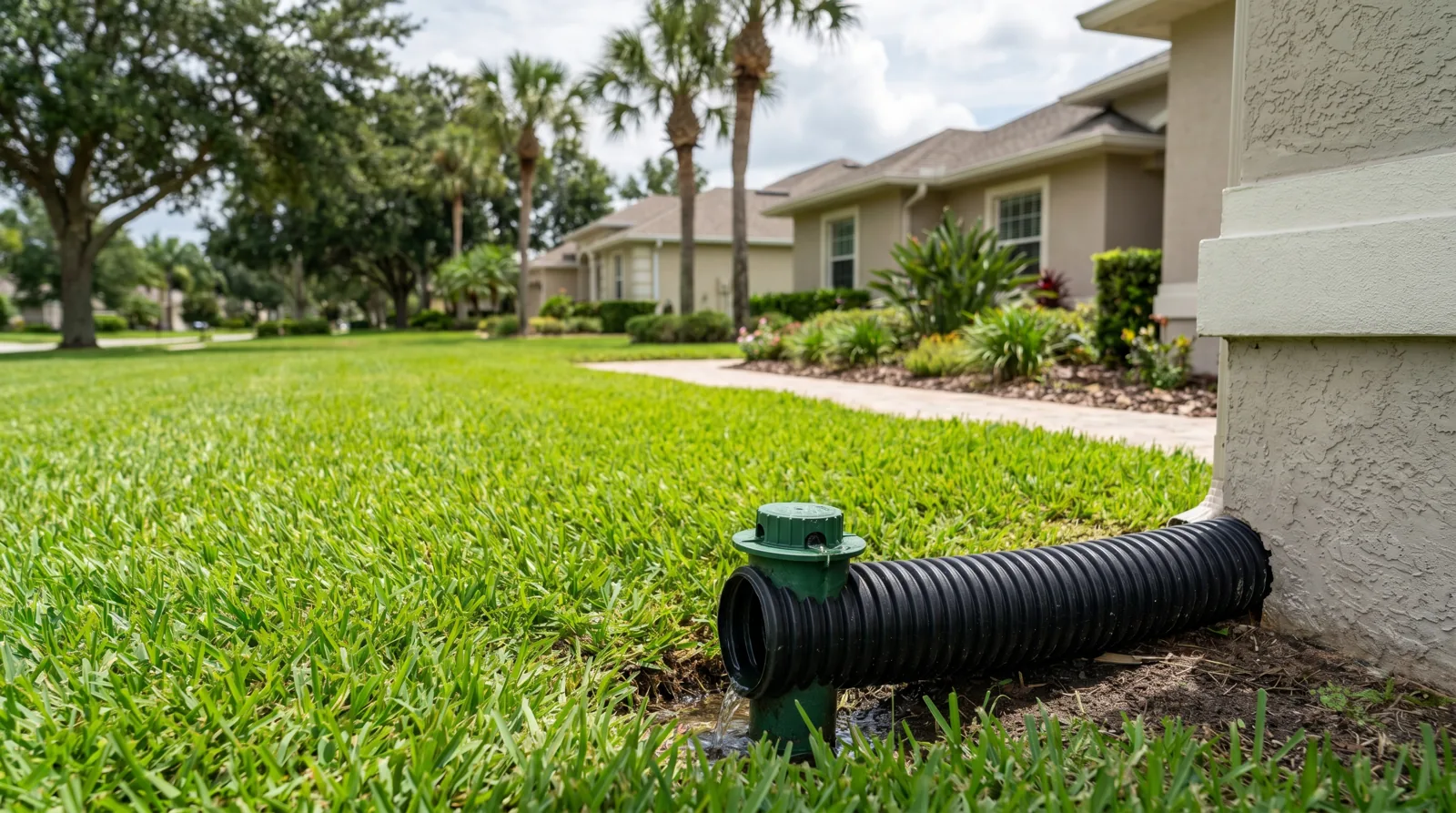
The most basic fix is extending the downspout so it discharges farther out. A flip-up surface extension buys a few feet; the cleaner, permanent version is a buried 4-inch pipe running underground to a lower point in the yard or a daylight outlet near a swale. We almost always use smooth-wall solid pipe rather than cheap ribbed black tubing — the ribs catch sediment and roots and clog within a couple of years, while smooth pipe flushes clean and lasts.
2. Pop-Up Emitters
A pop-up emitter is the outlet for a buried extension. The pipe runs underground to a spot 10 or more feet from the house and ends at a spring-loaded green cap set flush with the grass. When pressure builds during a storm, the cap pops open and releases the flow onto the lawn; when the rain stops, it closes so mowers and mulch can’t get in.
These are our go-to for most suburban yards in Winter Springs and Oviedo — invisible between storms, and they put water where the lawn can absorb it. The key is slope: you need a few inches of fall from the downspout to the emitter, or the pipe holds water and won’t drain.
3. Dry Wells
When there’s no good place to daylight the water — a flat lot, or a yard where the property line is close — a dry well gives the water somewhere to go down instead of out. It’s a buried pit or perforated barrel filled with gravel (or a plastic dry-well chamber) that collects roof runoff and lets it percolate slowly into the surrounding soil.
Dry wells work beautifully in our sandy soils where the sand actually drains. They’re less effective where that clay hardpan is shallow, so we test the percolation before we recommend one. Sized right, a dry well can swallow the output of one or two downspouts from a heavy storm and release it over the following hours.
4. Rain Gardens
A rain garden is the prettiest fix: a shallow, planted depression that catches downspout water and lets it soak in while feeding moisture-loving native plants. Done right, it turns a drainage headache into a landscape feature that supports pollinators. We plant them with species that tolerate both wet swings and our dry springs — Fakahatchee grass, blue flag iris, swamp sunflower — so they look good year-round. The University of Florida has an excellent free guide on building a Florida-Friendly rain garden with plant lists and sizing for our region.
Quick Comparison
| Solution | Best for | Roughly how involved |
|---|---|---|
| Buried extension + pop-up emitter | Most suburban yards with some slope | Low–moderate |
| Dry well | Flat lots, no daylight outlet, sandy soil | Moderate |
| Rain garden | Naturally low areas, homeowners who want curb appeal | Moderate |
| Surface extension only | Quick temporary relief | Very low |
Tying Downspouts Into Whole-Yard Grading
Here’s the part a lot of gutter installers miss: downspout drainage is only one piece of how water moves across your lot. If your yard slopes toward the house, or there’s a low spot the runoff feeds into, fixing the downspouts alone just relocates the puddle.
That’s why we look at the whole picture. Often the right answer combines downspout extensions with re-grading a problem area, a French drain along a chronic wet line, or a shallow swale to carry water to the street or a retention easement. If your yard turns into a pond after every storm, start with our breakdown of why your yard floods after rain and the five fixes that work, then we’ll match the right combination to your lot. It’s also far cheaper to solve drainage at the same time as other landscape work — see our full landscaping services for how we bundle it with bed and lawn work.
Frequently Asked Questions
How far should a downspout drain from the house?
Get roof runoff at least 5 to 10 feet from the foundation, and farther if your lot is flat or slopes toward the house. The goal is to discharge onto ground that drains and falls away from the slab. In our sandy Central Florida soils, 10 feet to a pop-up emitter is a reliable target for most yards.
Can I bury my downspouts myself?
You can, but DIY jobs usually get slope and pipe choice wrong. Without consistent fall, a buried pipe holds water and breeds mosquitoes; with ribbed tubing instead of smooth-wall pipe, it clogs with sediment and roots. We dig to grade with a laser level and use solid smooth-wall pipe so the system actually drains for the long haul.
Will a dry well work in Florida’s high water table?
Often yes, because our sandy soil percolates well — but not always. In the rainy season the water table can rise close to the surface, and lots with a shallow clay layer don’t accept water fast enough. We run a simple percolation test first; if a dry well won’t keep up, we’ll point you to a pop-up emitter or rain garden instead.
Get Your Downspout Drainage Fixed Before the Next Storm
You don’t have to live with a soggy foundation, a washed-out flower bed, or a downspout carving a trench through your yard. Our crew has solved drainage on hundreds of lots across Lake Mary, Longwood, Sanford, Winter Springs, Oviedo, Deltona, and the rest of Seminole and Volusia counties — and we’ll match the right downspout drainage solution to your soil and slope.
DeAngelo’s Land Services is veteran-owned, BBB A+ rated, Google Guaranteed, and proud to hold a 5.0-star rating across 211+ reviews. Veterans and active military receive a 10% discount on all services.
Ready for a free estimate? Contact us online or call (386) 675-2303 today, and we’ll walk your property, find where the water is going wrong, and give you an honest plan to fix it.
About the Author: Mark DeAngelo is the founder of DeAngelo’s Land Services and an ISA Certified Arborist serving Lake Mary, Longwood, Sanford, and the greater Central Florida area. A USAF combat veteran, Mark and his crew handle drainage, tree care, and landscaping across Seminole, Volusia, and Orange counties, earning a 5.0-star rating across 211+ reviews along the way.