
Live Oak vs Laurel Oak: Which Central Florida Oak Is Worth Keeping
You’ve got a big oak shading the backyard, and you’re wondering whether it’s an asset or a liability. It’s one of the most common questions we get across Volusia, Seminole, and Orange counties — and the answer almost always comes down to species. The live oak vs laurel oak question matters enormously, because these two trees look similar from a distance but behave completely differently over a lifetime. One can stand for centuries; the other often becomes a hazard within a few decades. Knowing which one you have should shape how you care for it.
Both are native, both are everywhere in Central Florida, and both thrive in our zone 9b heat and sandy soil. But if you’re deciding which tree to keep, plant, or remove, the differences are night and day. Here’s how a working arborist tells them apart — and why it matters for your property.
Live Oak vs Laurel Oak: The Core Differences
The short version: the live oak (Quercus virginiana) is one of the strongest, longest-lived trees in the South. The laurel oak (Quercus laurifolia) is a fast-growing, short-lived tree with weak, decay-prone wood. Both have their place, but they are not interchangeable.
- Lifespan: A live oak can easily live 150 to 300 years or more. According to UF-IFAS, a laurel oak typically lives only about 50 to 70 years before decline sets in.
- Wood strength: Live oak wood is dense, strong, and highly resistant to decay. Laurel oak grows fast and its wood is comparatively weak and brittle.
- Decay tendency: Laurel oaks are notorious for hollowing out. Trunks and large limbs rot from the inside, and a single bad pruning cut can start a column of internal decay running ten or twenty feet through the trunk.
- Storm performance: UF-IFAS post-hurricane studies of wind-resistant trees consistently rank live oak among the most wind-resistant species in the state, while laurel oak is one of the more failure-prone in hurricane winds.
- Mature size: Live oaks tend to spread wide and low, typically reaching around 60 to 80 feet tall with a canopy spread of roughly 60 to 120 feet. Laurel oaks grow more upright and rounded, usually topping out around 60 feet.
How to Tell Them Apart in Your Yard
You don’t need a botany degree to identify your oak. A few features give it away.
Leaves
Live oak leaves are thick, leathery, and oblong, with smooth edges that roll under slightly — dark green and glossy on top, fuzzy gray underneath. Laurel oak leaves are thinner, smoother, and more diamond- or lance-shaped, often with a pointed tip. Both are nearly evergreen here, dropping and re-leafing quickly in late winter.
Form
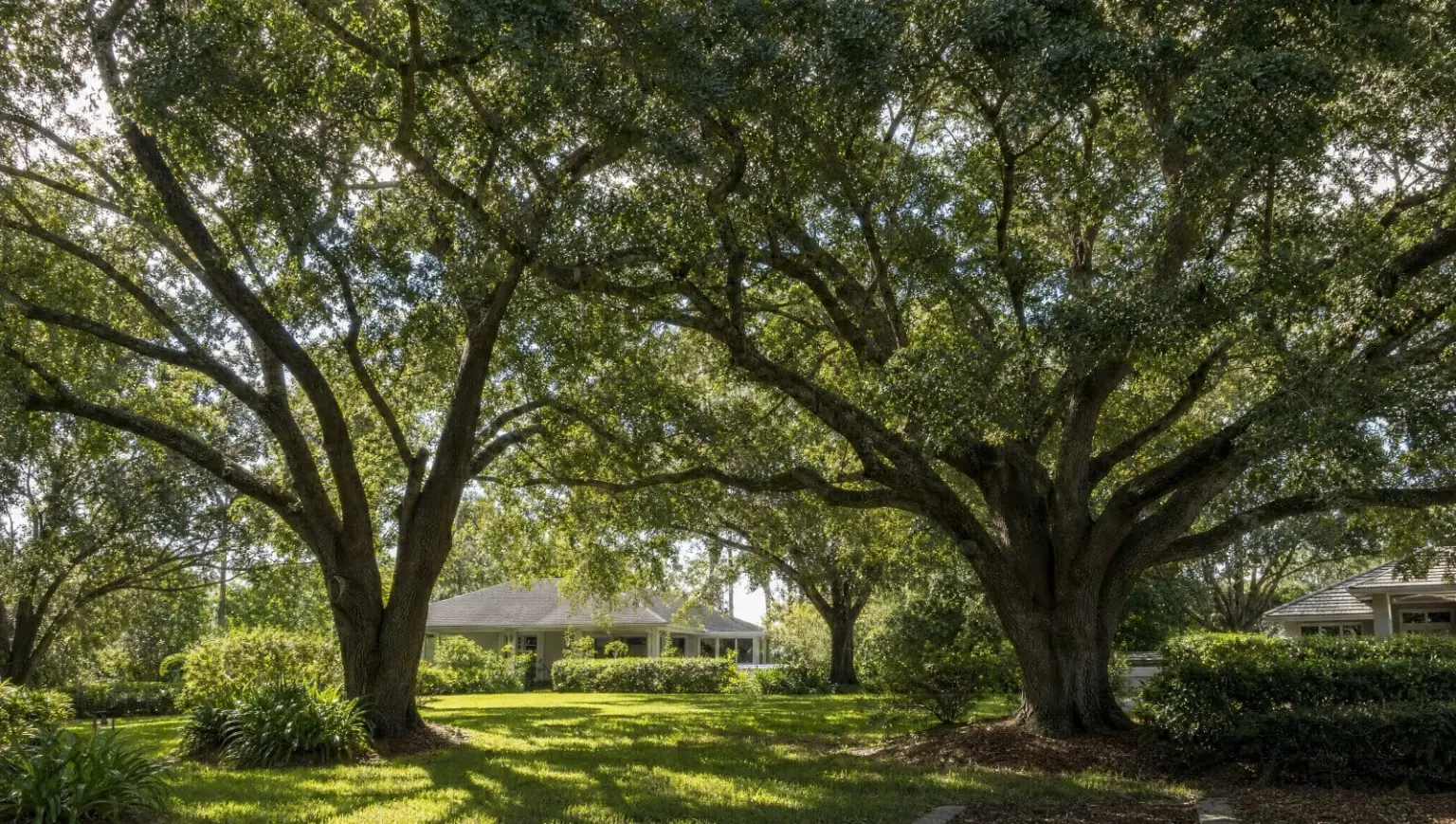
A mature live oak has that iconic sprawling, horizontal silhouette — the kind of tree with limbs that dip toward the ground and run sideways for forty feet. Laurel oaks grow taller and narrower, with a more rounded, upright crown and branches that head skyward.
Bark and trunk
Both have dark, ridged bark, but laurel oaks more often show signs of trouble: fungal conks (shelf mushrooms) at the base or on the trunk, cavities, seams, and dead branch stubs. If your oak has mushrooms growing on it, that’s a strong sign of internal decay and worth a professional look.
Which Oak Is Worth Keeping?
If you’re choosing what to plant or which tree to invest in protecting, live oak is the clear winner for a long-term Central Florida landscape. It’s the tree your grandchildren will climb. It handles drought once established, tolerates wet soil and even some salt, and stands up to storms better than almost anything else we can plant here.
That doesn’t mean every laurel oak needs to come down. A young, healthy laurel oak is a fine, fast-growing shade tree — it’ll give you a full canopy in 15 years instead of 40. The key is being realistic about its lifespan and watching it closely as it ages. The trouble starts when a laurel oak passes 40 or 50 years old and begins to decline, because the decline is often hidden inside a trunk that still looks solid from the outside.
Here’s how we think about it on a typical property:
- Healthy young live oak: Keep it, prune it well, and let it become the centerpiece of your yard. This is a generational asset.
- Healthy young laurel oak: Enjoy the fast shade, but plan for the long game. Consider planting a live oak nearby now so you have a mature replacement ready when the laurel oak’s time comes.
- Mature laurel oak with decay signs: Get it assessed. Cavities, conks, large deadwood, or a tree leaning over the house in our windy summers are reasons to take a serious look before hurricane season.
Caring for Either Oak in Central Florida
Whichever oak you’ve got, a few practices go a long way in our climate:
- Prune for structure while young. Establishing a single dominant trunk and good branch spacing early prevents the weak, co-dominant unions that fail in storms — especially important for laurel oaks.
- Make clean, correct cuts. Sloppy pruning is how decay gets in, and laurel oaks are unforgiving about it.
- Don’t pile mulch against the trunk. In our humid, rainy summers, that traps moisture and invites rot at the base.
- Inspect before storm season. A quick look each spring for deadwood, cavities, and weak limbs is the cheapest insurance there is.
Frequently Asked Questions
Is a laurel oak a bad tree?
Not bad — just short-lived and weaker-wooded than a live oak. A healthy young laurel oak is a perfectly good shade tree. It simply needs honest expectations and closer monitoring as it ages.
How can I tell if my oak is dangerous?
Warning signs include mushrooms or conks on the trunk, large cavities, big dead branches, cracks, a sudden lean, or heaving soil at the base. Any of these on a tree near your home is worth a professional inspection, particularly before hurricane season.
Should I plant a live oak or a laurel oak?
For a long-term shade tree, plant a live oak. The only reason to favor a laurel oak is if you want fast shade and accept a shorter lifespan. A common smart move is to plant a live oak now and let it mature while a faster tree fills in.
Can a hollow laurel oak be saved?
Sometimes. A tree with limited decay and sound surrounding wood may stand safely for years with monitoring and selective pruning. Extensive hollowing, especially on a tree near a structure, usually means removal is the safer call. It’s a judgment call best made on-site.
Not Sure Which Oak You’ve Got?
Identifying a tree and judging its health is exactly the kind of thing we love to help with — no pressure, no scare tactics, just an honest read on what you’re working with. LandTree (DeAngelo’s Land Services) is a veteran-owned crew serving Orange City, DeLand, Lake Mary, Sanford, Oviedo, Apopka, and the greater Orlando metro. If you’d like someone to take a look at your oaks and tell you straight whether they’re worth keeping, contact us for a free estimate and consultation. We’ll help you make a confident decision for your property.